Summary
- The problem
- A yield loss after transfer, a recurring intervention on one line or a material change affecting three sites needs the process definition, the manufacturing history and the evidence behind the difference. That evidence is spread across batch, historian, laboratory, quality and document systems.
- Seal’s approach
- Seal connects batch, historian, laboratory and quality evidence to the process version and the technical question. Neil drafts a technical assessment that keeps the observation, the hypothesis and the missing evidence apart, with each finding linked to its source records, for MSAT to review.
- Neil
- Seal’s AI agent sets the batch, development and laboratory evidence side by side and drafts the technical assessment and evidence requests. MSAT reviews it and decides what the evidence supports. About Neil.
- What changes
- A batch stays linked to its readings, lab sample and investigation. The reviewed conclusion stays with the process version, and a proposed change carries its affected records and verification work forward without rewriting the original batch.
- Where to start
- One yield investigation, technology transfer or continued process verification review, with existing systems kept in place. Book a demo.
Investigate a yield loss after transfer.
A yield loss after transfer usually has several candidate explanations: longer holds, a different scale, new material lots or a changed method. In this fictional example, three manufacturing runs held longer and yielded less than the development reference.
You: Yield has fallen since transfer. Compare the manufacturing runs with development and tell me what to investigate.
Yield (%)
Hold duration (h)
Neil
Longer holds, lower yields.
The three manufacturing runs have longer holds and lower yields than the development reference. RUN-214 has the longest hold and lowest yield. That is a lead worth examining—not evidence that the hold caused the loss.
| Record | Hold | Yield | What it is |
|---|---|---|---|
| DEV-REF | 0.8 h | 90% | Development median |
| RUN-201 | 6.4 h | 79% | Manufacturing run |
| RUN-207 | 6.9 h | 77% | Manufacturing run |
| RUN-214 | 7.8 h | 75% | Manufacturing run |
A yield loss after transfer. A recurring intervention on one line. A proposed material change that affects three sites. MSAT needs the process definition, the actual manufacturing history and the evidence behind the difference—not another dashboard without context.
MSAT usually works from historian exports, batch-record copies and development reports held in different systems, so a post-transfer investigation begins with data collection. In Seal the manufacturing and laboratory evidence connects to the development record, so Neil can set the evidence side by side, and an approved improvement is released as a new process version with its own verification while earlier batches keep the version they ran.
| Exports and spreadsheets | Seal | |
|---|---|---|
| Evidence | Exported and pasted by hand | Linked to batch, run and version |
| Development basis | A PDF report | The runs behind the reference |
| Hypothesis | Mixed with the observation | Kept apart, with what would test it |
| Missing evidence | Chased one request at a time | Assigned to the teams that hold it |
| Process change | Raised in another system | A changeset with affected records |
| Earlier batches | Hard to tie to a version | Keep the version they ran |
| AI | Text to paste elsewhere | Neil drafts the assessment |
| Getting started | A data-collection project | One question, systems kept in place |
Ask Neil to assemble permitted batch, historian, laboratory and quality records into a technical assessment. Keep the included population, source versions, missing evidence and alternative explanations visible. Your team decides what the evidence supports and what further work is needed.
Start with an investigation into yield, a technology transfer or a continued process verification review. Keep existing systems in place; connect their evidence to the process version and technical decision in Seal.


From lab scale to commercial production.
MiAlgae brought its electronic lab notebooks, quality processes and batch records into Seal as it scaled its algae production, and reports 75% less documentation time.
See how MiAlgae uses SealKeep the observation apart from the hypothesis.
Neil drafts the technical assessment with each finding linked to its source records. What the runs show, what they cannot establish and the evidence still needed stay separate, for MSAT to review.
You: Write the technical assessment and the evidence requests.
Neil
I’ve kept the observation separate from the hypothesis and assigned the missing evidence to the relevant teams. The assessment is ready for MSAT review; it does not change the process or decide batch disposition.
Investigate the hold alongside the other transfer differences.
- Observation
- Lower yield with longer holds
- Hypothesis
- Hold-related loss; not established
- Next evidence
- Matched run data and transfer conditions
- Manufacturing site (not met)Timestamps, temperatures and lots
- Process Development (not met)The runs behind the median
- MSAT lead (not met)A follow-up that tells causes apart
You: What would you ask the manufacturing site for?
Neil
The actual start and end timestamps, temperature history and interventions for each hold; material-lot and equipment references; and the yield calculation with its sample and method versions. I also need the development run-level data. That lets us compare like with like instead of explaining a difference between incompatible summaries.
Investigations reuse process knowledge without prejudging cause. Event chronology, hypotheses, prior occurrences, process models, risk assessments, similar batches, equipment and material histories, analytical evidence, experiments, causal conclusions, affected population and actions remain traceable. Prior knowledge informs the investigation; it does not replace testing the current event.
Manufacturing support begins with complete context. Request, urgency, product, batch, operation, event, question, current state, production owner, quality involvement, technical owner, evidence request, actions, response, decision and closure define each support case. Tribal conversations can still happen; the technical decision and evidence cannot disappear with them.
Follow a batch through Seal.
In this product walkthrough, example batch B-041 links its recorded hold to sample IPC-041 and investigation DEV-018, so the review starts from the batch rather than from exports.
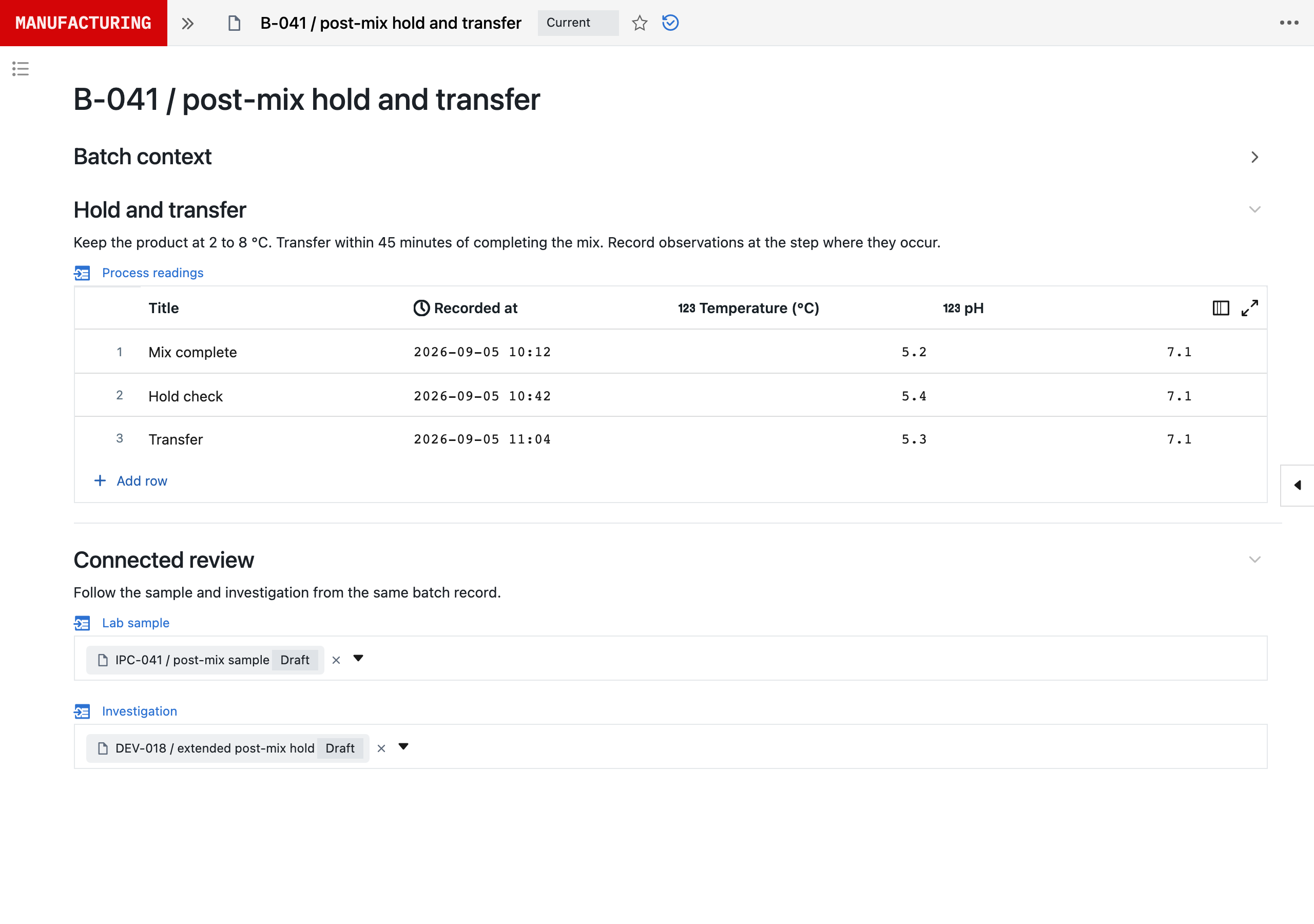
The batch carries its readings, lab sample and investigation together. IPC-041 keeps its results, sampling context and source batch, and DEV-018 brings the batch and lab evidence into an open investigation; the deviation blueprint follows that investigation in full.
Batch context is assembled continuously. Materials, equipment, personnel, recipe execution, process signals, alarms, interventions, holds, samples, test results, deviations, environmental data, reconciliation and disposition remain connected before a review begins.
Keep the reviewed conclusion with the process version. A proposed change can carry its affected records and verification work forward through change control; it does not rewrite the original batch.
Carry the process context into transfer, trending and change.
The records assembled for one investigation are the same records a transfer, a trend review or a change assessment needs. Linked to the process version, each piece of work starts from evidence already reviewed instead of a new search.
| Work | Starts from | Produces for review |
|---|---|---|
| Support case | Batch, historian and lab evidence | Assessment, evidence requests |
| Technology transfer | Sending process, receiving site | Transfer gaps, acceptance package |
| Trend review | A trend with its population | Trend assessment, follow-up work |
| Change across sites | A proposed change | Site impact, verification work |
Manufacturing support brings batch execution, historian, laboratory and material evidence into the same technical investigation. A technology transfer compares the sending process with the receiving site’s scale, equipment, materials and methods. A trend review reads the trend with its process version, population and operating context, so the team investigates the signal, not just the chart. A proposed material, parameter or equipment change is traced to the processes and evidence it affects at each site.
Process ownership has a defined boundary. Product, process version, unit operations, site, line, scale, equipment train, materials, control strategy, validated state, markets, lifecycle stage, technical owner, quality owner, support model and effective dates define responsibility. The record distinguishes global process ownership from local execution ownership.
The process knowledge model carries intent. Material attributes, process parameters, in-process controls, quality attributes, ranges, normal profiles, interactions, models, failure modes, control responses, sampling, holds, equipment requirements and scientific rationale remain connected. Manufacturing can navigate from a limit to the evidence and decision that created it. ICH Q10 asks for exactly this: product and process knowledge managed from development through the commercial life of the product, drawing on development studies, technology transfer, process validation, manufacturing experience and change management.¹
| Record | What it holds |
|---|---|
| Process ownership | Product, version, site, line, owners, dates |
| Knowledge model | Parameters, attributes, ranges, rationale |
| Site configuration | Equipment, scale, materials, local procedures |
| Process model | Dataset, assumptions, version, intended use |
| Commitment | Requirement, owner, due date, evidence |
| Improvement | Hypothesis, trial, measures, benefit |
Process models remain governed artefacts. Dataset, population, features, transformations, algorithm, assumptions, version, fit, diagnostics, prediction, uncertainty, intended use, applicability, validation, monitoring, reviewer and retirement define a model. A model that informs a manufacturing decision is not an untracked analyst file.
Commitments and residual risks remain visible. Validation commitments, enhanced monitoring, authority commitments, temporary controls, post-transfer actions, unresolved knowledge gaps, model limitations, due dates, owners, evidence, approval and closure stay attached to the effective process.
Process improvement has an evidence contract. Opportunity, hypothesis, expected benefit, risks, study or trial, protocol, batches, measures, acceptance, deviation, analysis, conclusion, change control, validation, filing, implementation, benefit verification and standardisation remain connected.
Accept a transfer one piece of knowledge at a time.
A transfer is accepted as evidence arrives, not when the recipe names match. MSAT sees which knowledge was accepted, adapted, rejected or is still provisional.
- From
- Development candidate PD-024
- To
- Receiving site, 20 L
- Feed strategy (met)Accepted from development
- Working volume (met)Adapted to the 20 L vessel
- 35 °C (not met)Provisional: not shown at 20 L
Process Development supplies the selected process, experimental evidence, scale assumptions and unresolved questions. MSAT assesses how that definition applies to the receiving equipment, site and operating conditions. A transfer package should make those differences inspectable; it does not establish equivalence just because the recipe names match. The purpose of transfer is to carry product and process knowledge between development and manufacturing, and between sites, as the basis for the manufacturing process, control strategy and validation approach.²
Technology transfer is an acceptance lifecycle. Sending definition, receiving fit, gaps, actions, document and master-data deployment, engineering batches, method transfer, training, qualification, validation, evidence review, commitments and acceptance remain one programme. MSAT can see which knowledge was accepted, adapted, rejected or remains provisional.
Site and line applicability is explicit. Facility, utility, equipment, automation, scale, geometry, sensor, recipe implementation, material source, analytical laboratory, staffing model, environmental state and local procedure define the deployed configuration. Site differences are assessed as controlled deltas rather than hidden inside local documents.
Site comparability separates equivalence from sameness. Process definition, equipment function, scale criteria, material sources, methods, normal profiles, capability, quality outcomes, deviations and uncertainty support the comparison. Different equipment can be comparable when the scientific and performance evidence supports the conclusion.
Manufacturing experience can then challenge the original understanding. Link a new observation to its unit operation, investigate it and prepare the proposed process or monitoring change. Preserve the earlier decision and evidence when a new version is approved.
Review a signal with its process context.
A trend arrives with its population, baseline and the process knowledge it is judged against, so MSAT investigates the signal, not just the chart.
- Signal
- Cross-site shift, AEX pressure
- Linked to
- Receiving-skid pressure control
- Population
- Batches at both sites
- Judged against
- Knowledge model PKM-MAB14 v23
Signals are evaluated against process knowledge. Alert, trend, drift, step change, atypical profile, capability decline, parameter-quality relationship, material shift, equipment behaviour, laboratory pattern or cross-site difference retains detection logic, population, baseline, magnitude, uncertainty, triage and consequence.
CPV is a technical decision system. Monitoring plan, parameters, attributes, stratification, frequencies, baselines, control limits, signal rules, exclusions, analyses, reviews, escalations, actions and reports remain governed. MSAT sees the signal with its process phase, material, equipment, site, method and batch context.³
Change process knowledge through a reviewed changeset.
New evidence proposes its changes line by line. A technical owner accepts, revises or rejects each one before a new knowledge version becomes effective; earlier batches keep the version they ran.
- pH operating range 7.0–7.4Accepted
- Temperature 35–37 °CAccepted
- Agitation
200–22090–110 rpmRevised Dissolved O₂ 40–60% as a CPPRejected
You: Should we shorten the hold limit?
Neil
Not from these summaries alone. I would first verify the hold definitions and yield basis, then compare temperature, materials, scale and transfer conditions. A controlled follow-up can test the hold hypothesis. Changing an operating limit needs its own technical assessment and authorised review.
When source evidence changes a parameter range, relationship, normal profile, control response or site applicability, the proposed updates appear as an explicit changeset. Reviewers accept, revise, reject or defer each change with rationale. The approved set publishes as a new knowledge version.
Changes traverse technical dependencies. Proposed change, rationale, affected products, sites, unit operations, parameters, attributes, materials, equipment, recipes, methods, validated state, stability, comparability, filings, inventory, supply, studies, actions and implementation state create the technical impact path.⁴
Approved knowledge propagates to controlled consumers. Approved updates identify affected recipes, master batch records, monitoring plans, validation requirements, specifications, training, methods, reports, transfer definitions, risk assessments and regulatory content. Propagation creates tracked implementation work; it never silently edits an executing record.
The operating loop is ingest, review, connect. Legacy files, source systems, new batch data, analyses, investigation conclusions and change evidence can propose structured updates. A human technical owner reviews the changes before approved knowledge becomes live. In line with the EU’s draft GMP Annex 22 on AI, Neil is not used in GMP execution. It helps set up configuration, which your team verifies and releases under change control. Customer data is not used to train AI models, and the requester’s permissions govern what Neil can read. See how Neil fits Annex 22 and more about Neil.
Work across the systems you already use.
Connect permitted records from your MES, historian, LIMS, ERP and documents, or start with supplied data. Neil brings the relevant evidence into the work in Seal.
| Where the work runs | What MSAT uses | Connections include |
|---|---|---|
| MES and process data | Batch steps, readings and history | Tulip, Emerson DeltaV, AVEVA PI |
| LIMS | Samples, tests and results | LabWare, LabVantage |
| ERP | Materials, lots and suppliers | SAP |
| An existing eQMS | Deviations and change controls | Veeva Vault QMS |
| Statistics | Analyses, graphs and reports | JMP |
| Documents | Development and transfer reports | Veeva Vault, SharePoint |
Seal acts as the cross-system technical record for products and processes. It does not replace MES, LIMS, QMS, historians, statistical tools or document systems; it connects their evidence to the current process model and the technical decisions made from it. A historian capture keeps its source timestamps, values, units and quality flags, so a reading in an assessment can be traced to the system that recorded it. See all integrations.
Prove one product lifecycle end to end.
Prove the model on one product before widening it: one transfer, its first commercial batches and the decisions they lead to.
The first implementation should follow one product from transfer into commercial manufacture through a site-specific delta, engineering and PPQ batches, CPV signal, manufacturing support case, investigation, process-model update, change control, supplemental validation, controlled propagation and benefit verification.
Include conflicting source data, an unapproved model proposal, a parameter-range change, two sites with different equipment, an overdue commitment and a commercial batch made under the prior knowledge version. The system must preserve which knowledge was effective for every decision.
References
- 1ICH Q10, Pharmaceutical Quality System (2008), section 1.6.1 (knowledge management): product and process knowledge should be managed from development through the commercial life of the product; sources include development studies, technology transfer, process validation, manufacturing experience, continual improvement and change management. ICH
- 2ICH Q10, section 3.1.2 (technology transfer): the goal is to transfer product and process knowledge between development and manufacturing, and within or between manufacturing sites; this knowledge forms the basis for the manufacturing process, control strategy, process validation approach and continual improvement. ICH
- 3FDA, Process Validation: General Principles and Practices, guidance for industry, Revision 1 (2011): defines process validation as the collection and evaluation of data, from the process design stage through commercial production, in three stages: process design, process qualification and continued process verification. FDA
- 4ICH Q10, section 3.2.3 (change management system): proposed changes should be evaluated with quality risk management, against the marketing authorisation and current product and process understanding, and by appropriate experts, and evaluated after implementation to confirm the objectives were achieved without deleterious impact on product quality. ICH
ACapabilities
| Capability | What it covers |
|---|---|
| Product and process knowledge model | Product, process versions, sites, unit operations, materials, parameters, attributes, ranges, profiles, interactions, models, failure modes, controls, rationale, risks, commitments and owners stay connected. |
| Manufacturing technical support | Request, urgency, product, batch, operation, event, context, evidence requests, actions, technical owner, quality involvement, response, decision, affected work and closure form an accountable support record. |
| Signal-to-technical-decision | CPV, atypical profile, drift, material, equipment, laboratory and site signals connect to population, baseline, context, triage, investigation, model, impact, actions, rationale, approval and downstream consumers. |
| Knowledge changeset review | New batch, study, investigation, transfer or change evidence proposes explicit additions, modifications, removals and conflicts; technical owners accept, revise, reject or defer before publishing a new effective version. |
| Cross-site applicability | Facilities, utilities, equipment, automation, scales, materials, methods, recipes, normal profiles, capability, quality, differences, uncertainty, restrictions, receiving evidence and conclusions remain comparable without assuming sameness. |
| Commitment and residual-risk control | Validation commitments, enhanced monitoring, authority obligations, temporary controls, knowledge gaps, model limitations, owners, dates, evidence, escalations, approvals, closure and affected process versions remain visible. |
| Change, validation and implementation | A proposed technical change traverses products, sites, parameters, materials, equipment, recipes, methods, validated state, comparability, stability, filings, inventory and supply, then retains actions and effective implementation. |
| Connected manufacturing evidence | MES execution, historian signals, LIMS results, SDMS source files, deviations, changes, validation, CPV, reports, documents and models connect to the process knowledge and technical decision they support. |
BConnected records
CQuestions and answers
What does Seal do for MSAT?
Seal connects development knowledge with manufacturing experience. Ask Neil to compare permitted batch, laboratory, historian and document evidence, draft a technical assessment and prepare the follow-up work in Seal. MSAT retains responsibility for the scientific conclusion and proposed process change.
Does Seal replace MES, LIMS, QMS or historians?
No. It can run parts of those workflows, but the MSAT blueprint primarily connects their evidence to a controlled process model and the technical decisions, changes and commitments that evidence supports.
How does MSAT process knowledge stay current?
New batches, studies, investigations and transfers propose updates to the process knowledge as change sets. A technical owner reviews each proposed addition, change or conflict before a new version becomes effective.
Can the system support urgent manufacturing questions?
Yes. A support case brings together the batch, materials, equipment, process data, samples and deviations relevant to the question, then records the evidence requests, actions and technical response through to closure.
How are process models governed?
As controlled records. The dataset, assumptions, version, fit diagnostics, intended use and reviewer stay with the model, and a change or retirement is reviewed like any other process change.
How does MSAT connect to CPV?
CPV signals arrive with their population, baseline and batch context. MSAT assesses what a signal means and records any investigation, model update or process change against the same process knowledge.
Can site differences be retained without fragmenting the global process?
Yes. A global process holds the common intent; each site configuration records its own equipment, scale, materials, methods and local controls, with the supporting evidence and effective dates.
How are technical decisions propagated?
An approved decision lists what it affects, such as recipes, methods, specifications, training, monitoring plans and regulatory content. Each owner receives tracked implementation work.
Can legacy MSAT knowledge be imported?
Yes. Historical reports, spreadsheets, statistical files and system records can seed proposed structured objects. Human technical owners review extraction and applicability before anything becomes approved process knowledge.
What should we bring to an evaluation?
Bring one technical question, the relevant process version and a bounded set of records. For a post-transfer yield question, that might include development and manufacturing run summaries, source calculations and the transfer assessment. Agree the comparison and desired output, then inspect whether each finding is supported and whether the follow-up work is useful. Expand the scope after that evaluation.