Summary
- The problem
- Printing the right label is the easy part. Showing that the correct identity held while every issued, applied, rejected, sampled, destroyed and serialised item was controlled means reconciling counts from the line, printers, vision systems and serialisation server, often after the run.
- Seal’s approach
- Seal resolves the packaging order from effective master data and connects bulk, components, artwork, line clearance (including electronic print queues), in-process checks, rejects, label events, serials and aggregation to it.
- What changes
- Dose units, components and serials reconcile as separate balances, so no single count hides a loss. A failed check identifies the last acceptable check and the affected unit interval, and configured tolerances do not silently close discrepancies.
- Where to start
- One packaging order from one bulk lot through clearance, first-off approval, rejects, rework and release, including a wrong queued print job. Book a demo.
Packaging converts released bulk, approved components, controlled artwork, variable data and physical line operations into the marketable unit. A released packaged batch rests on two facts: each unit carries the correct identity for its market, and every item issued to the line, whether applied, rejected, sampled, returned, destroyed, serialised, cased or palletized, is accounted for.
Seal connects the packaging order, bulk lot, market, bill of materials, artwork, components, line clearance, equipment state, coding setup, in-process checks, counts, rejects, label events, serial numbers, aggregation, deviations, reconciliation and final disposition. For US drug operations, written procedures must assure that the correct labels, labelling and packaging materials are used.¹ The rest of this paper describes how those procedures become controls on the line.
1The packaging order resolves one executable identity.
Product, strength, bulk lot, pack size, market, language, artwork version, packaging bill, code format, shelf life, serialisation rule, quantity, planned overage and line form the approved instruction. The system resolves each input from effective master data, so a planner cannot assemble a hybrid order from incompatible but individually approved versions.
Bulk enters first. Released status, lot, container, quantity, potency where relevant, storage and hold establish the starting population, and partial containers and multiple bulk lots stay separately traceable. Every finished unit and shipper can trace back to its bulk source, and remaining bulk is returned, carried forward, sampled or destroyed under control, never absorbed into an unexplained yield difference.
1.1Why teams choose Seal for packaging operations
Packaging is usually run from a paper batch record and a line-clearance checklist, with counts collected afterwards from the line controller, printers, vision systems and serialisation server and reconciled by hand. Seal records the clearance, the components, the label events and the serials against the packaging order, and keeps each balance as the line runs. A failed check identifies the affected unit interval while the line is still set up, and a revised clearance or reconciliation rule applies from the next order.
2Components and artwork are separate controls.
Bottles, vials, blisters, closures, cartons, leaflets, labels, desiccants and shippers keep their item, version, supplier lot, release, quantity, expiry and intended position. Issue verifies the exact component against the order and line location, and similar-looking strengths, languages and formats receive additional scan or vision checks according to risk.
Approved static artwork keeps its content, market, language, dimensions, barcode definitions, effective version and proof. Variable data (lot, expiry, serial, local code) resolves from the order and an approved formatting rule. The physical sample is verified against both layers: a correct artwork file with the wrong lot code is still a packaging failure.
Artwork, DE market
v2.1v3.0
Warning: do not freeze.
Warnung: nicht einfrieren.
A scan of v3.0 starts the line.
A scan of v2.1 is blocked before a label prints.
Printed materials form one ledger from receipt, quarantine, sampling and release through secure storage, issue, printer counts, returns, obsolete stock and destruction. Roll stock, preprinted cartons, leaflets and on-demand print can use different counting controls while keeping the same accountability.
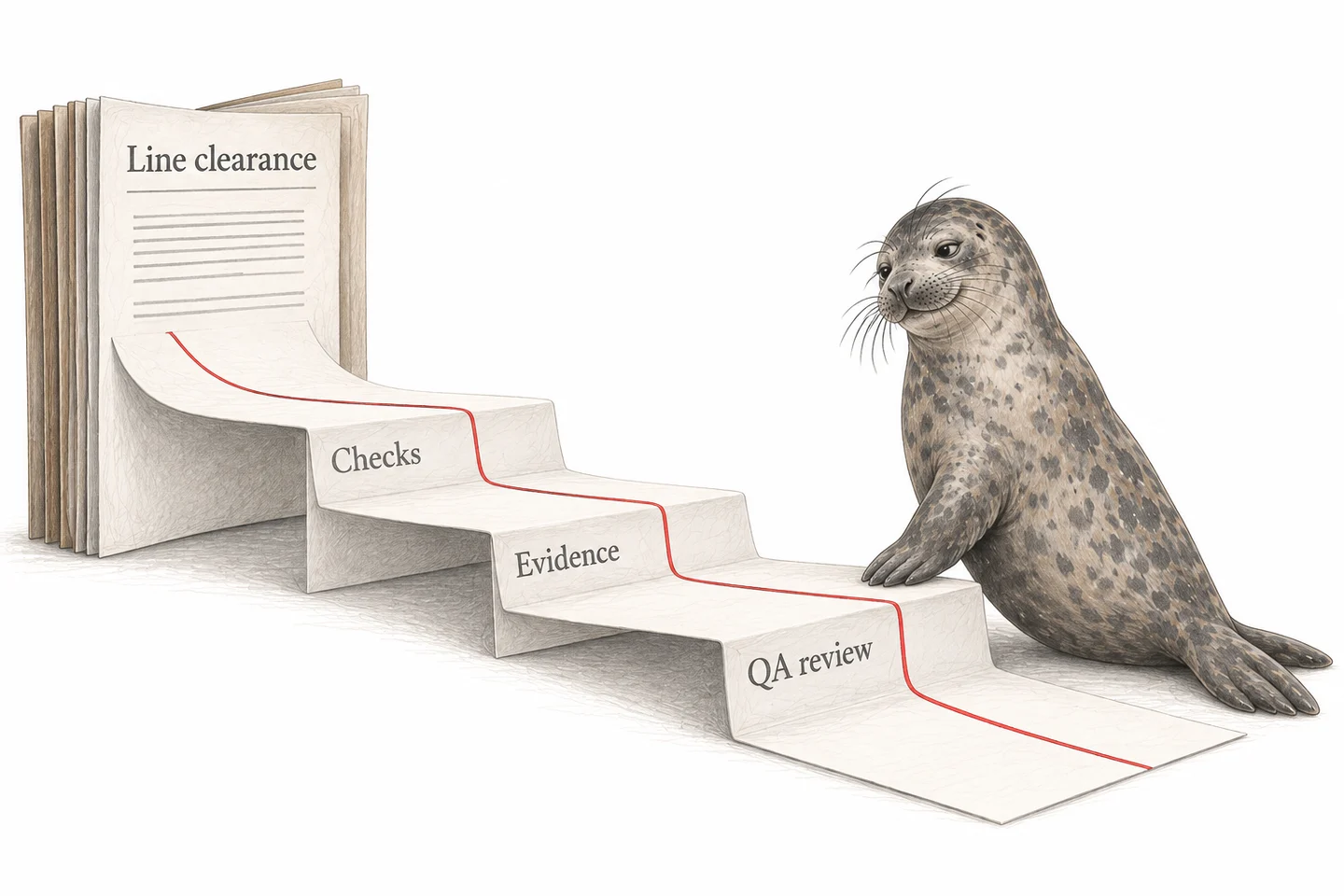
3Line clearance proves state, not checklist completion.
The clearance defines the zones, equipment, conveyors, hoppers, printers, vision systems, benches, bins, waste points, documents, materials and electronic queues that must be free of the previous order or configured for this one. Each observation records location, expected state, person, time, evidence, exceptions and independent verification where required. Reconciliation and removal of the previous order are dependencies, not assumptions.
Digital job queues and cached print files are part of changeover. Line, printer, coder, camera, checkweigher, serialisation station and aggregation system keep their qualification, calibration, recipe and current order state, and clearing the bench while leaving the previous market’s file available is not a complete clearance.
Setup then uses first-off and challenge evidence. Tooling, guides, code positions, print content, vision recipes, reject mechanisms, checkweigher limits and aggregation configuration are verified before routine production, and first-off units keep their images, actual codes, measurements, barcode grades, reviewer and approved transition to run state.
4In-process checks and rejects stay tied to units and time.
Appearance, count, fill, torque, seal, leak, print, barcode, leaflet presence and weight checks resolve by product and line, at time-, count-, event- or change-driven frequencies. Results attach to line state and to serial or bounded unit ranges, so a failed check identifies the last acceptable check, the affected interval, containment, inspection, rework and restart authorisation.
Automatic and manual rejects keep their station, time, reason, count, bin, verification, rework eligibility and disposition. Reject-mechanism challenges show that nonconforming units actually leave the accepted stream, and scrap counts cannot serve as an unexplained balancing figure.
Rework preserves old and new identities. Relabelling, repacking, aggregation repair and recovery from rejected populations need approved instructions and bounded units, and rework yield, component use, serial changes and checks reconcile before the units rejoin the accepted population.
5Reconciliation is multi-dimensional.
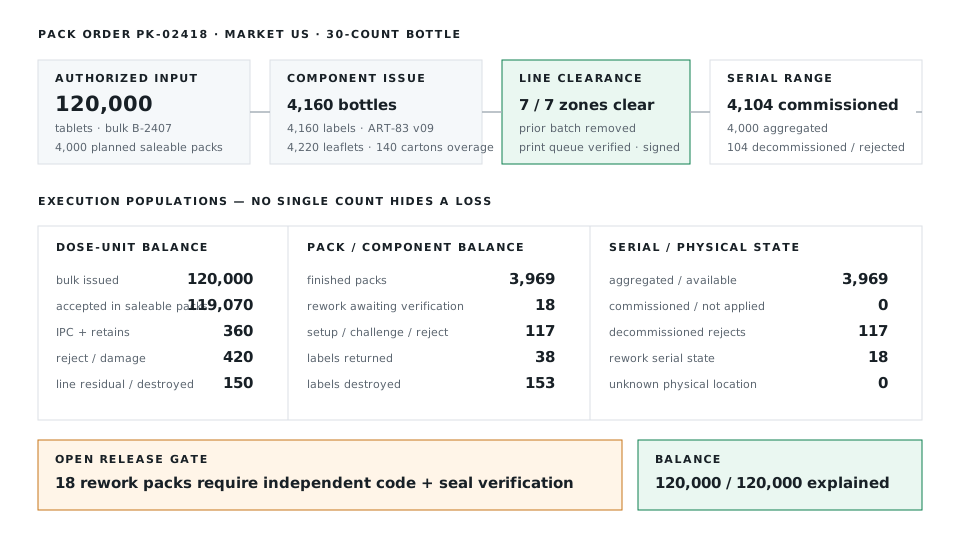
The order reconciles bulk quantity, dose units, components, printed items, labels, serials, aggregation, accepted packs, samples, rejects, rework, returns, destruction and final shippers as separate balances, so no single count hides a loss.
Configured tolerances do not silently close discrepancies. An unexplained difference is investigated, with its risk, scope, conclusions and QA decision recorded.²
Commission, print, apply, verify, decommission, aggregate, disaggregate, case, palletize and ship events keep their serial, parent, order, line, time, reason and source system. Seal connects serialised state and exceptions to the packaging batch, physical counts, quality events and release.
6Deviations scope exact units, and release sees every balance.
A wrong code, failed vision challenge, label discrepancy, mixed component, checkweigher drift, broken seal, lost serial event or clearance failure identifies the bulk, component lots, unit intervals, shippers, people, equipment and time affected. The inspection population stays explicit; narrowing it later requires evidence, and a successful restart does not resolve units already produced.
The quality unit approves or rejects the packaged batch after reviewing bulk status, effective order, component release, artwork, clearance, setup, in-process checks, rejects, rework, printed-material accountability, serialisation, yields, deviations and samples.³ The decision freezes evidence and versions, and shipment eligibility follows the packaged configuration and destination market.
High-speed vision, coding, checkweighing, serialisation repositories and warehouse automation stay authoritative for native execution, and Seal receives their events, summaries and exceptions at the granularity the batch needs. If the need is only artwork approval, a labelling system may suffice; if it is only serial exchange, a serialisation platform may. Seal shows that the whole packaging batch became the correct marketable population.
7Prove one difficult packaging order.
Follow one bulk lot through two component issues, market artwork, line clearance with an electronic queue purge, first-off approval, coding, in-process checks, automated rejects, label reconciliation, aggregation, samples, rework, final count and release.
Include a leftover carton, a wrong queued print job, a failed reject challenge, a missing label, checkweigher drift, a serial commissioning gap, a broken case hierarchy and an unexplained bulk difference. The workflow is ready when every physical and digital count reaches an evidence-backed state.
References
- 121 CFR 211.130, Packaging and labeling operations: written procedures must assure that correct labels, labelling and packaging materials are used. eCFR
- 221 CFR 211.192, Production record review: an unexplained discrepancy must be thoroughly investigated, with a written record of the conclusions and follow-up. eCFR
- 321 CFR 211.22, Responsibilities of quality control unit: a quality control unit must have the responsibility and authority to approve or reject components, in-process materials, packaging, labelling and drug products, and to review production records. eCFR
AConnected across Seal
BCapabilities
| Capability | What it covers |
|---|---|
| Effective packaging orders | Resolve the product, bulk lot, market, pack, components, artwork version, code format and quantities into one approved packaging order. |
| Physical and digital line clearance | Clear each defined zone, piece of equipment, bin and document, and purge printer and coder job queues, with evidence and verification before startup. |
| Component and artwork control | Keep released component lots and approved artwork as separate controls, with physical issue, scan verification, returns and destruction recorded. |
| Setup and in-process checks | Record first-off approval, reject-mechanism challenges and in-process checks at their configured frequency, each linked to the unit window it covers. |
| Reject and rework populations | Rejects keep their station, time, reason, count, bin and disposition. Rework follows approved instructions and keeps old and new identities. |
| Multi-dimensional reconciliation | Reconcile bulk, dose units, components, labels, serials, accepted packs, samples, rejects and destruction, with unexplained differences investigated. |
| Serialisation context | Connect commission, verify, decommission, aggregation and shipping events to the order, line and batch state. |
| Packaged batch release | The quality unit reviews bulk status, components, artwork, clearance, checks, rejects, reconciliation, serialisation and deviations before approving the packaged batch. |
CConnected records
DQuestions and answers
What is pharmaceutical packaging operations software?
It records how released bulk became the correct marketable packages, using approved components and artwork, a cleared line, in-process checks, reconciled counts and serialisation. The quality unit’s release decision draws on that evidence.
How is this different from labelling software?
Labelling software controls artwork, templates, printing and label identity. Packaging operations also cover bulk, components, line clearance, setup, in-process checks, rejects, rework, reconciliation and packaged-batch release.
Can Seal perform electronic line clearance?
Yes. Physical zones, equipment, bins, documents, materials, printers and digital job queues can each require observation, evidence and approval. Exceptions are recorded rather than ticked off.
How are packaging components controlled?
Each component keeps its item and version, supplier lot, release status, quantity, expiry and issue. Scans, consumption, rejection, returns and destruction are reconciled against the order.
Can Seal integrate with vision and coding systems?
Yes. Those systems stay authoritative for native execution. Seal connects their jobs, recipes, challenges, summaries, exceptions and unit ranges to the batch.
How does label reconciliation work?
Issued, printed, applied, rejected, sampled, destroyed and returned quantities are reconciled under configured rules. Configured tolerances do not silently close a discrepancy, and an unexplained difference needs investigation and a QA decision.
Can Seal manage rejected units?
Yes. Each reject, or bounded population, keeps its station, time, reason, count, bin, inspection, rework eligibility, serial state and disposition.
Does Seal replace serialisation software?
No. Seal connects serial and aggregation events from line servers and repositories to the packaging genealogy, physical counts, exceptions and release.
How are failed in-process checks scoped?
The record identifies the last accepted check and the unit or serial interval since then. Containment, inspection, rework, investigation and restart approval are linked to that bounded population.
Can several bulk lots be packaged in one order?
Where the approved process permits it, yes. Each source container and lot is reconciled separately and traceable to the packs and shippers it produced.
How does packaged-batch release work?
The quality unit reviews bulk and component status, clearance, setup, in-process checks, rejects, rework, reconciliation, serialisation and deviations. It then approves or rejects the packaged batch.
What should the first implementation prove?
Follow one bulk lot through component issue, line clearance with a job-queue purge, first-off approval, in-process checks, rejects, reconciliation, serialisation and release. Include a failed check and check that it scopes the exact units affected.