Summary
- The problem
- A dispense can be right on weight and wrong on material. When the balance reading, the container and the verification are checked separately on paper, a correct number can carry a grade mismatch into the next operation.
- Seal’s approach
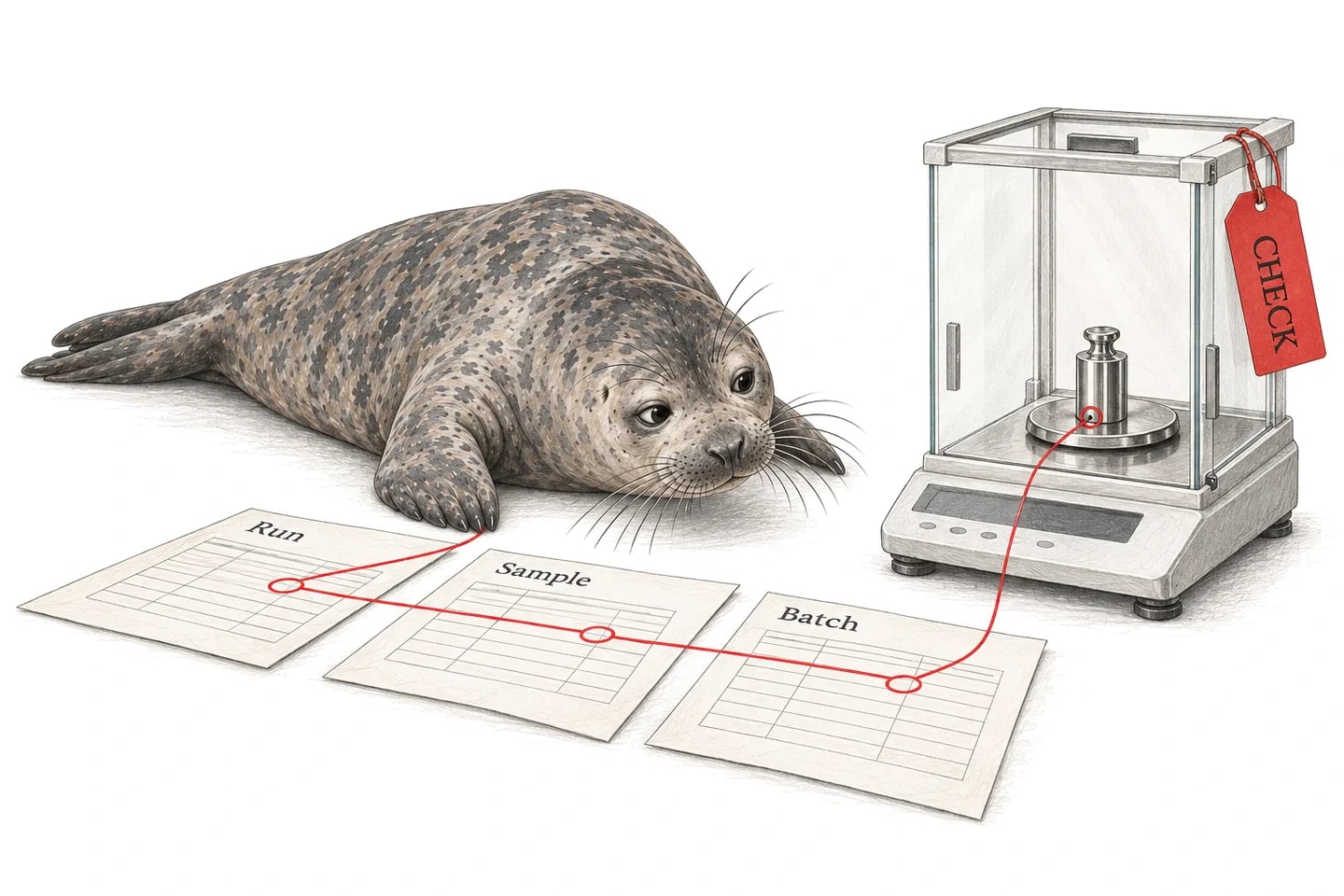
- The protocol sets material identity and grade, target, tolerance and any witness check. The container scan, the gross, tare and net readings and the verification are recorded against the batch step, with the original values retained.
- What changes
- A failed identity check stays on the record beside a passing weight, and a correct number alone does not complete the step. Corrections keep the first reading and scan, and the dispense is reconciled against the source container’s stock.
- Where to start
- One dispensing step, a balance output and the checks your operators need. Book a demo.
One dispense.
A complete record.
Follow an illustrative dispense from container to batch. Your protocol defines the sequence, limits and verification required in Seal.
Sodium chloride USP
Sodium chloride USP
BUF-045 / step 04Start with the material, not the number.
The protocol sets the material and grade. Link the source container and lot to the destination, then check identity, release status and expiry before dispensing.
Container identity and lot stay with the dispense.
The weight is right. The material may not be.
A separate example, batch BUF-044, calls for 2.500 kg of sodium chloride USP. The reading is on target, but the scanned container holds a different grade. Compare the three checks.
Buffer preparation / dispense 04
- Gross
- 2.820 kg
- Tare
- 0.320 kg
- Net weight
- 2.500 kg
Container identity
WD-044-M- Expected
- NaCl / USP
- Scanned
- C-219 / laboratory grade
- Batch
- BUF-044
- Verification
- Mismatch
The step requires sodium chloride USP. Scanned container C-219 identifies a laboratory-grade material. Its nominal name is similar, but it does not match the required material identity.
What follows
Resolve the container mismatch and follow the approved handling procedure before proceeding. Do not overwrite the failed scan.
The weight passes. The material check doesn’t: this step requires USP, but container C-219 was scanned as laboratory grade. A correct weight isn’t enough to complete verification.
Start with C-219 and the destination container. Check their labels and movements against step 04, and confirm with the operator what was actually dispensed. These records do not establish whether this was a wrong scan or a wrong-material dispense—that distinction matters for the review.
I’ve linked the three checks and set out who needs to follow up. Material disposition and verification remain open for your team.
BUF-044 / dispense exception
DraftResolve the material mismatch before completing step 04.
| Check | Required | Recorded |
|---|---|---|
| Weight | 2.495–2.505 kg | 2.500 kg net |
| Material identity | Sodium chloride USP | C-219 / laboratory grade |
| Verification | Completed step verification | Not recorded |
The question for review
Was the wrong container scanned, or was the wrong material dispensed? Cause, batch impact and material disposition are not established. Keep that distinction open until the physical reconciliation and operator evidence have been reviewed.
Follow-up for review
Operator
Reconcile C-219, its physical identity and the source/destination movements against step 04. Record what was scanned and what was dispensed.
Manufacturing reviewer
Review the reconciliation and assess batch impact under the applicable procedure. Keep the original scan, gross, tare and net readings with any correction.
Authorised verifier
Complete the configured verification after the discrepancy is resolved.
From the balance to the batch record.
Why teams choose Seal for weigh and dispense
On a paper dispensing sheet or in a standalone dispensing module, the balance printout, the container label and the second-person check are reconciled only at review. Seal records the container scan, the balance reading and the verification against the batch step, on the same platform as inventory and the batch record.
A grade mismatch stops the step while the operator is still at the balance, and the source container’s stock changes with the dispense. A revised tolerance or check applies to dispenses made under the new protocol version.
The formulation sets the work.
Configure the sequence, target quantities, units and material requirements for the selected batch size.
Keep potency or moisture corrections, where required, with their source values and reviewed calculation. Define rounding, tolerances and verification in the protocol. Preserve the version used for the actual dispense rather than recalculating history against a revised formulation.
The room and equipment matter too.
Include the line-clearance, cleaning, equipment and operator checks the dispensing operation needs.
Connect the work to the applicable handling procedure and required readiness evidence. Record interruptions, substitutions and unresolved checks. Software records and checks support the operation; they do not replace physical containment or safe material handling.
A balance connection has an operating context.
Keep units, stability indicators where available, device identity and calibration status with each capture.
Agree the balance model, interface and data format before configuring the connection. Test disconnection, stale readings, unit changes and invalid values. Any permitted manual fallback needs its own attribution and review.
The stock balance follows the physical work.
A dispense changes both the batch record and the source container’s quantity.
Keep corrections distinct from new movements. Record partial containers, over-dispense handling, returns and waste using your procedure. A numerical reconciliation does not establish that material is suitable for reuse.
Connected to the surrounding work.
Keep specialised systems where they belong. Agree the source of each record, the permitted actions and the reconciliation at each handoff.
Explore integrationsAQuestions and answers
Can we connect our existing balances?
Scope the connection around the device model, interface and required readings. Confirm capture and failure behaviour with representative equipment; do not assume every balance has the same protocol.
Who sets tolerances and witness checks?
Your team defines them for the material, process and intended use. Configure and test those controls before production use. The tolerance in this example is fictional.
Can operators correct a mistake?
Configure a correction workflow that retains the original event, reason, person and review. A corrected value should not silently replace the first reading or failed identity check.