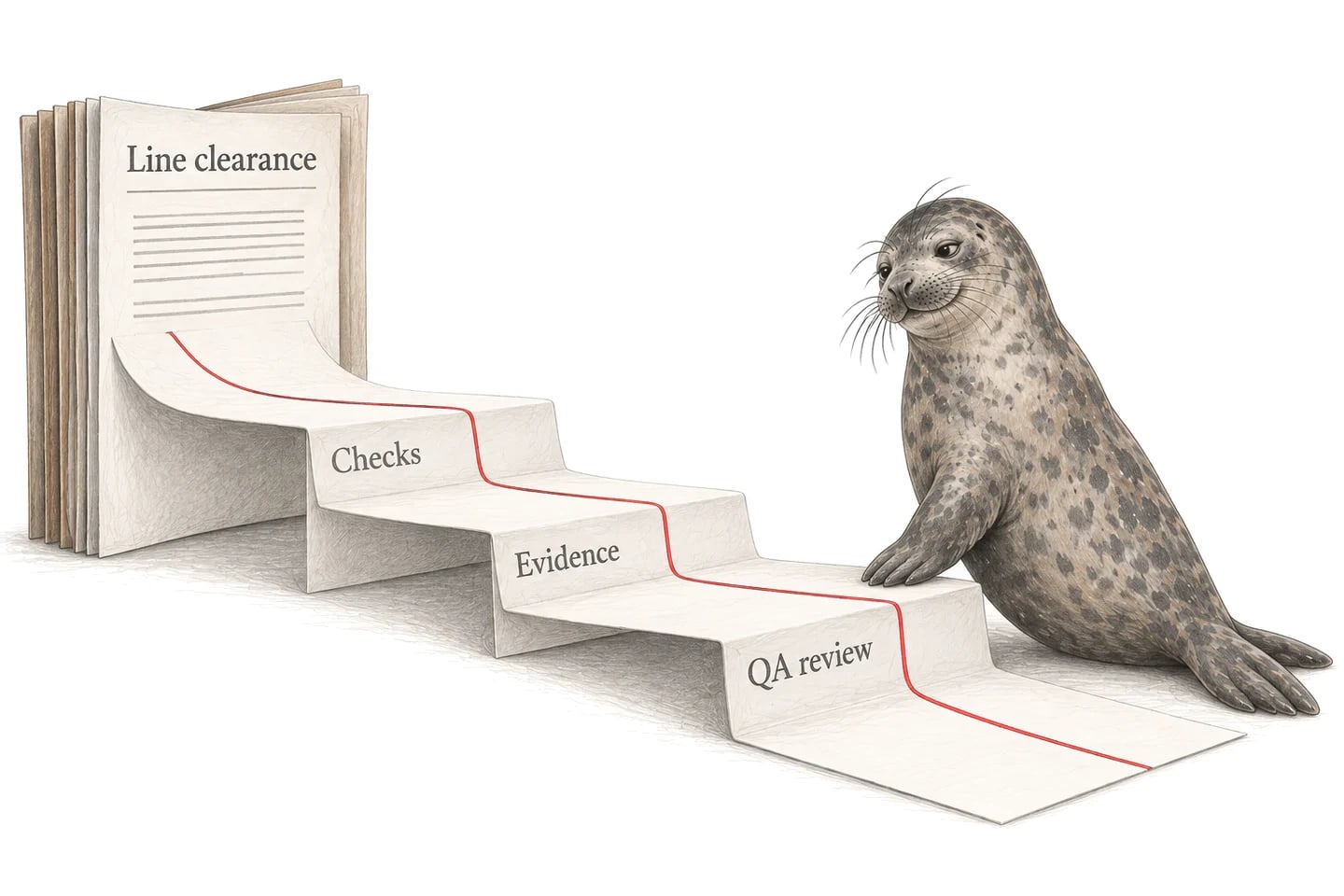
1Revision 5 becomes active while three batches sit at different stages.
Instruction WI-208 revision 5 becomes active at the site’s recorded 10:00 transition point. The reviewed implementation plan permits B-208-A to finish on revision 4, requires assessment of prepared but unstarted B-208-B and assigns revision 5 to newly created B-208-C.
| Batch | State at transition | Existing instruction reference | Implementation-plan treatment |
|---|---|---|---|
| B-208-A | In progress | WI-208 revision 4 | Continue on revision 4 under the stated plan |
| B-208-B | Created; not started | WI-208 revision 4 | Resolve reassignment before starting |
| B-208-C | Created after transition | WI-208 revision 5 | Execute revision 5 after other readiness checks |
All three batches can belong to the same product while legitimately requiring different handover work. B-208-B does not switch versions simply because it has not started. Its existing reference and any generated instructions must be assessed against the implementation plan.
2Review output and next actions
The default change is implemented only for the work it actually affects. B-208-B remains an open handover item until its prepared execution basis is reconciled. B-208-A’s historical instruction remains revision 4.
Manufacturing change owner
Link the permitted continuation decision to B-208-A.
Evidence needed: The original instruction and the reviewed reason for continuation remain available beside the execution evidence.
Batch preparation owner
Assess B-208-B’s copied content, tasks and prerequisites before reassigning its instruction.
Evidence needed: The actual prepared work agrees with the authorised revision; changing a revision label alone is insufficient.
Batch reviewer
Inspect a newly created B-208-C and reconcile any batches created during transition.
Evidence needed: The assigned reference resolves to revision 5 and the applicable prerequisites are satisfied.
The filled review worksheet: WI-208 handover assessment at the 10:00 transition
This is a fictional worked assessment to adapt to your procedure and actual evidence.
Source pack
- The reviewed revision-5 implementation plan and the actual activation time.
- All affected batches, including prepared work; inspect pinned references, generated instructions, assignments and prerequisites.
- B-208-A
- Already executing revision 4. The illustrative implementation plan permits it to finish on that basis.
- B-208-B
- Created but not started, with revision 4 assigned. Its reassignment remains unresolved.
- B-208-C
- Created after transition with revision 5 assigned. Other readiness requirements still apply.
3Decisions and exceptions
| Situation | Response | Consequence |
|---|---|---|
| Batch already executing revision 4 | Apply the reviewed transition treatment | Retain the original instruction and decision evidence |
| Prepared batch still references revision 4 | Assess generated work and reassignment before start | Changing the current default is insufficient |
| New batch after revision 5 activation | Inspect its assigned reference and prerequisites | Confirm revision 5 is actually the execution basis |
4Find existing work before changing the default.
Identify batches created from the affected template and their current instruction references. Include prepared work that has not started. A search for only “in progress” would omit B-208-B, which may already contain copied instructions, assigned tasks or linked preparation records derived from revision 4.
Keep the reviewed population and its assessment identifiable. New work can continue to appear while the change is being introduced. Define who checks that newly created batches receive the intended basis and how batches created during the transition are reconciled. A change to the default is useful, but it does not itself assess every existing instance.
5Use the reference behaviour that matches execution history.
Seal distinguishes a pinned version from an Active version reference. By default, instances use pinned references, and an Active version reference on a template resolves when the instance is created. A type setting can allow Active version references in instances. Inspect that setting rather than assuming every existing batch will preserve the same reference behaviour.
For the historical execution basis in this design, retain a pinned reference to the assigned instruction revision. An Active reference can be appropriate for locating the current standard, but its later target does not establish what an operator used earlier. Also inspect copied page content and instance fields: changing a reference alone may leave generated work based on an earlier instruction.
6Make reassignment an explicit operation.
For B-208-B, compare the prepared work with the changed tasks. Determine which assignments, prerequisites or instructions need updating and which evidence can be retained. Record the authorised treatment before starting. Do not change a revision label to 5 while leaving revision-4 content or dependencies underneath it.
For B-208-A, the illustrative plan permits continuation on revision 4. Keep that decision and the original execution basis connected to the batch. Another change could require a different response; the software should express the responsible team’s actual plan. A later instruction revision should not rewrite completed observations.
7Inspect what must change on the prepared batch.
Extend B-208-B with a fictional revision delta: revision 5 adds an independent setup verification before the first addition. The handover owner must inspect the prepared task list, assigned reviewers and readiness evidence, not only its instruction link. Record the specific changed requirement from the actual controlled instruction; this example does not prescribe an additional manufacturing check.
At the transition point, retain the original affected-batch list. Immediately before releasing B-208-B to start, reconcile any work created since that list was taken and inspect whether execution has begun in the meantime. If the batch has started, its treatment needs reassessment against the implementation plan; yesterday’s “not started” classification cannot govern today’s in-progress work.
Accept the reassignment only when the revision reference, executable content and prerequisites agree and the authorised treatment is recorded. If preparation cannot be updated consistently, keep start readiness unresolved while the owner decides how to correct or replace the prepared work. Retain the old preparation and its superseding relationship so the history explains the change.
| Item inspected | Evidence before start | Unresolved mismatch |
|---|---|---|
| Instruction assignment | Pinned WI-208 revision 5 and authorised reassignment | Revision label changed without the assigned reference |
| Generated steps | The new setup-verification task is present in executable work | Copied revision-4 task list remains |
| People and prerequisites | Required verifier assigned; applicable readiness evidence reviewed | A task exists but nobody can perform its required review |
| Execution state | A fresh check confirms the batch has not started | The batch began while the change assessment was being prepared |
ICH Q10 §3.2.3 describes evaluating, approving and implementing changes through a change-management system that addresses unintended consequences. The prepared/running/new-batch comparison is this guide’s practical application of that principle. The transition plan supplies the actual treatment for each batch.
8Questions this example raises
Will changing a template update every existing batch?
Inspect the configured instance and reference behaviour. Existing work may contain pinned references and copied content from an earlier version. Identify and assess affected batches instead of assuming a new default has updated them.
Can an in-progress batch finish on the older instruction?
That depends on the reviewed implementation plan. The worked case explicitly permits one batch to continue on revision 4. Retain that decision and its scope; another change could require a hold or different treatment.
9Proposed record fields
Start from the Electronic batch records blueprint. The fields below are a proposed design for this case, using Seal’s documented field types and references.
Download the proposed field list
Instruction revision
Identify the content and revision that can be assigned to work.
- Instruction identityText
- WI-208, kept separate from its particular revision.
- Controlled revisionReference
- The published revision containing the actual instruction content.
- Implementation planReference
- The reviewed scope and timing for adopting revision 5.
- Changed tasksText / References
- The steps whose execution differs and the evidence needed for handover.
Batch instruction assignment
Retain the actual execution basis for a specific batch.
- BatchReference
- The individual batch, not only the product or template.
- Assigned instructionPinned Reference
- The exact revision intended for this batch.
- Execution stateSelect
- Prepared, in progress or completed as defined by the operation.
- Readiness evidenceReferences
- Applicable materials, training and checks for the assigned revision.
Transition assessment
Account for existing work when the instruction changes.
- Affected batchesReference, multiple
- The population actually assessed at the transition.
- Treatment by batchText / References
- Continue, reassign or hold for assessment, with supporting reasons.
- Authorised decisionReference
- The reviewed instruction-assignment decision for the affected work.
- Transition time basisTime & date / Text
- An explicit site time and timezone basis where timing defines applicability.
Seal’s versioned records and References can retain the instruction basis used by a batch. The practical value is a reviewer being able to read the instruction the operator followed, alongside any authorised transition decision. The fictional example below illustrates version assignment; it does not prescribe when your process should adopt a change.
10Configure Seal to make the assigned basis visible.
Put the Assigned instruction Reference and transition evidence where operators and reviewers can inspect them on the batch record. Use Template instance configuration for the required reviews and Checks. Verify the template’s reference mode and create representative batches before and after the transition to inspect the resulting assignments.
A proposed readiness Check can require a resolved instruction assignment and the prerequisites for that revision. Keep that Check attached to the record decision it is intended to govern. It does not directly prevent a physical operation outside the configured workflow. Use the organisation’s implementation procedure to connect the recorded readiness decision to actual execution.
11Configuration references
The record design above is illustrative. These product documentation pages explain the Seal capabilities used in it. They open in the signed-in Seal platform.
12Acceptance tests
These are proposed acceptance tests for the configured workflow. They describe expected behaviour to verify, rather than results of a customer implementation.
Download these acceptance cases
An active default changes after instance creation
Input: Create B-208-B while revision 4 is active, then activate revision 5.
Expected: The instance follows the configured reference mode. The handover report identifies its actual assignment rather than assuming it changed.
The reference changes but copied content does not
Input: Prepare an assignment update with a revision-5 reference and retained revision-4 step content.
Expected: The transition review detects inconsistent execution content before the reassignment is accepted.
A completed batch is inspected later
Input: Read B-208-A after another instruction revision becomes active.
Expected: Its executed instruction revision and transition decision remain identifiable; the current default is not presented as its historical basis.
13Apply this to your records
Use one instruction transition. Reconcile prepared, running and newly created batches against the implementation plan before relying on the new default.
Download the blank working review
Write your working notes here
Notes stay in this tab and are not submitted. Download them before leaving to keep a copy. Use record references to identify your evidence.
Name the instruction revisions, changed tasks, implementation-plan revision and transition time with timezone. State the authorised treatment of running, prepared and newly created work.
Record the population query and time. For every batch, identify its current execution state, exact assigned instruction reference and whether generated content was copied from an earlier revision. Include unstarted work.
For each batch requiring reassignment, compare the instruction reference, executable steps, assigned verifiers and prerequisites with the changed requirement. Name every item that must be updated or regenerated and the evidence that can be retained.
Recheck whether the batch started while the handover was being prepared. Identify work created since the first population extract. Verify reference behaviour and copied content together; record any reassessment when execution state changed.
Record the decision for each batch, the responsible owner and remaining actions. Link the prior preparation and any superseding work. For a batch permitted to continue on the older revision, retain the actual instruction and transition decision.
Unanswered sections remain marked ‘Not recorded’ in the download.
Evidence needed to finish
Each affected batch has a supported treatment, consistent executable content and an identifiable historical instruction basis. Newly created work and batches that changed state during the transition are reconciled. A revision-5 label with revision-4 steps remains unresolved.
14Review the evidence with Neil
Assess the WI-208 revision-5 handover against the implementation plan. List affected batches with their actual instruction references, execution states and generated dependencies. Separate work allowed to continue from work requiring reassignment or further assessment. Prepare the change owner’s evidence brief and identify any mismatch between a revision reference and copied execution content.
Review the proposed output against these deliverables:
- An affected-batch table with actual version assignments.
- The changed content and prerequisites requiring action on prepared work.
- Unresolved assignment decisions with source evidence and responsible follow-up.
15Configure this process with Seal
Use a representative source record and an exception your current process struggles with. We can work through the record design, review responsibilities and connection requirements with you.