Summary
- The problem
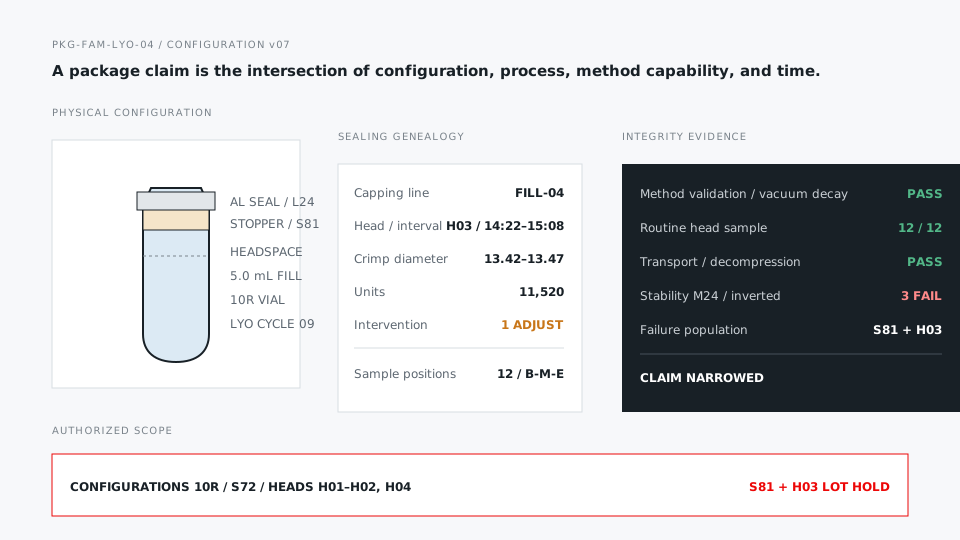
- A passing CCIT result is easily read as a claim about every stopper, crimp, fill and capping condition in a package family. The evidence that bounds the claim, from method capability and sample provenance to stability age and transport challenge, sits in separate reports.
- Seal’s approach
- Seal connects each package configuration and its manufacturing history to method validation, characterised defect standards, sample genealogy down to the capping head, stability and shipping studies, and investigations. The integrity claim is stated for an exact configuration and population.
- What changes
- A failure cluster resolves to a physical mechanism, such as one stopper lot on one capping head, and impact traverses the affected claims, lots and batches. Release shows which package populations remain supported.
- Where to start
- One lyophilised vial family through its configurations, method validation, line samples by capping head, stability pulls and one component change. Book a demo.
Container closure integrity is a lifecycle argument that the actual package system (components, dimensions, processing, assembly, sealing, transport, storage and use) maintains the protection claimed for the product. One test attached to a finished-product specification cannot carry that argument alone.
Seal connects the package configuration and its manufacturing history to method capability, sample provenance, positive controls, study conditions, results, defect mechanisms, stability timepoints, investigations and the exact population and claim the evidence supports.
1The package configuration is a controlled system.
Product, route, container, closure, seal, overseal, delivery device, dimensions, materials, suppliers, component lots, washing, sterilisation, coating, assembly, sealing process and secondary packaging together define the system. Configuration version and effectivity stay explicit. A passing study on a nominal “10 mL vial” cannot support every stopper, crimp, headspace, fill or capping condition.
The requirement starts with product risk. Sterility, microbial barrier, gas and moisture ingress, solvent loss, oxygen sensitivity, vacuum maintenance and in-use protection determine the performance needed. The control strategy names the critical quality attributes, failure mechanisms, allowable leak or ingress, detection threshold, sampling stage and how each result will be used.
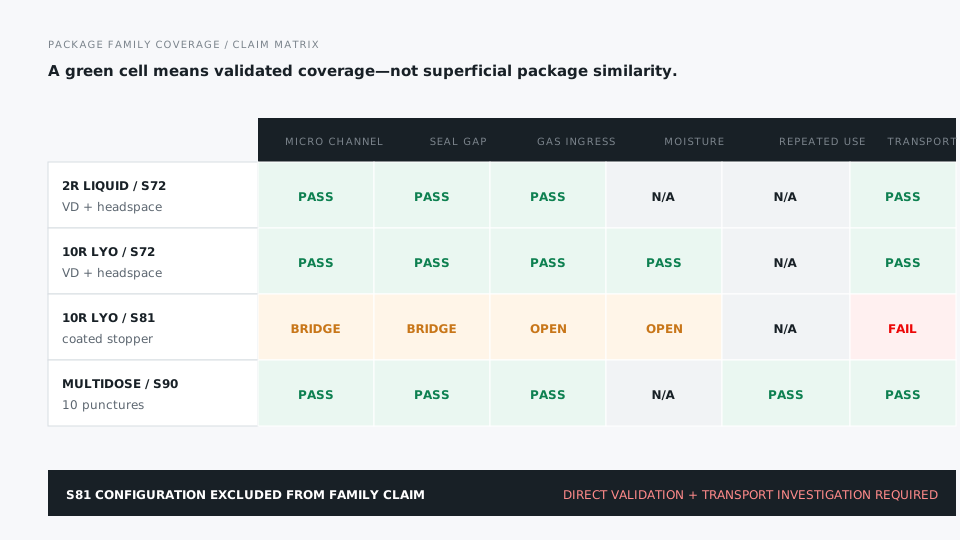
Package families need defensible bracketing. Container size, neck finish, closure geometry, fill volume, headspace, capping range, lyophilised versus liquid presentation, shipping orientation and use pattern can support or defeat a bracket. The worst-case rationale stays linked to engineering and study evidence, so Seal shows which configurations inherit a claim and which need direct data.
1.1Why teams choose Seal for CCIT
A failed integrity result or a component change is often the first time CCIT evidence is read together: method validation in one report, routine results in a LIMS, stability and transport studies in others. Seal records the package configuration, method, samples by capping head, stability pulls and investigations against each other, so each integrity claim names the configuration and population it supports. A failure cluster or component change resolves to the claims, lots and batches it affects.
2Methods are chosen for the mechanism and validated for the claim.
Vacuum decay, pressure decay, high-voltage leak detection, laser headspace analysis, tracer gas, mass extraction, dye ingress and microbial ingress differ in determinism, sensitivity, destructiveness, throughput, matrix effects and defect coverage. Each approved use names the package, stage, defect range, acceptance, limitations and purpose: development, validation, release, stability, investigation or in-process control.
Defect standards anchor capability. Calibrated leaks, laser-drilled holes, wires, capillaries and damaged seals keep their characterisation, certified flow or equivalent size, test conditions, handling, use history and expiry, and positive-control identity travels with each run. A nominal defect size without its characterisation conditions is not an adequate reference.
Development explores settings, conditioning, pressure profile, temperature, headspace, product properties, container compliance and fixtures against intact and defective populations, and exploratory runs are never promoted into approved evidence. Validation then covers agreement, precision, range, detection capability, specificity, robustness, system suitability, false-positive and false-negative behaviour and package applicability, with every sample and standard linked to its raw data, calculation and approved method version.¹
3Samples keep their manufacturing position.
Each sample, or bounded population, carries its component lots, filling line and interval, stoppering station, capping head or lane, interventions, reject history, lyophiliser position, sterilisation load, tray, shipper and storage condition. A failure cluster can then resolve to a physical mechanism, such as one stopper lot on one capping head, instead of disappearing inside a study mean.
Routine process controls, including seal force or crimp measurement, closure position, line settings, vision outputs, in-process checks, alarms and interventions, show how sealing was controlled. Batch review connects them to laboratory CCIT without treating either as a substitute for the other.
4Integrity is shown through shelf life, shipping and use.
Stability studies link protocol, configuration, batch, orientation, storage condition, pull point, method, system suitability and result. Accelerated, long-term, frozen, temperature-cycled, inverted and in-use studies each keep their own applicability, and passing at time zero does not establish end-of-shelf-life protection.
Shipping challenges connect the shipper configuration, lane, decompression, temperature, vibration, shock, freeze-thaw and pre- and post-challenge comparison to the package system, so transport damage is assessed against the exact units and exposure rather than a detached qualification report. In-use claims have their own boundary: puncture count, needle gauge, angle, sequence, dwell time and acceptance for the intended use.
5Results keep raw evidence, and failures stay bounded.
Instrument files, traces, method and software versions, controls, sample preparation, measured values, thresholds, calculations, repeats, exclusions, reviewers and audit trail remain attributable.² Source data can stay indexed in SDMS while the approved result and package context remain usable in the lifecycle record.
A failed system suitability, missed positive control, intact-control failure, sample leak or atypical trace follows the laboratory’s approved investigation procedure. Impact then traverses sibling samples, study conclusions, package-family claims, component lots, sealing periods, stability protocols and distributed batches. A retest does not erase the original signal.
Trending by method, instrument, fixture, operator, configuration, supplier lot, sealing head, stability age and defect mechanism separates a baseline shift after instrument service from increased leakage after a stopper or capping change.
6Changes and disposition state exactly what is supported.
A change to a component supplier, dimensions, coating, sterilisation, fill, headspace, capping, lyophilisation, shipping, method, instrument or defect standard identifies the evidence and claims it affects. Revalidation, bridging, stability and filing needs resolve before the changed package becomes authoritative.
Disposition, whether study acceptance, package-family authorisation, batch release, restricted use or disqualification, names the configuration, lots, quantities, conditions, evidence, unresolved risk and approvers. Seal does not turn a passing CCIT result into a generic claim of sterility; it keeps what the evidence can and cannot conclude. Instruments execute the tests and the MES executes sealing, while Seal holds the package claim across them.
7Prove one difficult package family end to end.
Follow a lyophilised vial family through its component and dimensional configurations, capping ranges, method selection, defect standards, validation, line samples by capping head, stability pulls, a decompression challenge, an atypical trace, investigation and a component change.
Include a positive-control failure, a stopper-lot dimensional shift, a package outside the bracket, repeated puncture use and a transport failure cluster. The release view must identify exactly which package populations remain supported.
References
AConnected across Seal
BCapabilities
| Capability | What it covers |
|---|---|
| Package configuration and claim | Version the product, container, closure, seal, component materials and dimensions, processing and assembly, together with the protection the package is claimed to provide. |
| CCIT method and defect standard | Each method keeps its technology, settings, fixtures and validated range. Defect standards keep their characterisation, certified size or flow, handling and use history. |
| Package-family coverage | Justify a bracket factor by factor, such as container size, closure geometry, headspace, capping range and presentation. Variants outside the bracket remain excluded. |
| Sample and sealing genealogy | Each sample keeps its component lots, filling interval, capping head or lane, interventions and lyophiliser or sterilisation position, so a failure can be related to its mechanism. |
| Integrity study lifecycle | Link development, validation, release, stability, shipping and in-use studies to their protocols, sample populations, positive controls, results and conclusions. |
| Failure-to-population impact | After an invalid run or confirmed leak, trace the impact through sibling samples, sealing intervals, component lots, package claims and batches, with bounded exclusions. |
| CCIT source data and review | Instrument files, traces, method and software versions, controls, calculations, repeats, exclusions and review remain attributable to the result. |
| Package integrity trending | Trend results by method, instrument, fixture, configuration, supplier lot, sealing head, stability age and defect mechanism, to separate an instrument shift from a real change in leak rate. |
CConnected records
DQuestions and answers
What is container closure integrity testing software?
It connects package configurations and their manufacturing history to CCIT methods, defect standards, samples, studies and results. Failures, trends, changes and package decisions then work from the same evidence.
Does CCIT prove product sterility?
No. CCIT evaluates the integrity or barrier performance of the package system for its validated application. It does not replace the overall sterility assurance strategy or show initial product sterility by itself.
Which CCIT methods can Seal manage?
Deterministic and probabilistic methods, including vacuum or pressure decay, high-voltage leak detection, laser headspace analysis, tracer gas, mass extraction and dye or microbial ingress. Each keeps its own settings, capability and limitations.
How are positive controls managed?
Each defect standard keeps its mechanism, certified size or flow, characterisation conditions, handling, storage, use history and expiry. Its relationship to the method’s validated range stays visible.
Can one validation cover several package sizes?
Yes, where an approved bracket establishes the relevant factors, worst cases and method applicability for the included configurations. Unsupported variants remain excluded rather than inheriting the claim.
How does CCIT connect to manufacturing?
Samples keep their component lots, fill and seal time, capping head or lane, settings, interventions and lyophiliser or sterilisation position. That genealogy supports the investigation of a failure mechanism.
Can CCIT support stability protocols?
Yes. Stability studies link the package version, batch, orientation, storage condition, pull point, method, controls and result, and connect them to the shelf-life conclusion.
How are shipping effects evaluated?
Shipper configuration, lane, decompression, temperature, vibration, shock and pre- and post-challenge results stay tied to the package units tested. Transport damage can then be separated from sealing problems.
What happens after a CCIT failure?
The laboratory’s approved procedure first assesses whether the run was valid. The impact is then traced through sibling samples, component lots, sealing intervals, package-family evidence, stability conclusions and batches.
What should the first implementation prove?
Follow one lyophilised vial family through configurations, bracketing, method validation, samples by capping head, stability and transport. Include a positive-control failure and a stopper-lot shift, and check that the release view identifies exactly which claims remain supported.