Summary
- The problem
- A revised monograph reaches specifications, methods, reference standards, suppliers, stability, filings and laboratories across several markets. Tracked in spreadsheets and email, the official date arrives before anyone can show what changed where, or which products may cross to the new state.
- Seal’s approach
- Each monograph revision is decomposed into reviewed requirement clauses with an explicit delta. A where-used graph resolves applicability by market and claim, and routes laboratory, supplier and regulatory work, with old and future states carrying their own effective dates.
- What changes
- Sample registration and batch release resolve the correct monograph state from product, market, site, date and lot rather than analyst memory. Exceptions such as a delayed official standard stay visible before the official date.
- Where to start
- One difficult monograph change end to end, including an erratum, a delayed official standard and one market retaining an approved alternative. Book a demo.
A pharmacopoeial change becomes operational through a long chain of dependencies: the edition or supplement, the monograph or general chapter, national applicability, material and product claims, specifications, analytical procedures, reference standards, suppliers, stability, filings, laboratories and effective dates. That chain usually crosses regulatory intelligence, the analytical lifecycle, LIMS, change control, regulatory records and batch release.
Seal turns the published change into one controlled implementation record. It records what changed, where the requirement applies, which current controls already comply, what evidence is missing, and which products and markets can move to the new state, so each implementation decision can be traced to the records it changed.
1Decompose the publication into reviewed clauses.
The source publication stays authoritative. Its pharmacopoeia, edition, supplement, publication and official dates, transition provisions, errata and monitoring owner are recorded, and a proposal, final text, correction, postponement and supersession remain separate versions. Planning can begin on a proposal without presenting it as effective.
The text is then broken into requirement clauses: identification, assay, impurities, performance tests, microbial requirements, packaging, storage, labelling, reference standards, apparatus, reagents, calculations and acceptance criteria. Each clause keeps its exact source location. Human review authorises the interpretation; extraction alone does not create an obligation.
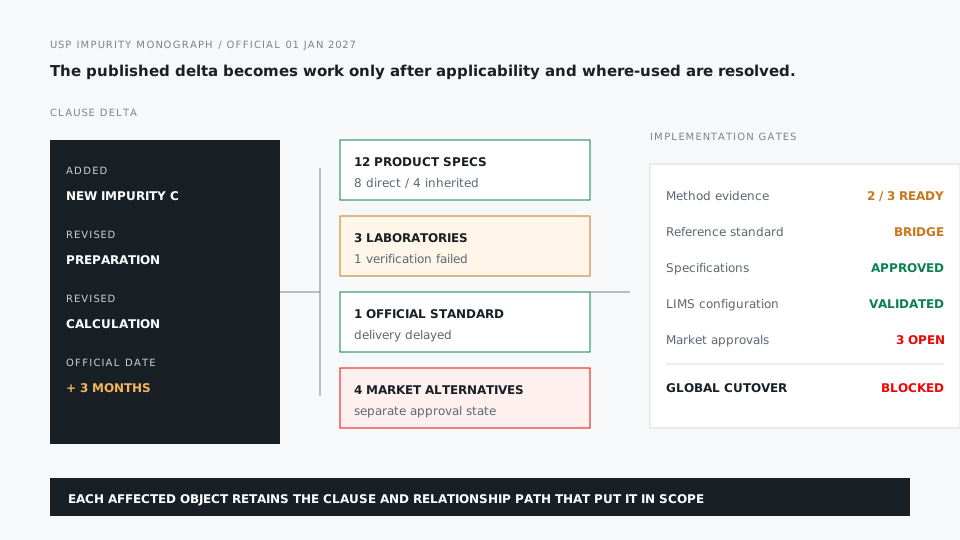
The delta is explicit at clause level. Prior and future text are compared, and the record states whether each change affects the scientific outcome, execution, documentation or filing, or no controlled state, with the rationale.
1.1Why teams choose Seal for compendial change
When a monograph revision is published, each laboratory, supplier and regulatory owner is often asked by email whether they are affected, and the answers are tracked in a spreadsheet of upcoming revisions. Each revised clause is connected to the specifications and methods that use it, the products and markets it applies to and the implementation work. Sample registration and batch release resolve the correct monograph state from the record, so the move to the new text happens on its date and not before.
2Resolve applicability, then where it is used.
Market, product application, dosage form, compendial claim, grade, supplier certificate, specification wording, approved method, filing commitment, site and official date determine whether a clause applies. A USP change does not automatically apply to every global product, and a company can deliberately adopt it more broadly as an internal standard, with explicit governance.
The where-used graph then runs through materials, suppliers, products, specifications, tests, methods, instruments, reagents, standards, calculations, stability protocols, release templates, documents, training, sites, partners and filings. Each hit keeps its relationship path, the applicable clause, an owner and the reason it was included or excluded.
Triage sets the route for each hit, from no impact or documentation only through method verification, validation, supplier action, stability impact and regulatory assessment. Due dates derive from the official date, market requirements, laboratory lead time, submission path and supply constraints.
3Plan laboratory evidence against the actual gap.
Method comparison is scientific and operational. It compares the principle, sample preparation, reagents, apparatus, system suitability, calculations, specificity, sensitivity, precision, range and throughput of the compendial, approved and internal methods. An alternative method can stay in use only with the required equivalence, validation and filing strategy.
The required work might be a paper assessment, method verification, partial or full validation, equivalence, bridging or transfer, instrument or software change, or reagent and column qualification. Each becomes executable work with its samples and acceptance criteria, and its protocols, data, deviations and conclusions attach to the clause and the use they address.
Reference standards and reagents can control timing. Official standard availability, lot, assigned value, qualification, shipping and in-house bridging stay linked to readiness, so the record shows when the official date precedes practical availability and preserves the approved response.
4Assess specifications, products and stability deliberately.
Current and future tests, methods, limits, units, calculations, sampling, market, product, site and effective dates form controlled specification versions, approved and changed under quality control.¹ Global, market-specific, release, shelf-life and supplier limits can coexist without overwriting historical batch decisions.
A tighter limit or a more capable method can change how past results read. Historical results, method bias, impurity visibility, release status, ongoing stability pulls, trends, shelf-life claims and distributed inventory may need retrospective or prospective assessment. Seal identifies the exact batches and studies whose interpretation may change.
5Suppliers, partners and filings resolve market by market.
Supplier specifications and certificates, test methods, change notifications, acceptance of new limits, the first compliant lot, quality agreements, contract laboratory readiness and CMO implementation are tracked with acknowledgements and evidence. External readiness cannot be inferred from an internal procedure’s effective date.
Regulatory assessment connects application content, the pharmacopoeial reference, approved alternatives, established conditions, reporting category, submission type, commitments and approval to the change.² Official compendial status and marketing-
6Dual-state control prevents premature cutover.
Old, future and effective monograph states, current and future methods and specifications, inventory lots, stability pulls, sites, laboratories, partners, markets, documents and training each carry transition dates and permitted use. The execution system resolves the correct state at sample registration and batch release from product, market, site, date and lot, not from an analyst’s memory.
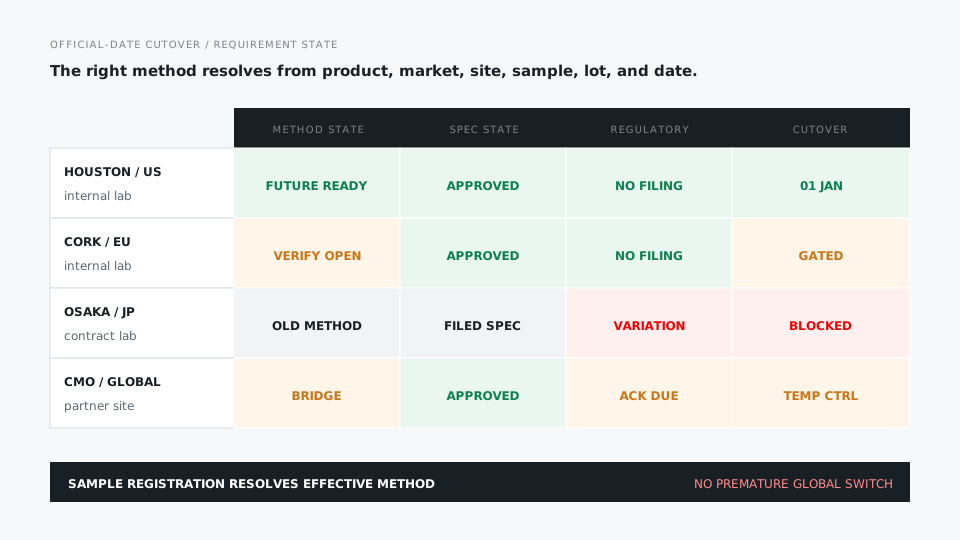
Exceptions are visible before the official date. A missing standard, failed verification, unexpected bias, supplier delay, pending approval or overdue training records its consequence, mitigation, owner, due date, escalation and temporary control. A risk acceptance cannot quietly become permanent noncompliance.
7Verify that every dependent state changed.
Specifications, methods, calculations, master data, instruments, reagents, standards, supplier requirements, documents, worksheets, training, LIMS configuration, release templates and regulatory records each receive controlled effectivity and verification. Cutover evidence includes a representative sample and batch tested under the new state.
Effectiveness review then checks the outcome: first results, system suitability, invalid and OOS rates, method bias, throughput, supplier certificates, partner execution, batch release and stability trends. The review can refine the method or its implementation without losing the official-date history. Across the portfolio, upcoming changes group by pharmacopoeia, date, technique, laboratory, product, market and effort, so shared method work can be reused with explicit applicability instead of repeated product by product.
8Prove one difficult monograph change end to end.
Follow a revised drug-product impurity monograph from proposal monitoring through final publication, clause-level delta, applicability, where-used, method comparison, a new reference standard, verification and equivalence, specification changes, historical and stability impact, supplier and contract-lab readiness, market filings, dual-state LIMS configuration, official-date cutover, first batch and effectiveness review.
Include an erratum, a delayed official standard, one market retaining an approved alternative, a failed site verification, inventory tested under the old method, a CMO that is not ready and a result that changes category under the new calculation. The system must show which requirement governed every test and release.
References
- 121 CFR 211.160, General requirements: laboratory specifications, sampling plans and test procedures, and any changes to them, must be approved by the quality control unit, followed and documented at the time of performance, with any deviation recorded and justified. eCFR
- 221 CFR 314.70, Supplements and other changes to an approved NDA: the applicant must notify FDA about each change in each condition established in an approved NDA beyond the variations already provided for in it. eCFR
AConnected across Seal
BCapabilities
| Capability | What it covers |
|---|---|
| Publication and requirement delta | Each publication, edition, supplement and erratum is versioned, and changed clauses are compared with the prior text. The change class, scientific and operational consequence and interpretation are reviewed and approved. |
| Compendial where-used impact | A changed clause is traced to the materials, products, specifications, methods, standards, stability studies, sites, partners, filings and markets that use it, with the relationship path and any exclusion recorded. |
| Method and specification gap | Compendial, approved and internal methods are compared on principle, preparation, apparatus, suitability, calculation and limits, so the scientific and operational gap is explicit for each market. |
| Laboratory evidence and readiness | Verification, validation, equivalence or transfer studies stay connected to their samples, instruments, standards, source data and reports, alongside laboratory capacity and training. |
| Jurisdictional dual-state cutover | Old and new requirements, methods and specifications coexist by product, market, site, laboratory and date until evidence, filing, approval and authorisation permit the cutover. |
| Official-date readiness evidence | Due dates, readiness exceptions, temporary controls, effectivity in LIMS and documents, partner acknowledgement and first-batch results show whether each site was ready by the official date. |
| Compendial source data integrity | Protocols, instrument files, calculations, audit trails, standards and results remain attributable to the changed requirement and the use it affects. |
| Change governance and effectiveness | Deadlines, owners, dependencies, risks and partner actions are tracked to closure, and first results, method bias, invalid rates and throughput are reviewed after implementation. |
CConnected records
DQuestions and answers
What is compendial change management software?
It takes pharmacopoeial publications and requirement changes through applicability, where-used impact, laboratory and specification gaps, evidence and regulatory assessment. It then manages deadlines, the period when old and new states coexist, first use and the effectiveness review.
Which pharmacopoeias can Seal manage?
USP–NF, the European Pharmacopoeia, the Japanese Pharmacopoeia and other national, regional or organisation-
Can proposed revisions be tracked before they are final?
Yes. Proposed, consultation, adopted, published, corrected, postponed and official states are kept separate. Planning can begin early, while execution uses only the requirements that are officially in effect.
How does Seal identify affected products?
Changed clauses are traced through compendial claims to materials, products, markets, specifications, methods, stability protocols, suppliers, sites, partners, filings and commitments. Each result shows the relationship path, and each exclusion keeps its rationale.
Does a compendial method always replace an internal method?
Not necessarily. The approved strategy may use the compendial method or a validated alternative, subject to equivalence, filing and jurisdictional requirements. Both states stay explicit in the record.
How are method verification and validation planned?
The scientific and operational gap determines the work: a paper assessment, verification, partial or full validation, equivalence, bridging or transfer. The plan also covers instruments, software, reference standards, samples, criteria and reports.
Can different markets use different effective methods?
Yes. The product, claim, application, market, site, approved alternative and authority status determine which method and specification apply at sample registration and release.
How are official reference-standard delays handled?
Availability, stock, lot, assigned value, any bridge to an internal standard and temporary controls are recorded. The effect on laboratory readiness and the due date stays visible until the standard is in use.
How is historical batch impact assessed?
A revised limit or calculation, or a more capable method, can be traced to prior results, batches, stability studies, distributed inventory and filings. The assessment states which historical populations need review and why.
What should the first implementation prove?
Take one difficult monograph revision from proposal through global impact, method evidence, standards, specifications and filings. Continue through partner readiness, the dual-state period, official-date cutover, first batch and effectiveness review.