
Summary
- The problem
- Nitrosamine risk can originate in API synthesis, recovered solvents, excipients, packaging or the API’s own amine structure, and acceptable intakes continue to evolve. When a limit is revised or a supplier changes, finding every product, result, batch and filing that relied on the old assumption becomes a manual search.
- Seal’s approach
- Formation pathways and material knowledge connect to product-specific risk assessments, versioned acceptable intakes, reproducible product limits, confirmatory results, mitigation and market action, with the evidence and calculations behind each conclusion preserved.
- What changes
- A revised acceptable intake or new supplier data identifies the dependent product limits, methods, results, batches, markets and prior decisions for reassessment, without recreating assessments by hand.
- Where to start
- One difficult product family, such as an API with secondary amine functionality, followed from pathway risk through testing, stability, mitigation and market filings. Book a demo.
Nitrosamine control is a portfolio-scale knowledge and evidence problem. Risk can originate in API synthesis, recovered solvents, reagents, excipients, water, cross-
The decisions cross chemistry, toxicology, suppliers, analytical laboratories, manufacturing, stability, quality and regulatory. Each function can hold its own evidence well and still lose the dependency between them. Seal keeps the relationship from each scientific assumption to the product decisions it supports, so a revised limit or newly understood pathway is traced forward rather than rediscovered product by product.
1Define the portfolio and the compounds it can form.
The assessment universe is the portfolio: API and salt, dosage form, strength, maximum daily dose, treatment duration, formulation, manufacturing and packaging sites, material sources, process versions and markets. Each product carries a status that distinguishes screened, potentially at risk, confirmatory testing required, mitigated, controlled, temporarily accepted and under reassessment.
Compound records keep small-molecule nitrosamines and nitrosamine drug substance-related impurities (NDSRIs) distinct, with structure, identifiers, precursor relationship, predicted potency category, analytical standards and the acceptable intake with its source. One compound can reach different conclusions by route, duration, product or jurisdiction, and those conclusions stay versioned.²
1.1Why teams choose Seal for nitrosamine risk
When an acceptable intake is revised, every product assessment that used it has to be found and reopened, and with per-product documents, limits calculated in spreadsheets and supplier data held in email, that is done by hand. The pathway, material knowledge, acceptable intake, product limit, test results and market actions are connected, and each limit is calculated from versioned inputs. A new limit or supplier disclosure identifies the dependent products, results, batches and filings for reassessment.
2Model the formation pathway, not a summary of it.
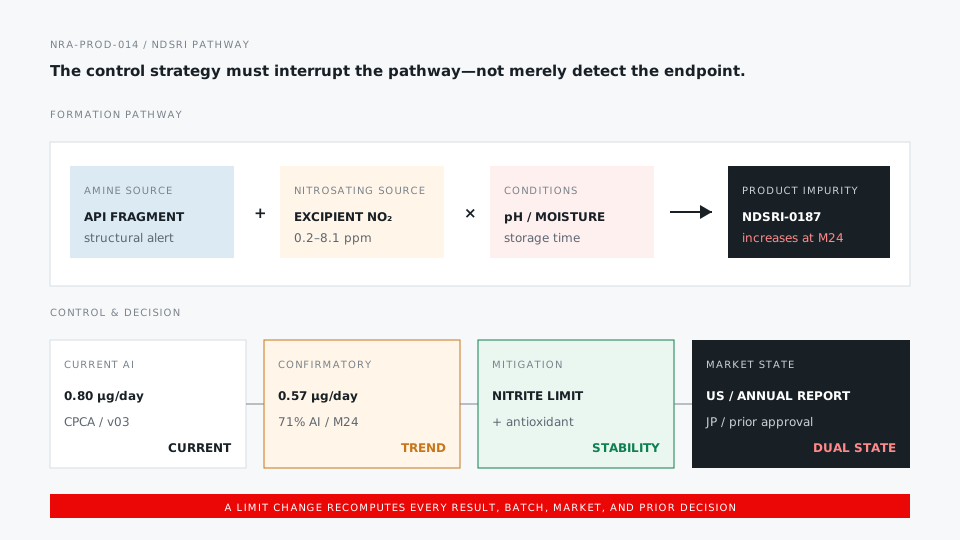
A pathway needs a vulnerable amine or susceptible structure, a nitrosating source such as nitrite and conditions that allow the reaction: pH, solvent, temperature, water activity, time, sequence, quench, recycle, packaging and storage. Each pathway in Seal records the evidence for presence, absence, prevention, purge or remaining uncertainty, and the process stages and products it can affect.
Materials carry their trace contributions. Starting materials, reagents, recovered solvents, water, excipients, packaging materials and shared equipment keep their amine and nitrite knowledge, test results, variability and supplier change obligations. A compendial excipient grade does not, by itself, establish a suitably low nitrite contribution for every formulation.
3Assess each product against its own process.
The risk conclusion follows from pathway plausibility, precursor levels, process conditions, purge, equipment and campaign history, formulation, package, dose, duration, analytical capability and prior results. Seal keeps the cited evidence and calculations with the conclusion rather than reducing the assessment to a questionnaire answer, so a reviewer can see why a product was screened out as well as why another needs testing.
4Hold acceptable intakes as versioned decisions.
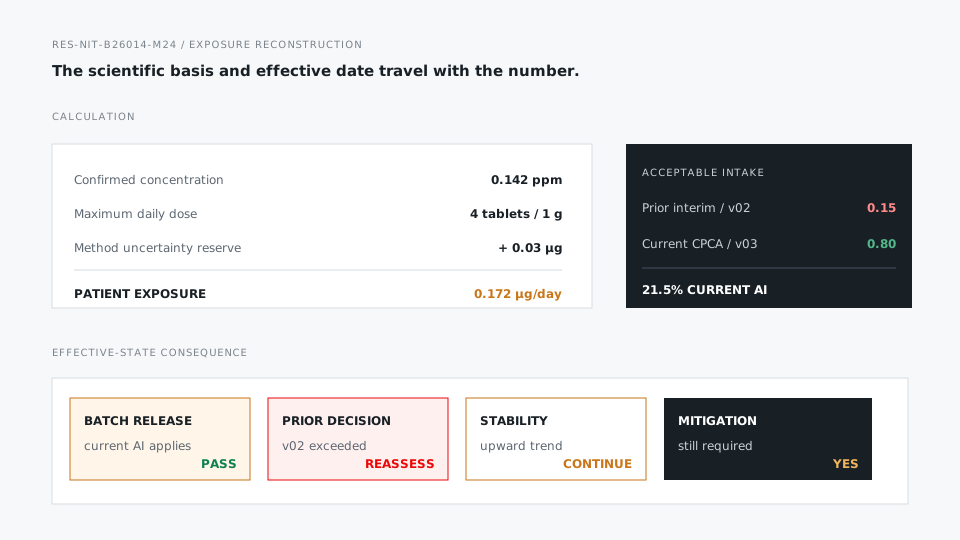
An acceptable intake has an authority source, publication date, structural basis, interim or final status, numerical limit, rationale, reviewer and effective date.¹ When it is revised, Seal identifies the dependent specifications, methods, results, products, markets, filings, inventory and prior decisions for reassessment.
Product limits are calculated from the acceptable intake, maximum daily dose, dosage units, strength and reporting basis, including how multiple nitrosamines are combined and how values are rounded. Every product-limit version keeps its inputs and the inventory population it applies to, so the calculation can be reproduced for any batch.
5Test to answer the risk question.
The analytical strategy follows the question being asked: screening, targeted confirmatory testing, NDSRI-specific methods, formation studies, raw-material testing or stability monitoring. Method capability is judged against the product-specific limit, not a generic reporting threshold. Reference standards, calibration, chromatograms, integration, blanks and system suitability stay attributable, and Seal connects the source data to each result while retaining every reintegration, exclusion and repeat.
Confirmatory testing needs a representative population across strengths, sites, suppliers, process versions, packaging and storage ages, with the selection rationale visible. One conveniently available batch cannot stand for a diverse global portfolio without justification. Results translate into patient exposure and margin against the current acceptable intake, and below-quantitation, estimated, confirmed, invalid and not-tested states remain distinct.
Stability data separates an impurity introduced during manufacture from one that forms on the shelf. Long-term, accelerated and stress results, package and headspace conditions, and any antioxidant or inhibitor stay linked to the shelf-life model, so a late increasing trend cannot be hidden by an early clean result.
6Mitigate the pathway and act on batches and markets.
Each mitigation connects to the pathway it interrupts: a supplier control, a tighter nitrite limit, a process sequence or pH change, a quench or purge step, a formulation change with an antioxidant, a package or a shorter shelf life. Development, validation, stability, bioequivalence, supply and filing dependencies stay in one plan.
Batch and inventory decisions resolve against the effective limit and control strategy: release, hold, retest, rejection or recall assessment for specific API lots and drug-product batches, with distributed quantity and shortage considerations visible. A market action can be scoped without changing the scientific record for unaffected products. Regulatory communication resolves by application and market, and Seal distinguishes guidance recommendations, approved commitments and internal targets.
7Reassess when the science or the supply changes.
A new API route, recovered solvent, excipient source, nitrite level, package, method or quality-agreement change traverses every pathway and product that relied on the earlier knowledge. Changed evidence can narrow or widen the risk without recreating assessments by hand.
Periodic review watches for new compounds, acceptable-intake updates, analytical advances, internal results, stability trends and authority communications. The review records what changed, which assumptions still hold, the affected products and the actions, owners and completion evidence.
8Prove one difficult product family end to end.
Follow an API with secondary amine functionality through route and supplier assessment, excipient nitrite data, the NDSRI pathway, acceptable-intake rationale, product-limit calculation, method validation, representative testing, stability, mitigation, market filings, inventory controls and periodic reassessment.
Include an updated acceptable intake, an unknown supplier nitrite range, a below-LOQ result, a confirmed late-shelf-life finding, a reformulation, one market using an interim limit and a batch already distributed. The system must recompute every affected decision without losing the historical basis.
References
AConnected across Seal
BCapabilities
| Capability | What it covers |
|---|---|
| Portfolio and pathway risk model | Each API and product is connected to its strengths, doses, routes, processes, materials, suppliers, sites, packages, storage and markets. Formation pathways sit on the same model, with their cited evidence, controls, uncertainty and current state. |
| Acceptable intake and product limit | Each acceptable intake records the compound, its authority source, the CPCA or data basis, interim or final status and effective date. Product limits reproduce from the AI, dose, route, duration, units and multi-compound logic, with the calculation version and uncertainty retained. |
| Confirmatory testing strategy | The testing strategy states which products, strengths, sites, supplier combinations, process versions, packages, batch ages and stability points are covered, and how bracketing and sample plans justify that coverage. Methods, standards, capability, criteria, results and remaining gaps are kept with it. |
| Exposure and stability decision | Each exposure conclusion links the validated result and its uncertainty to the daily dose, the current AI and any other nitrosamines present. For stability, the package, condition, timepoint, formation trend and shelf-life model stay with the conclusion, together with any exception. |
| Pathway-specific mitigation | A mitigation, whether a supplier control, material limit, test, process change, formulation or antioxidant change, or a packaging, storage or shelf-life change, is linked to the pathway it addresses. Its evidence, validation, supply impact, filing and cutover are recorded against the same pathway. |
| Limit-change dependency impact | When an AI is revised, a new compound or supplier fact emerges, method capability changes, a stability signal appears or an authority position shifts, the dependent product limits, results, specifications, inventory, filings, prior decisions, controls and markets are identified for reassessment. |
| Low-level analytical data integrity | Low-level results keep their standards, preparations, method, instrument and source files, including chromatograms and spectra. Blanks, carryover, suitability, integrations, repeats and calculations remain attributable through audit trails, review and signatures. |
| Supplier and material knowledge | Supplier knowledge covers the API route, starting materials, reagents, recovered solvents, water, excipients, nitrite and amine data, packaging and sub-suppliers. Tests, limits, variability, gaps, quality agreements and changes are linked to each risk assessment that depends on them. |
CConnected records
DQuestions and answers
What is nitrosamine risk assessment software?
It connects the product inventory, nitrosamine compounds, materials and formation pathways to product-specific risk assessments. Acceptable intakes, limits, methods, confirmatory results, exposure, mitigation, market actions and reassessment sit on the same records.
Can Seal manage nitrosamine drug substance-related impurities?
Yes. Each NDSRI keeps its structural relationship to the API, formation pathway, identity, standards and analytical characteristics. Its predicted potency or other acceptable-intake basis, product dose, results, stability, controls and regulatory state are recorded with it.
How are acceptable intake updates handled?
Each AI is versioned by source, basis, status and effective date. A revision identifies the dependent product limits, methods, results, specifications, batches, markets, filings, mitigations and prior decisions for reassessment.
Does the system calculate product-specific limits?
Yes. An approved calculation retains the AI, maximum daily dose, strength, units, dosage frequency and multiple-compound logic. The conversion, uncertainty, rounding, result, version, scope and reviewer are kept with it.
How are formation pathways documented?
A pathway record links the amine and nitrosating precursors to the process stage and conditions: pH, solvent, catalyst, temperature, water, oxygen, time, sequence and recycle. Degradation, packaging, storage and cross-contamination routes are recorded alongside prevention, purge and remaining uncertainty.
Can supplier and excipient data be reused?
Yes. Each reuse preserves the source, material and site revision, method, lot coverage and nitrite or amine variability. Limits, uncertainty, the quality agreement, actual formulation use and downstream dependencies stay attached.
How are below-LOQ results treated?
Detected, estimated, below quantitation, below detection, not detected, invalid and not tested remain distinct states. Calculations and conclusions apply the approved handling for each, and preserve the source signal, method capability, uncertainty and review.
How does stability integrate with nitrosamine control?
Stability results keep their batch, process and package versions, storage condition and timepoint, so formation over shelf life can be reviewed as an exposure trend. Those trends link to mitigation, limits, expiry, filings, inventory and market decisions.
Can mitigation implementation differ by market?
Yes. Each application and market keeps its own reporting path, interim controls, authority questions, commitments and approval. Affected inventory, supply considerations, the effective configuration and the implementation date are recorded per market.
What should the first implementation prove?
Take one product family from molecular and supplier pathway risk through the AI and limit, method, representative testing and stability formation to mitigation, market filing and inventory action. Then introduce a later scientific change and check that its impact is identified.