Summary
- The problem
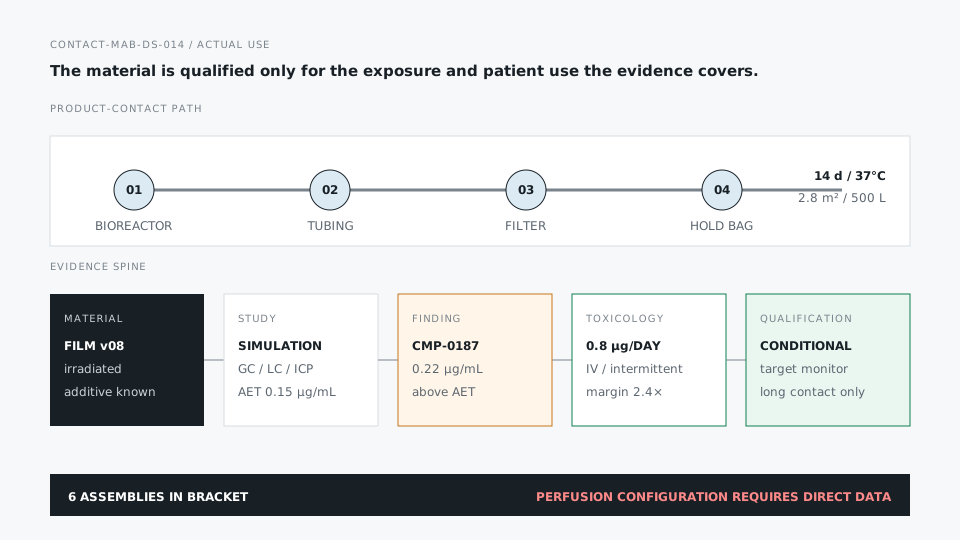
- Material knowledge, actual process contact, analytical data and toxicology usually sit in separate reports. A film extractables study is then asked to qualify a bioreactor bag it never covered, and an unidentified peak is closed because it sits below an arbitrary reporting value.
- Seal’s approach
- One evidence record runs from material and component through worst-case exposure, study sample, raw analytical signal, compound identity, analytical evaluation threshold and toxicological assessment to a qualification decision for a stated use.
- What changes
- Each qualification shows which exact uses it supports and the assumptions they depend on. When a supplier changes a formulation or a threshold is revised, where-used and bracketing identify the affected conclusions and the minimum new evidence.
- Where to start
- One difficult contact system, such as a single-use flow path and its final container closure, including a proprietary formulation and an unknown above the AET. Book a demo.
Extractables and leachables evidence breaks down when material knowledge, actual process contact, analytical data, toxicology and product lifecycle live in separate files. A film extractables report does not by itself qualify a bioreactor bag; a stopper study does not support every drug product; an unidentified peak cannot be closed because it sits below an arbitrary reporting value.
E&L work crosses engineering, suppliers, analytical laboratories, toxicology, development, stability, manufacturing, packaging, quality and regulatory, and the gaps between them are where a conclusion drifts away from the configuration it was drawn from. Seal keeps the argument connected from material and component through worst-case exposure, study sample, raw analytical signal, compound identity, toxicological assessment and qualification decision, to every use that inherits the conclusion.
1Map what touches the product, and under which conditions.
The product-contact map is the starting model: process stages, single-use assemblies, filters, tubing, connectors, gaskets, container closure, delivery device and hold containers, each with its material of construction, formulation, additives, sterilisation, supplier and part revision. It records direct and indirect contact and where each component sits in the assembly.
Exposure conditions stay quantitative. Fluid composition, pH, surfactant or protein content, temperature, duration, surface-
Material and supplier knowledge is versioned to the exact material revision: formulation disclosure, controlled additives, residual monomers, supplier extractables and change notifications. Where composition is proprietary, the record governs confidential evidence and shows what remains unknown rather than implying completeness.
1.1Why teams choose Seal for extractables and leachables
E&L conclusions usually live in study reports and toxicology memos, with the link between a study and the assemblies it is used to qualify maintained in spreadsheets. With the product-contact map, study samples, analytical signals, identities and toxicological conclusions connected, each qualification states the uses it supports. When a supplier changes a formulation or a threshold is revised, where-used and bracketing identify the affected conclusions instead of a manual search.
2Let risk set the study, and treat bracketing as a claim.
Patient route, daily dose, duration, population, contact intensity, material complexity, process stage, downstream clearance and prior knowledge set the depth of study. Manufacturing equipment, packaging, delivery systems and combination products are assessed differently within one portfolio view.
Each study starts from the conclusion it is meant to support: screening, controlled extraction, simulation, leachables, stability-
Bracketing is a scientific claim that must be justified factor by factor: formulation, supplier, geometry, surface area, contact solution, temperature, duration, sterilisation, route, dose and shelf life. Seal records the worst case for each factor and shows every use that inherits it. An excluded configuration stays visible instead of disappearing from the study matrix.
3Make every threshold reproducible.
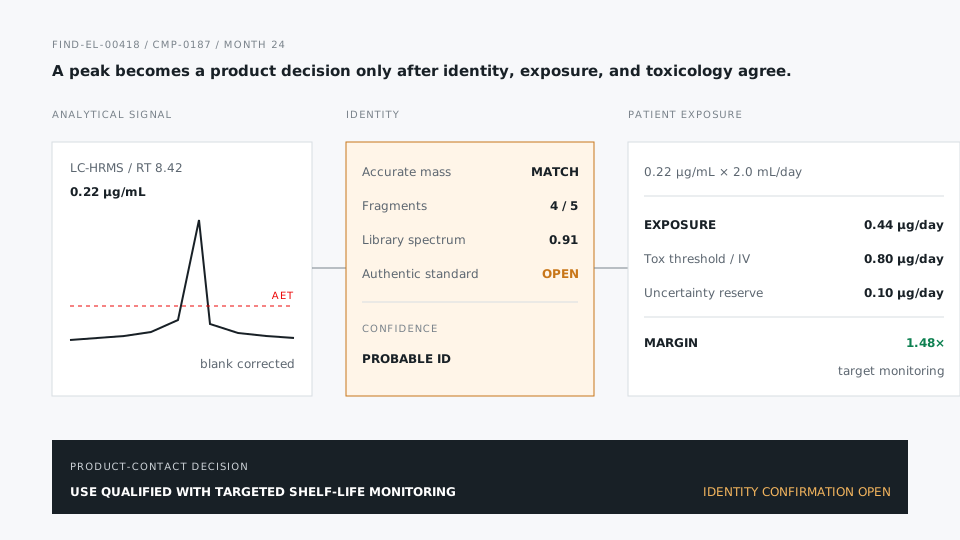
The analytical evaluation threshold (AET) is derived from a safety concern threshold, daily dose, units per day, sample preparation, dilution, extraction ratio and analytical uncertainty. Every threshold keeps its formula, inputs, units, version, rounding and approval. When the dose or presentation changes, recalculation identifies the findings and conclusions affected.
4Keep each signal and its identification confidence.
GC-MS, LC-MS, ICP-MS, headspace and other techniques keep their instrument methods, source data, calibration, blanks, system suitability, libraries, processing and audit trail. Seal connects the source files to normalised findings without pretending identification confidence is the same across techniques.
Each signal has an identification lifecycle: retention, accurate mass, fragments, spectral match, candidate identities, authentic standard, confidence category and quantitation basis evolve as the investigation proceeds. Unknowns remain findings in their own right, with mass, estimated concentration, confidence, open work and decision impact.
Compound identity resolves across studies. Synonyms, salts, isomers and identifiers map to one controlled compound record, so the same compound is not counted twice under several laboratory names, while genuine ambiguity is preserved.
5Assess toxicology against actual patient exposure.
Exposure is calculated from the measured or estimated concentration, product volume, maximum daily dose, dosing frequency, duration, leaching trend and uncertainty. Manufacturing-
The toxicological assessment is evidence, not a traffic light. Structure, genotoxicity, sensitization, route relevance, duration, population, read-across, permitted daily exposure, uncertainty factors, data gaps and assessor remain versioned. A conclusion of acceptable, monitor, identify further, reduce exposure, control by specification or unacceptable states its exact scope and assumptions.
6Qualify for a stated use, then monitor it.
A qualification decision names the contact configuration, process or package, product, presentation, site, market, conditions, maximum exposure, supporting studies, unresolved unknowns, controls, restrictions and review date. Supplier extractables can support the conclusion without becoming a blanket authorisation.
Leachables monitoring follows the stability protocol: target compounds, unknowns, batches, orientations, conditions and pull points, with trends visible. It distinguishes a transient manufacturing leachable from a compound that increases through shelf life. A new peak, an unknown above threshold or a blank contaminant opens a bounded investigation that keeps the original evidence and traces impact to materials, products, batches, stability conclusions and filings.
7Start change impact at the physical state.
A changed resin source, additive, supplier site, geometry, sterilisation dose, contact time, product formulation, dose, route, package, method, threshold or toxicological value can each affect a qualification. Where-used and bracketing identify the minimum new evidence, without assuming that every change needs a full repeat or none.
Material knowledge, compound assessments, standards, methods and qualified brackets can be reused across programmes with explicit applicability. Seal shows both the leverage and the dependency: a revised toxicological threshold or supplier formulation identifies every conclusion that reused it.
8Prove one difficult contact system end to end.
Follow one single-use flow path and final container closure through material versions, supplier disclosures, contact stages, risk assessment, controlled extraction, unknown identification, AET calculation, toxicological assessment, leachables stability, bracketing, qualification and a supplier change.
Include one proprietary formulation, an unknown above the AET, a blank contaminant, a compound with route-specific thresholds, an unbracketed long contact, a dose change and a changed film additive. The first qualification must show which exact uses are supported and every assumption they depend on.
AConnected across Seal
BCapabilities
| Capability | What it covers |
|---|---|
| Product-contact and exposure model | Map each material, component, assembly and container closure to the products and process stages it touches, with quantitative contact conditions such as surface area, volume, time, temperature and sterilisation. |
| E&L study and bracketing strategy | Start each study from the conclusion it supports. A bracketing claim is justified factor by factor, with its covered uses and exclusions stated. |
| AET and exposure calculation | Derive the analytical evaluation threshold and patient exposure from recorded inputs, such as safety threshold, dose, extraction ratio, dilution and uncertainty, so each value can be reproduced. |
| Signal-to-compound identity | Each signal keeps its source data, blanks and identification confidence as the investigation progresses. Synonyms and identifiers resolve to one compound record across studies. |
| Toxicological risk conclusion | Record the structure, hazard data, route, duration, population, thresholds, uncertainty factors and data gaps behind each toxicological conclusion, with its assessor and scope. |
| Use qualification and dependency impact | Qualify a contact configuration for a stated product, conditions and maximum exposure. Reused evidence keeps a record of the conclusions that depend on it. |
| Leachables stability monitoring | Follow target compounds and unknowns through stability batches, orientations, conditions and pull points, with trends and investigations linked. |
| Material change impact | Trace a change to composition, additive, supplier site, geometry, sterilisation, dose or threshold to each qualified use and conclusion that depends on it. |
CConnected records
DQuestions and answers
What is extractables and leachables management software?
It connects product-contact materials and their conditions of use to studies, analytical signals, compound identities, exposure calculations and toxicology. Qualification, monitoring and change impact then work from the same evidence.
What is the difference between extractables and leachables?
Extractables are compounds released under deliberate laboratory conditions. Leachables migrate into an actual drug product or process fluid during manufacture, storage or use. Seal keeps their evidence related but distinct.
Can supplier extractables reports be reused?
Yes, with an explicit comparison against your use: material revision, sterilisation, extraction conditions, surface ratio, analytical coverage, thresholds, route and dose. Differences that the report does not cover remain visible gaps.
How does Seal calculate an AET?
The approved formula keeps its safety threshold, daily dose, units, sample preparation, extraction and dilution factors and uncertainty. The result, version and reviewer are recorded, so the threshold can be reproduced.
How are unidentified peaks managed?
An unknown keeps its source signal, spectrum, retention, estimated concentration, confidence and blank assessment. Candidate identities, open work and its comparison with the threshold remain visible until it is resolved.
Can one study cover several assemblies or products?
Yes, when a factor-by-factor bracketing claim establishes coverage of material, geometry, contact, solution, pH, surface ratio, time, temperature, sterilisation, route and dose. Exclusions are stated explicitly.
How are toxicological assessments versioned?
Each conclusion keeps its compound identity, evidence, route, duration, population, threshold basis, uncertainty, data gaps, assessor and scope. A revised assessment supersedes the earlier one without erasing it.
Does Seal store chromatograms and spectra?
Seal can preserve or reference native analytical files and index the samples, methods, instruments, processing, signals and reviews connected to them.
What happens when a supplier changes a material formulation?
The change is traced through material revisions, product-contact uses, study brackets, compounds, toxicology and qualified products. The result shows which uses need bridging or requalification.
What should the first implementation prove?
Follow one single-use flow path and container closure from material disclosure through study, AET, unknown identification, exposure, toxicology and qualification. Then apply a supplier change and check its downstream impact.