Summary
- The problem
- Viral safety evidence spans source knowledge, bank testing, external clearance studies, process parameters and release. When those sit in separate reports, nobody can say quickly which claims a resin change or an equivocal result affects.
- Seal’s approach
- Each claim stays connected to the source system, virus model, scaled-down process, study run, calculation and commercial process version it rests on. Commercial batches are checked against the effective step claim.
- What changes
- A change or signal identifies the exact claims, studies, batches and products that depend on it, with explicit exclusions, instead of starting a document search.
- Where to start
- One monoclonal-antibody process from source risk through clearance claims to batch release, including a censored result and a later supplier concern. Book a demo.
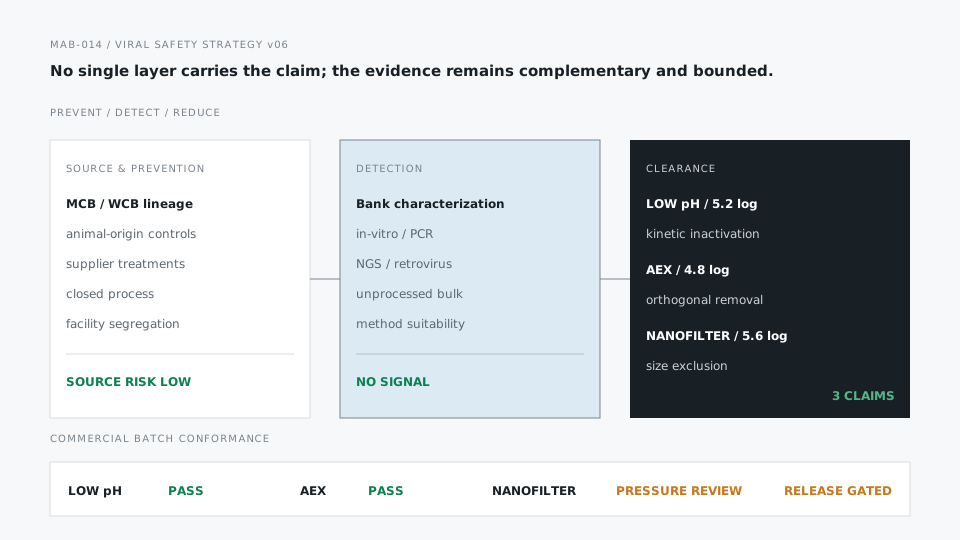
Viral safety rests on complementary controls: knowledge of raw and biological sources, testing of cell substrates and process materials, prevention and detection of adventitious agents, and validated process steps that inactivate or remove viruses.¹ The evidence spans development, specialised external laboratories, manufacturing, quality and regulatory commitments, and it usually lives in separate reports.
Seal keeps each viral safety claim connected to the source system, virus model, scaled-down process, study run, calculation, commercial process version and product decision it supports. When a resin changes or a result comes back equivocal, the team can see which claims, batches and products depend on it.
Why teams choose Seal for viral safety
The viral safety argument crosses cell-bank management, raw materials, development, viral-clearance laboratories, analytical methods, manufacturing, validation, quality and CMC, and it usually sits in study reports that are reopened only for a filing or a change. Seal connects those functions so each claim stays linked to the studies, calculations and commercial process version it rests on, and a resin change or equivocal result identifies the claims and batches it affects. The argument can be followed and maintained while the process runs, not only reconstructed. It does not replace scientific experts, biosafety controls or the regulator-agreed strategy; it keeps the evidence behind each conclusion attached to it.
1The strategy defines complementary layers.
Product, expression system, cell substrate, source materials, process, facility, open or closed operations, testing, clearance steps, hold conditions, release requirements and market commitments together form the strategy. Testing and clearance are not interchangeable. The record identifies which risk each layer addresses and what uncertainty remains.
2Source and substrate evidence stays with exact versions.
Source knowledge covers species and tissue origin, passage and adventitious-agent history, animal-origin raw materials, serum or trypsin use, supplier controls and treatments. It stays attached to the exact cell bank, viral seed, material and supplier version.²
Cell-substrate testing is staged. Master and working banks, cells at the limit of in-vitro age, production cells and unprocessed bulk receive their own identity, sterility, mycoplasma, virus and retrovirus testing. Sample provenance, passage, method suitability, invalid results and bank authorisation remain connected.
Each adventitious-agent method, whether a cell-culture indicator assay, PCR panel, reverse-
3Clearance models must justify themselves.
Each clearance step, whether low-pH inactivation, solvent or detergent, chromatography, nanofiltration or another operation, is a process object with its mechanism, operating parameters, load composition, capacity, equipment and commercial version. The record distinguishes dedicated clearance steps from steps that contribute incidental removal.
Virus models keep their family, genome, envelope, size, resistance, stock origin, titre and the rationale for their selection, so the panel shows how it challenges each mechanism and represents known or potential contaminants. Scaled-down models compare geometry, resin or membrane, bed height, residence time, load, buffer conditions, flow and pressure against manufacturing. Each difference is justified individually; a model is not accepted merely because it uses a smaller column.
4Study runs preserve material balance and uncertainty.
The protocol follows from the claims the study must support. Kinetics, capacity, robust removal or orthogonality determine the virus panel, worst-case conditions, spike level, sample points, controls, cytotoxicity checks, replicates and acceptance criteria.
Virus stocks and assays remain qualified evidence, with stock identity, passage, titre, storage, assay controls, limit of detection and run validity attributable. Contract-laboratory reports are broken down far enough to reproduce the claim, while the source files and controlled reports are preserved.
Spiking runs reconcile process material, spike amount, dilution, volumes, titres, fractions, hold times, recoveries and losses. Unexplained loss before the challenged step cannot be credited as clearance. Log-reduction calculations keep their input and output titres, volumes, detection limits, handling of non-detects, confidence intervals and reviewer, and individual run results remain distinct from the accepted step claim. Inactivation kinetics and removal capacity answer different questions, so Seal keeps the mechanism-specific evidence rather than presenting every step as one number.
5Step claims are bounded, and totals need a rationale.
A step claim names the virus or virus class, process step and version, operating range, model, accepted runs, reduction factor, uncertainty, limitations, lifecycle conditions and approver. Applying a platform claim to another product requires comparable feedstream and step conditions, and the exclusions stay explicit.
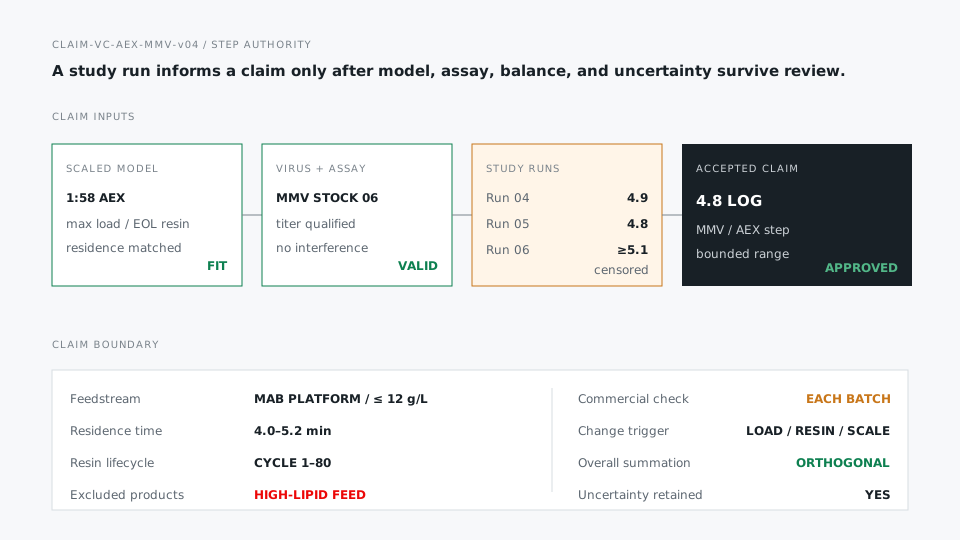
The overall reduction argument considers mechanism, orthogonality, independence, assay limitations and overlapping effects before step claims are combined. The record shows both the calculated total and the scientific rationale for which claims can be summed.¹
6Commercial batches resolve against the effective claim.
The clearance study is not repeated for each batch. Instead, each batch shows that every validated step operated within its supported state: resin or membrane lot and cycle, actual pH, temperature, time, flow, pressure and load, alarms, interventions, samples and deviations. A step that falls outside its claim boundary, such as a filter pressure excursion, holds the dependent release decision until it has been assessed.
7Signals and changes reassess every dependent claim.
A positive or equivocal adventitious-agent result, control failure, atypical cytopathic effect, raw-material concern or post-study stock issue opens an investigation. The impact traverses source materials, banks, cultures, intermediates, batches, studies, claims, released products and markets, with explicit exclusions.
A change to the cell substrate, a raw material, the process sequence, pH, time, resin, reuse, load, filter area, scale, site, assay or virus stock identifies the bridging or repeat work it requires. Seal separates a change to commercial execution from a change to the scientific model or assay, because they call for different evidence.
8Prove one difficult process end to end.
Follow one monoclonal-antibody process through source and bank risk, unprocessed-bulk testing, virus panel rationale, low-pH inactivation and nanofiltration models, study runs, a censored result, step claims, combined clearance, commercial parameter evidence, a resin change and batch release.
Include assay interference, incomplete spike recovery, an invalid control, kinetic tailing, a filter pressure excursion, a platform claim exclusion and a later supplier concern. The system is ready when it shows which scientific and commercial conclusions remain supported after each one.
References
- 1ICH Q5A(R2), Viral Safety Evaluation of Biotechnology Products Derived from Cell Lines of Human or Animal Origin (2023). ICH
- 2EudraLex Volume 4, Annex 2, Manufacture of Biological active substances and Medicinal Products for Human Use (2018). European Commission
AConnected across Seal
BCapabilities
| Capability | What it covers |
|---|---|
| Viral safety strategy and source risk | The strategy connects the cell substrate, species and donor sources, animal-origin materials and supplier controls to prevention, testing, clearance steps and commercial controls, with residual uncertainty stated. |
| Adventitious-agent evidence | Cell bank, limit-of-age, control-cell and unprocessed-bulk samples are linked to the methods that tested them, with controls, source data, validity and interpretation. |
| Virus stock and assay authority | Model-virus relevance, stock source, passage, titre, characterisation and aliquot use are recorded with the assay’s cells, reagents, sensitivity, interference, controls and calculations. |
| Scaled-down clearance study | Differences between the commercial step and the scaled-down model are documented and approved, and each spiking run keeps its conditions, fractions, samples, recoveries and material balance. |
| Step and overall clearance claim | Run calculations, detection limits, censoring and uncertainty resolve into bounded claims for each virus and step. Mechanism, orthogonality and independence determine whether reductions can be combined. |
| Commercial-state and change impact | Each batch’s actual parameters, materials, equipment, resin or membrane state and deviations are compared with the effective claims. A process, source, model, assay or supplier change identifies the evidence it affects. |
| Positive-signal lineage impact | A positive, equivocal or invalid signal is traced through source materials, banks, cultures, harvests, batches, facilities and released products, with evidence paths and exclusions recorded. |
| Regulatory viral safety dossier | Source characterisation, testing strategy, method suitability, clearance studies, claims, process controls and commitments stay linked to the products, applications and commercial versions they support. |
CConnected records
DQuestions and answers
What is viral safety management software for biologics?
It connects source and cell-substrate risk, adventitious-agent testing, model viruses and stocks, and scaled-down clearance studies. It also holds LRV calculations and claims, and links them to commercial execution, changes and product impact.
Does viral testing replace clearance validation?
No. Source controls, testing and validated inactivation or removal are complementary layers with different roles in detecting and reducing risk. Seal keeps each layer and the residual uncertainty explicit.
How are adventitious-agent methods represented?
Each method records its intended target range, sample stage, indicator system or technology, controls, sensitivity, matrix interference, known blind spots and validation. Results keep the effective method version, source data and interpretation.
Can Seal manage outsourced viral clearance studies?
Yes. The sponsor’s strategy and process versions link to the external laboratory’s protocols, models, virus stocks, assays, runs, calculations, deviations and reports. Questions, approvals and the resulting claims are recorded against them.
How is a scaled-down model qualified?
Commercial and model geometry, equipment, resin or membrane, feedstream, load, residence time, pH, temperature, flow, pressure and reuse state are compared. Documented differences are assessed and the model is approved before use.
How are below-detection titres handled?
Detection limits, assay replicates, censoring convention, confidence, cytotoxicity or interference and volume corrections are explicit in each calculation. The original data and uncertainty stay with the resulting claim.
Can log-reduction values simply be added?
Only as the approved scientific rationale allows. Mechanism, orthogonality, independence, overlapping effects, assay limitations and claim scope determine which step reductions contribute to an overall argument.
How does commercial manufacturing use clearance studies?
Actual batch parameters, materials, equipment and lifecycle state are checked against the effective step claim. Deviations or changes identify the exact claim and evidence requiring assessment.
What happens after a positive adventitious-agent signal?
The investigation keeps the original signal and examines method controls and sample provenance. It then traces materials, banks, cultures, process lots, facilities, related samples and released products, with each exclusion bounded and justified.
What should the first implementation prove?
Take one product from source and bank testing through model-virus rationale, scaled-down studies, calculations and claims to commercial conformance. Include an ambiguous signal and a process change, and show the impact assessment and release decision.