Summary
- The problem
- Responsibilities agreed with a CDMO, laboratory or supplier sit in a signed PDF, and teams interpret them from memory while notification and investigation clocks run.
- Seal’s approach
- Each responsibility becomes a structured obligation resolved against the products, batches, samples, changes and events it governs, with its performer, approver, evidence and clock.
- What changes
- The live case shows which party must act and by when, revisions assign open work to old or new terms, and periodic review compares the agreement with actual practice.
- Where to start
- One outsourced batch followed end to end through every agreed clock and handoff. Book a demo.
1A quality agreement governs the work after signature.
A quality agreement sets the operating boundary between the parties: who performs, reviews, approves, notifies, investigates, supplies records, releases, retains, audits and escalates each regulated activity. Its value lies in how the work runs after signature, which a signed PDF in a contract repository cannot show.
Seal turns those responsibilities into obligations connected to actual products, sites, batches, samples, changes, deviations and decisions, so both parties can show that the agreed operating model is the one in use.
FDA’s quality agreements guidance for contract drug manufacturing is the primary US reference for defining and documenting each party’s manufacturing activities while preserving each party’s CGMP responsibilities. The owner’s quality unit remains responsible for approving or rejecting product made under contract.¹
2Structure responsibilities instead of burying them in prose.
Scope starts with the legal entities, sites, quality units, authorised contacts, products, markets, subcontractors and effective dates. Each regulated service (manufacturing, testing, release, storage, transport or complaint handling, for example) can be included independently. Commercial terms stay outside the quality workflow unless they create a regulated obligation.
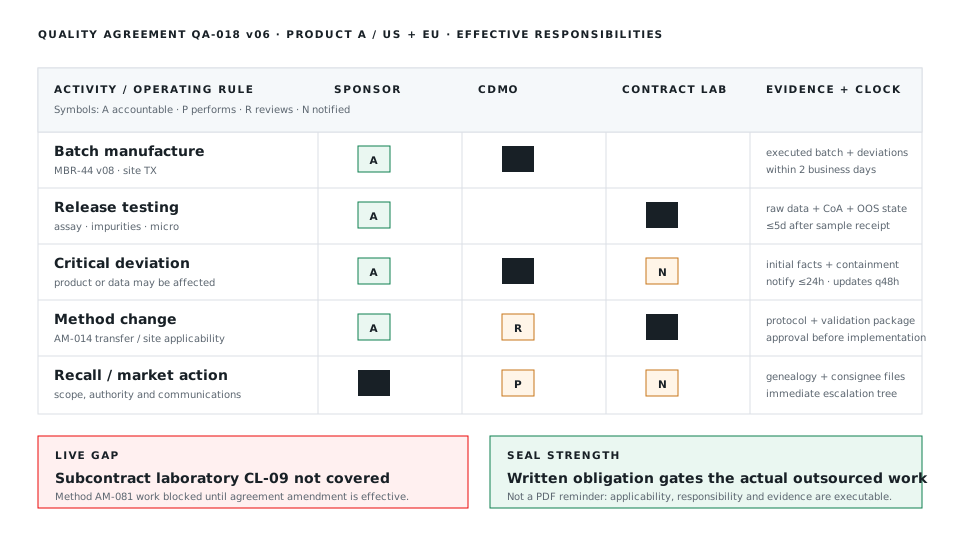
Each activity then names the accountable party, performer, reviewer, approver, parties to notify, evidence provider, timing, governing procedure and escalation. The controlled narrative is generated from those obligations, so overlaps and unassigned activities are visible before approval. Applicability rules show which obligation governs each batch or sample when one relationship covers several products, methods and sites. A corporate template can supply defaults without treating an aseptic CDMO, a microbiology laboratory and a warehouse as if they needed the same controls.
2.1Why teams choose Seal for quality agreements
A contract repository stores the signed PDF, and the teams on both sides interpret it from memory while notification and investigation clocks run. Seal resolves each obligation against the batches, samples, changes and events it governs, so the agreement routes work and shows whether each promised control happened on time, with the right evidence and the accountable party. When the agreement is revised, open work is assigned to the old or new terms explicitly, rather than left to whoever remembers the change.
| Agreement stored as a document | Seal | |
|---|---|---|
| Responsibilities | Clauses in prose, interpreted when needed | Structured obligations by activity, party and product |
| During an event | Someone searches the PDF while the clock runs | The live case shows the applicable obligation and its clock |
| Revisions | A new signed version | Obligation-level differences with open work assigned to old or new terms |
| Periodic review | A reread of the document | Written responsibilities compared with actual practice |
3Keep procedures, records and data exchange explicit.
The agreement identifies whose procedure governs, how differences are reconciled, who authors and approves each record, which system is authoritative, and how certified copies, retention and inspection support work. System access does not transfer accountability: each party keeps the signatures and decisions assigned to it.
conditional
ready
complete
client ack
released
instrument · source data
instrument · source data
instrument · source data
instrument · source data
instrument · source data
Data exchange has content and timing requirements. Batch records, raw data, audit trails, certificates, stability data and investigations can each have a required format, completeness, transfer method and deadline. Receipt and acceptance are separate states, and missing metadata or an unreadable native file remains an open obligation.
4Make notifications and investigations follow the agreed rules.
A change to a process, material, method, specification, equipment, site or subcontractor can require pre-approval, prior notification, prompt notification or periodic reporting. Seal resolves the applicable obligation, required information, recipients, due clock and implementation conditions.
For deviations and OOS results, the agreement sets notification thresholds and timelines, containment, who leads the investigation, data access, retest authorisation, product impact, CAPA and report approval. Complaints, recalls and safety signals resolve to named parties and clocks in the same way. The live case shows what the agreement requires for this product and service, and each event keeps the obligation version in effect when it occurred, even if the agreement is later revised.
5Separate manufacture, certification and release.
Manufacturing review, testing, deviation closure, CoA issue, disposition recommendation, certification by a qualified or authorised person, sponsor release and shipment authorisation can belong to different parties.² Each decision keeps its prerequisite evidence, authority, signature, conditions and handoff. Hosting the system does not let one party approve a step assigned to another.
6Oversee subcontractors, audits and performance against the promised controls.
Approved subcontractors keep their service, site, qualification, sponsor consent, agreement, oversight and audit rights. Delegation by one party does not remove the original party’s responsibility, and a subcontractor change identifies the products, methods, records and commitments it affects.³
Audit scope, observations, responses and CAPA connect to the services and obligations assessed. Repeated findings can reveal an obligation that is poorly defined, or a control that is not working across several products. Performance measures, such as notification timeliness, on-time records, investigation cycle time and data completeness, use defined denominators and stay linked to actual cases. A poor score opens the evidence rather than ending the conversation.
7Revise, review and terminate with the operations in view.
A proposed revision shows obligation-level differences and the affected products, records, systems, procedures, training, contacts and open events. Both parties review and approve the same change. Open batches, samples, investigations and changes are explicitly assigned to the old or new terms; signature alone does not make an agreement operational.
Periodic review compares the written responsibilities with actual practice: deviations, changes, release performance, data exchange, audits and open commitments. Differences become actions, agreement changes, training, system changes or service restrictions. At termination, final batches, retained samples, stability, complaints, records and regulatory commitments receive an explicit disposition. Ending the commercial service does not close the quality obligations that survive it.
Each organisation can keep its own QMS, LIMS, MES, DMS and identity system. Seal supports controlled exchange, client-specific visibility, verified copies, source links and decision handoffs. Where both parties use Seal, tenant and permission boundaries keep them separate while shared records expose only the agreed evidence and actions.
8Prove one outsourced batch end to end.
Start with one sponsor product and follow it through material sourcing, contract manufacture, external testing, a deviation, a change notification, record transfer, CoA, sponsor disposition, shipment and periodic review.
Include the difficult cases: a late notification, missing raw-data metadata, a disputed investigation conclusion, retest authorisation, a subcontracted assay and an agreement revision. The first release should route the batch through every agreed clock and handoff, surface any uncovered subcontractor before work begins and leave no decision dependent on remembering who is responsible.
References
- 121 CFR 211.22, Responsibilities of quality control unit: a quality control unit must have the responsibility and authority to approve or reject components, in-process materials, packaging, labelling and drug products, and to review production records. eCFR
- 2EudraLex Volume 4, Annex 16, Certification by a Qualified Person and Batch Release (2015), sections 1 (the process of certification) and 3 (handling of unexpected deviations). European Commission
- 3EudraLex Volume 4, Part I, Chapter 7, Outsourced Activities (2013). European Commission
AConnected across Seal
BCapabilities
| Capability | What it covers |
|---|---|
| Structured responsibility matrix | Accountable, performing, reviewing, approving, consulted, notified, evidence-owning, timing and escalation duties become governed obligations. |
| Product and service applicability | Products, sites, methods, markets, services, lifecycle stages and subcontractors resolve the correct obligations for actual work. |
| Change notification control | Triggers, required content, recipients, deadlines, questions, assessments, approvals, implementation conditions and acknowledgements remain enforceable. |
| Shared event governance | Deviation, OOS, complaint, recall, CAPA and audit cases use agreed thresholds, decision rights, evidence access, clocks and approvals. |
| Record exchange completeness | Required records, native data, metadata, format, source, timing, transfer, receipt, review, exceptions and acceptance remain visible. |
| Delegated release decisions | Manufacturing review, certification, testing, CoA, sponsor disposition, market release and shipment authority retain separate prerequisites and signatures. |
| Relationship performance | Timeliness, right-first-time, events, investigation quality, data completeness, release, complaints, audits and CAPA use linked evidence and denominators. |
| Living agreement review | Written obligations reconcile with actual practice, current contacts, subcontractors, systems, performance, events, regulations and surviving duties. |
CConnected records
DQuestions and answers
What is pharmaceutical quality agreement software?
It turns cross-company GMP responsibilities into governed obligations connected to real products, services, records, changes, events, decisions, performance and periodic review.
How is this different from contract management?
Contract tools manage legal and commercial documents. Seal manages operational quality responsibilities, applicability, notification clocks, evidence, decision rights, regulated records and proof of performance.
Can Seal create a responsibility matrix?
Yes. Each activity can identify accountable, performing, reviewing, approving, consulted, notified, evidence-owning, timing, procedure and escalation responsibilities by product and service.
Can different products use different obligations?
Yes. Product, site, market, method, service, lifecycle stage and effective dates resolve which agreement clauses and responsibilities apply to each actual batch, sample or event.
How are changes notified between parties?
Change classes trigger the correct obligation, content, recipient, due clock, questions, impact assessment, pre-approval or acknowledgement, implementation conditions and final effective state.
How are OOS investigations handled?
The agreement defines notification, investigation lead, raw-data access, hypothesis and retest authorisation, review rights, product impact, report approval, CAPA and closure for the applicable service.
Can Seal support separate sponsor and CDMO systems?
Yes. Source systems can remain authoritative while Seal controls obligations, exchange packages, verified copies, acknowledgements, shared actions, decision handoffs and client-specific visibility.
How are subcontractors managed?
Subcontractor service, site, qualification, consent, agreement, information flow, oversight, audits, changes, records and termination remain connected through the delegation chain.
Can quality agreements govern batch release?
Yes. Manufacturing review, testing, certification, CoA, sponsor disposition, market release and shipment authorisation can each retain assigned authority and prerequisites.
How are agreement revisions implemented?
Obligation-level differences identify products, services, systems, procedures, training, contacts, open work, and transition tasks. Both parties approve before effective use.
What belongs in periodic review?
Scope, contacts, licences, subcontractors, obligations, actual practice, notifications, events, release, data exchange, audits, CAPA, complaints, recalls, metrics, regulations and open commitments.
What should the first implementation prove?
Trace one outsourced batch through manufacture, external testing, deviation, change notification, record exchange, delegated release, shipment, complaint, performance review and agreement revision.