Summary
- The problem
- A CAPA is closed when the procedure is revised, the work order completed and people trained. Those records show the action was implemented, not that the outcome improved under comparable conditions.
- Seal’s approach
- Instead of closing a CAPA when the procedure is revised, the source deviation, investigation, actions, controlled change and follow-up evidence share one record. The effectiveness review keeps its baseline, population, exposure and follow-up window, so a quieter period is not mistaken for a successful correction.
- What changes
- Closure can be configured to require the approved effectiveness review, and a failed or inconclusive check follows a reassessment path that preserves the earlier decision.
- Where to start
- One recurring failure mode with a CAPA already in progress: define the comparison, then review the outcome against it. Book a demo.
1Keep the action and its effect in the same investigation.
A procedure was changed. The work order is complete. The people involved have been trained. Those are implementation records; the effectiveness review asks a different question: did the intended outcome improve under comparable conditions?¹
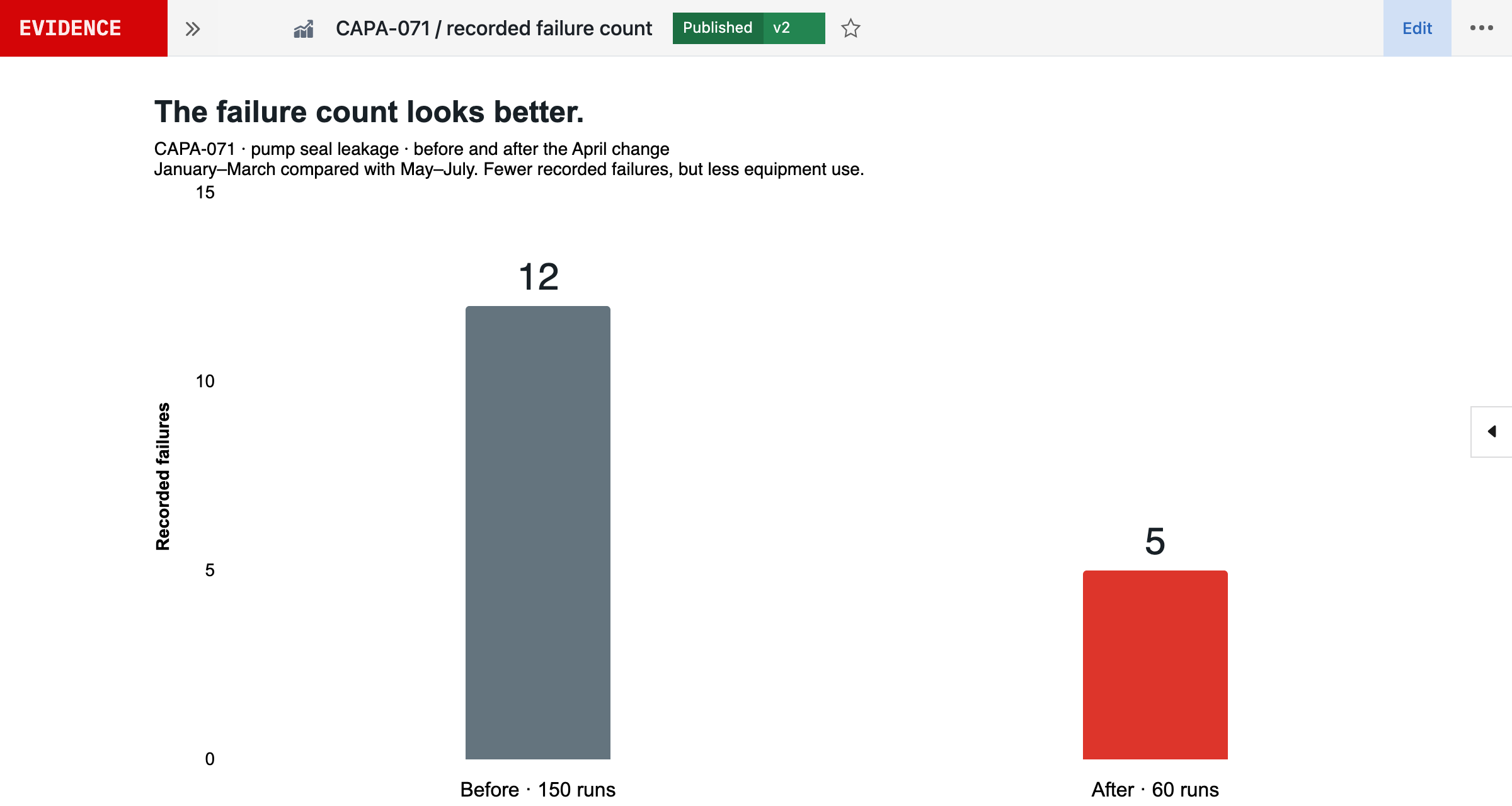
Seal connects the source deviation, investigation, action, controlled change and follow-up evidence. Open the CAPA to inspect the work performed; follow its source records to challenge the conclusion. Figure 1 keeps both the failure count and the equipment-use population, so a quieter production period is not mistaken for a successful correction.
1.1Why teams choose Seal for CAPA
A traditional CAPA ends in the QMS as a revised procedure, a training task and a closed record, while the process it was meant to correct runs unchanged in another system. Seal lets the corrective action be a controlled change to the workflow itself, and the effectiveness review reads the same execution records the failure came from. Neil can look for recurrence across those records; your team decides whether the change worked.
2Define the comparison before reviewing the outcome.
Record the failure classification, asset or product population, baseline, intervention date, follow-up window and measure of exposure. Retain the inclusion and exclusion rules. Decide how much observation is needed and what result would satisfy the review, with the rationale and required authority.
CAPA-071 compares January–March with May–July, excluding the April intervention. The saved charts use six linked period records. They show a descriptive comparison, not a statistical conclusion: event classification, population changes and uncertainty still need assessment. A missing run count is missing evidence—not zero exposure and not a zero failure rate.
3Investigate competing explanations.
The same symptom can follow a different mechanism. Keep observations separate from hypotheses, and connect each proposed explanation to supporting evidence, contrary evidence and the work that would distinguish it. Equipment configuration, replacement-part lots, service history, operating conditions and personnel scope may all matter.
Neil can investigate the permitted record population, compare related events and prepare linked evidence requests. Ask it to expose the assumptions behind the comparison and propose the next measurements. An investigator reviews the explanation; a pattern alone is not a root-cause determination.
4Turn the investigation into controlled work.
Each action retains its owner, due date, dependency, required completion evidence and relationship to the finding. A procedure revision, equipment modification and training assignment can be different pieces of the same response. Configure reminders and escalation around the agreed workflow, retaining reasons and approvals for changed commitments.
Bring the source procedure to Neil. It can author proposed changes to the plan, capture fields and review states, then prepare verification cases. That includes a missing exposure count, a recurrence after implementation and an attempted closure with outstanding evidence. Your team tests and publishes the change through its authorised process.
5Review effectiveness without rewriting the history.
Retain the implemented version, original baseline, actual follow-up population, analysis and reviewer conclusion. If the outcome is not demonstrated, record why and define the further work. A configured reassessment or reopening path should preserve the earlier decision, not erase it.
The review record should let a colleague reconstruct what changed, which records were compared, what remains uncertain and why the CAPA was closed or continued.² It should not require rebuilding that history from separate action trackers and spreadsheets.
Explore deviations and investigations, change control and equipment.
References
AConnected across Seal
BCapabilities
| Capability | What it covers |
|---|---|
| Linked to source | Each CAPA links to the deviation, audit finding or complaint that prompted it, so the source context stays with the action. |
| Root cause tools | Structure 5-Why, Fishbone and Is/Is-Not assessments with evidence, competing explanations and tests that could distinguish them. |
| Action tracking | Record the owner, due date and required evidence. Configure escalation paths for overdue actions. |
| Effectiveness before closure | Configure the required effectiveness review before closure, including criteria, exposure, observation window and supporting evidence. |
| Reassessment after failure | Configure failed or inconclusive checks to reopen assessment. Review implementation, exposure, measurement and the original explanation. |
| Trend analysis | Compare recurrence with its exposure and source population. A lower event count need not mean a lower failure rate. |
| Escalation workflows | Configure escalation paths for overdue CAPAs, such as owner, then manager, then QA leadership, so overdue work stays visible. |
| CAPA history | Keep a CAPA’s source, investigation, actions, effectiveness review and closure in one record, from initiation to verified closure. |
| AI root cause suggestions | Ask Neil to compare similar CAPAs and deviations and propose candidate explanations with their supporting evidence. Investigators test them before concluding a cause. |
| Neil effectiveness analysis | Ask Neil to compare historical actions and recurrence with their exposure, flag comparability gaps and prepare an effectiveness assessment for review. |
CConnected records
DQuestions and answers
How do you ensure effectiveness verification actually happens?
Configure closure to require the approved effectiveness review, not merely an attachment. Define the criteria, source population, exposure and observation window up front. Verify the workflow with missing, failed and inconclusive evidence before using it.
What if the effectiveness verification fails?
Use a configured path to reassess the action and its evidence. A failed check does not by itself prove the original cause was wrong: incomplete implementation, changed exposure or measurement differences may matter. Retain the original assessment and record the next authorised work.
Can we link multiple source events to one CAPA?
Yes. Where the investigation shows that several deviations share a common cause, they can be linked to a single CAPA. Similar categories alone do not establish that; link the evidence for the shared cause before combining the events.
How do you prevent CAPA overload?
Dashboards show CAPA workload by owner and team, so managers can see who is overloaded and redistribute work. Trend analysis can point to possible systemic issues for investigation.
What about preventive actions vs. corrective actions?
Both are supported. Corrective actions address problems that have occurred; preventive actions address potential problems identified through risk assessment, trend analysis or proactive review. The workflow is similar, but the triggering event differs.
How do you track external CAPAs from suppliers or contract manufacturers?
External CAPAs can be recorded with visibility controls that show status and evidence without exposing internal details. They link to your supplier quality records and incoming inspection results.
Can we customise the CAPA workflow?
Yes. Define your own phases, approval requirements and escalation rules, and give different CAPA types different workflows. A simple correction may need less rigour than a systemic corrective action.
How does this integrate with audit management?
An audit finding can open a CAPA directly and stays linked to it. You can track the response status across all findings and show which findings are addressed and which CAPAs have been verified as effective.
How do you identify systemic CAPAs?
Compare related events, assets, parts and operating conditions across the permitted records. Shared categories are a starting point for investigation, not proof of a common cause. Link the evidence and testable explanations before extending an action to a wider population.
What metrics show the health of a CAPA programme?
Useful measures include closure and overdue rates, time-to-close distributions, effectiveness outcomes and recurrence rates. Recurrence should be read with its exposure: fewer repeat events can reflect less use rather than a better control. Reviewers interpret the trend in context.