

A date from the plant, not the lead time.

Neil reads each customer’s ask and works out when the plant can ship: material first, then hours on the line. Customer service sends the reply.

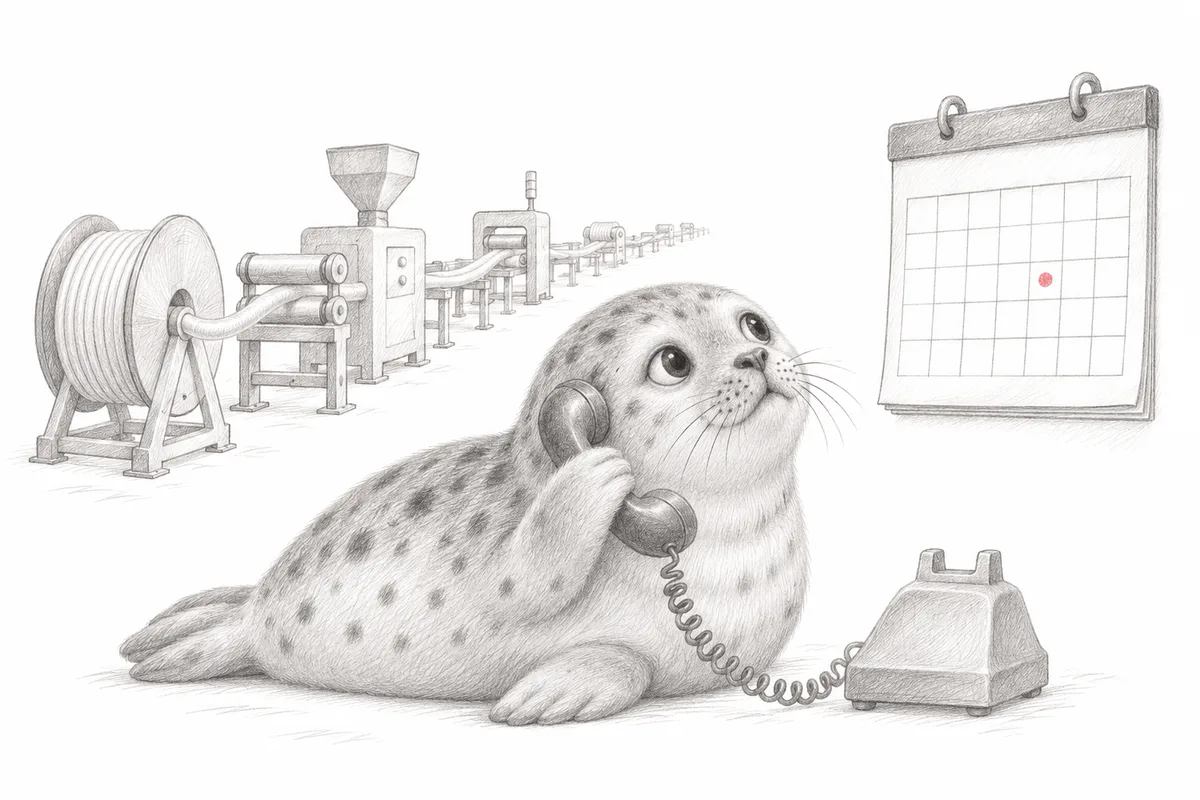
  1. Pencil drawing: a seal on an old telephone looks up at a wall calendar with one red dot, while a production line of tubing runs into the distance behind it.

    Can you do 12,000 more?

    The ERP says yes by 15 November: today plus a lead time. It doesn’t know what’s in the building.

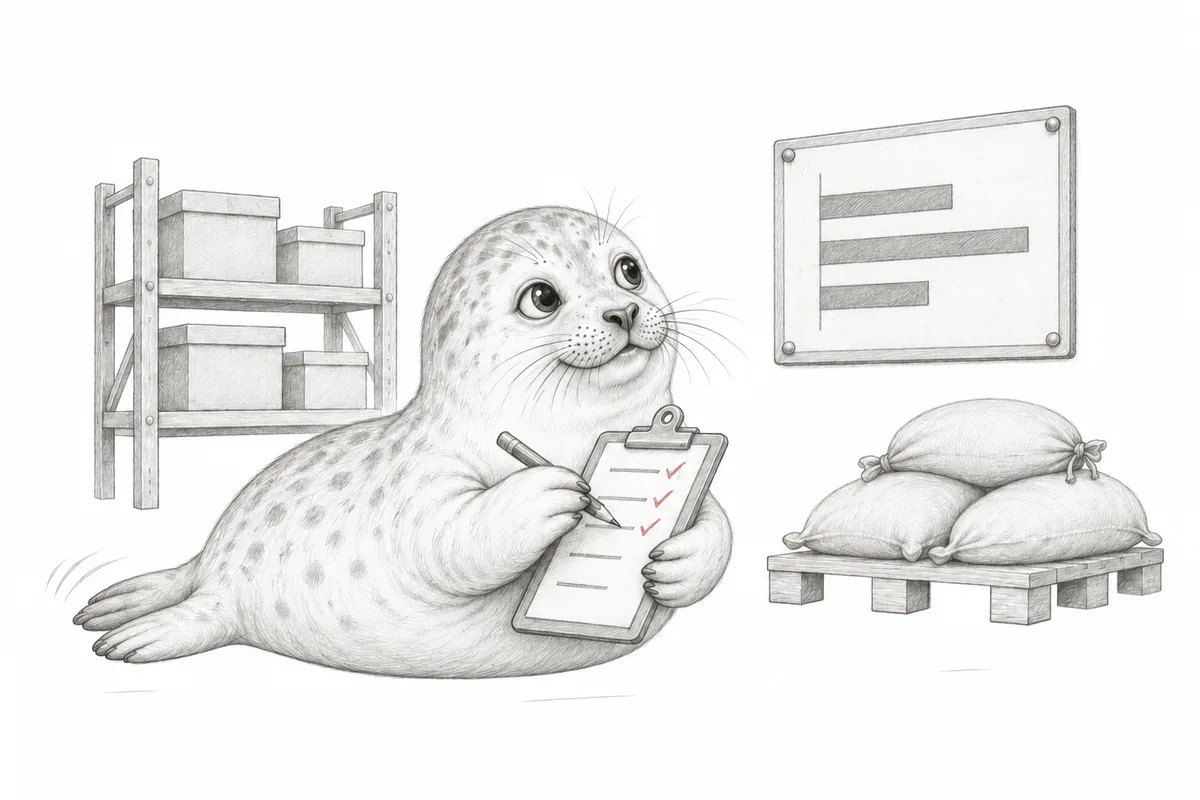
  2. Pencil drawing: a seal with a clipboard looks over a shelf of boxes, a planning board and a pallet of sacks, making red ticks.

    Neil checks the plant.

    Material first, through to when an order placed today could arrive, then free hours on the line, week by week.

  3. Pencil drawing: a seal at a wall calendar draws a red arrow from one day to a later one and circles it.

    It finds a date you can keep.

    The first week the run fits, what holds it there and the day it can ship.

  4. Pencil drawing: a seal smiles as it closes a laptop while through the window another seal reads a letter and nods, a small red envelope between them.

    Customer service answers.

    Neil drafts the reply, including the correction to a date already given. Customer service sends it.

What the lead time doesn’t know.

The ERP’s date is arithmetic. These are the asks where the plant disagrees.

  • ERP says
    15 November
    Plant can ship
    8 February

    Material that isn’t there.

    PEBA 72D has to be ordered first.

  • Customer told
    17 November
    Plant can ship
    30 November

    A yes already sent.

    Given on the ERP’s lead time. The liner only docks on 17 November.

  • Run needs
    56.1 h
    Free next week
    23.0 h

    A full line.

    Asked for 13 November. It can ship 23 November.

  • Asked by
    20 November
    Plant can ship
    16 November

    A real yes.

    30,000 ft: in stock, with hours free.

Every ask, answered from the plant.

Real Seal screens from a full test run: Acme Medical’s customer service mailbox, stock and schedule, as of 06:00 on 5 November 2026.

  1. 1

    The ERP’s date beside the plant’s.

    Every ask in the customer service mailbox, worked through stock, open orders and free hours on the line.

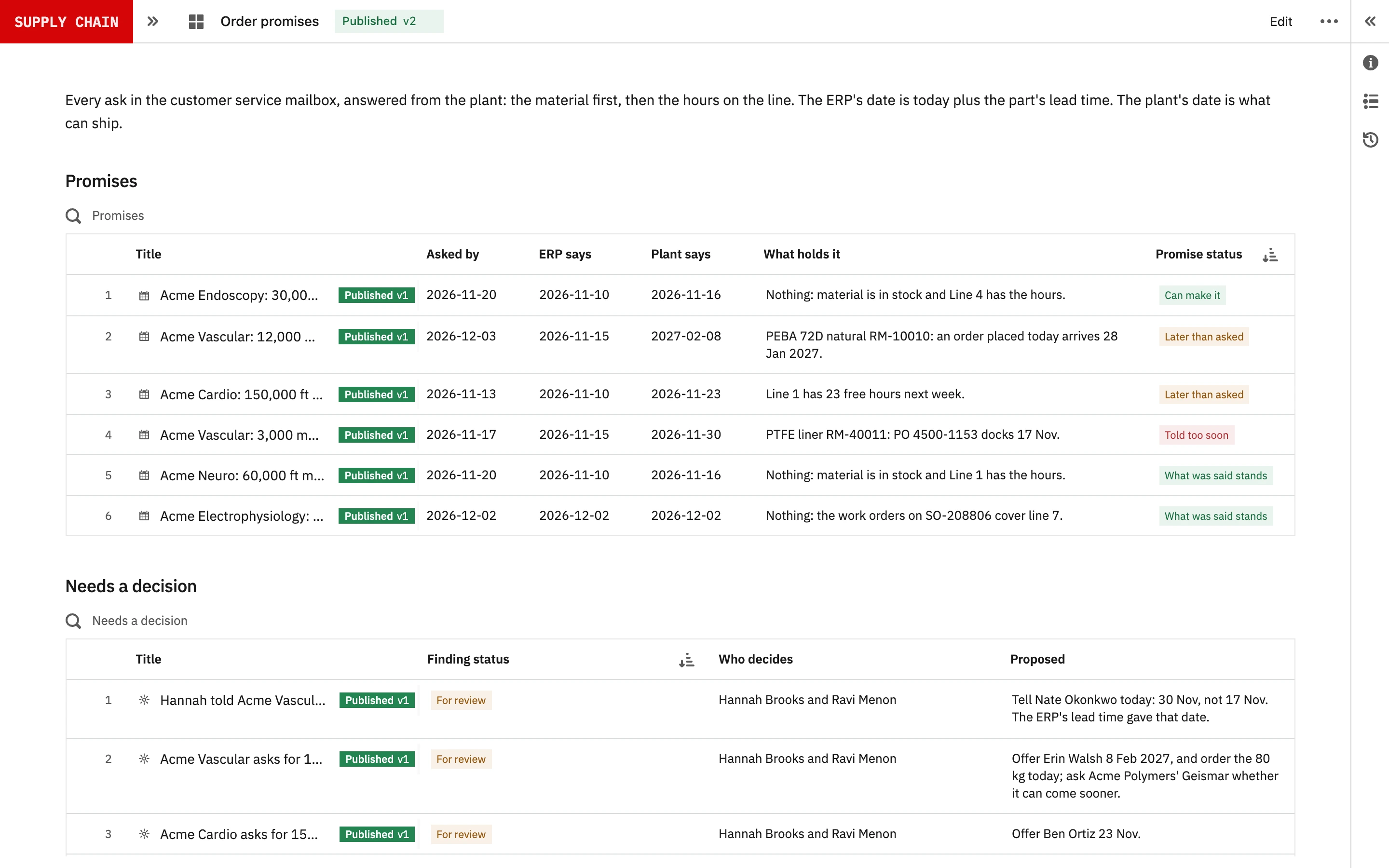
    The order promises board in Seal: six customer asks, each with the date asked for, the ERP’s date, the plant’s date, what holds it and a status, above the findings that need a decision.
    1. Three datesAM-S-2210: asked for 3 December, 15 November by the ERP, 8 February from the plant.
    2. What holds itThe material or the line, in a sentence. Or nothing, when it can ship.
    3. Where each standsOne told too soon, two later than asked, one that can make it, two that stand.
  2. 2

    A yes already sent.

    17 November went to the customer on the ERP’s lead time. The liner the run needs docks that day.

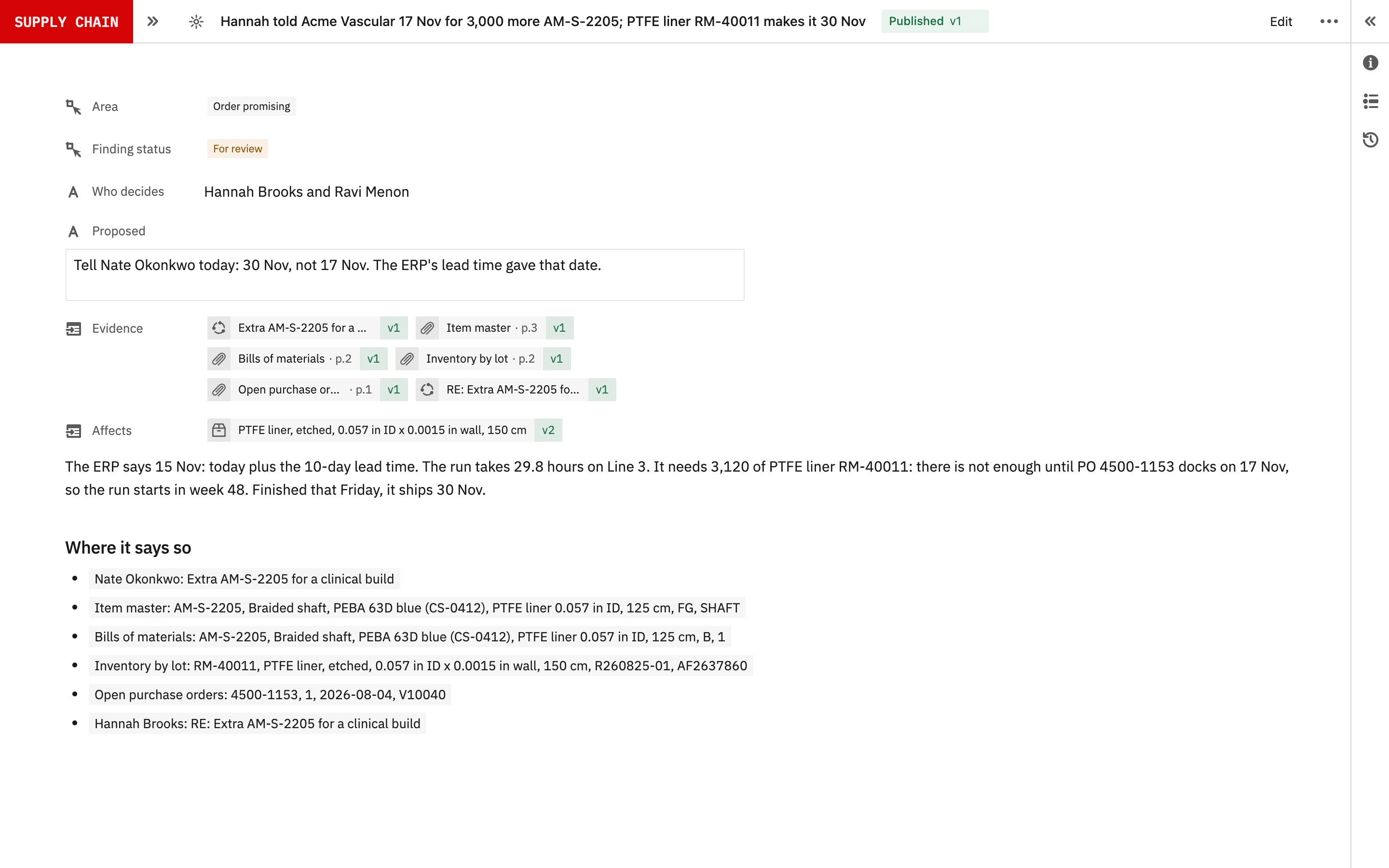
    Neil’s finding in Seal that Hannah Brooks told Acme Vascular 17 November for 3,000 more AM-S-2205: who decides, the proposal, the evidence and the working to 30 November.
    1. What Neil proposesTell Nate Okonkwo today: 30 November, not 17.
    2. The workingNot enough liner until the PO docks, so the run starts in week 48 and ships 30 November.
    3. Both emailsThe ask and Hannah Brooks’s reply, beside the item master, bill of materials, stock and PO.
  3. 3

    Material that isn’t there.

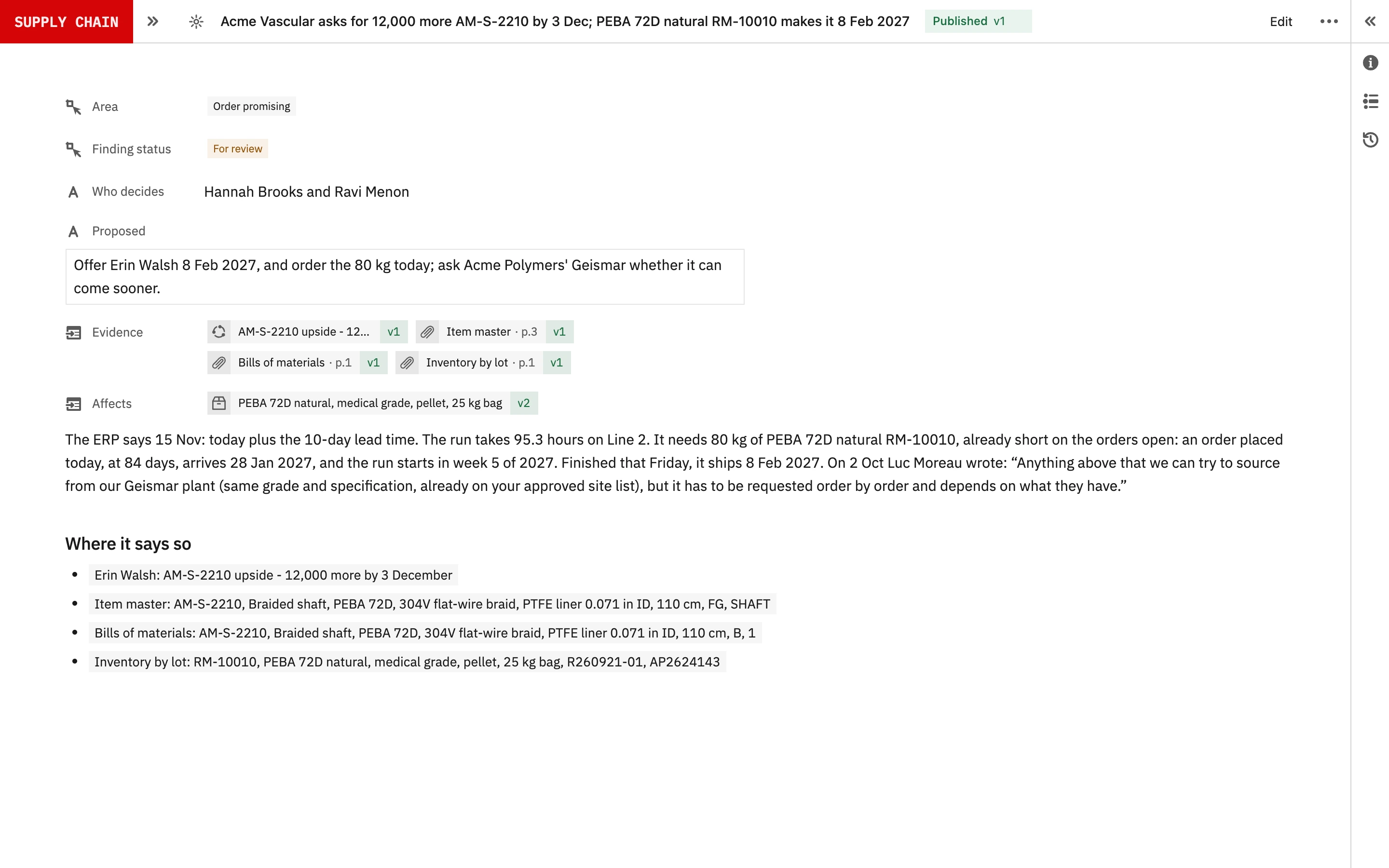
    The ERP says 15 November. PEBA 72D has to be ordered, at 84 days, so the plant says 8 February.

    Neil’s finding in Seal that Acme Vascular asks for 12,000 more AM-S-2210 by 3 December and PEBA 72D makes it 8 February 2027, with the proposal, the evidence and the working.
    1. The working95.3 hours on Line 2, and 80 kg already short. An order today arrives 28 January.
    2. What Neil proposesOffer 8 February, order the 80 kg today, and ask Geismar whether it can come sooner.
  4. 4

    The correction, drafted.

    The new date, the reason and a question about the build. Hannah Brooks edits it and sends it.

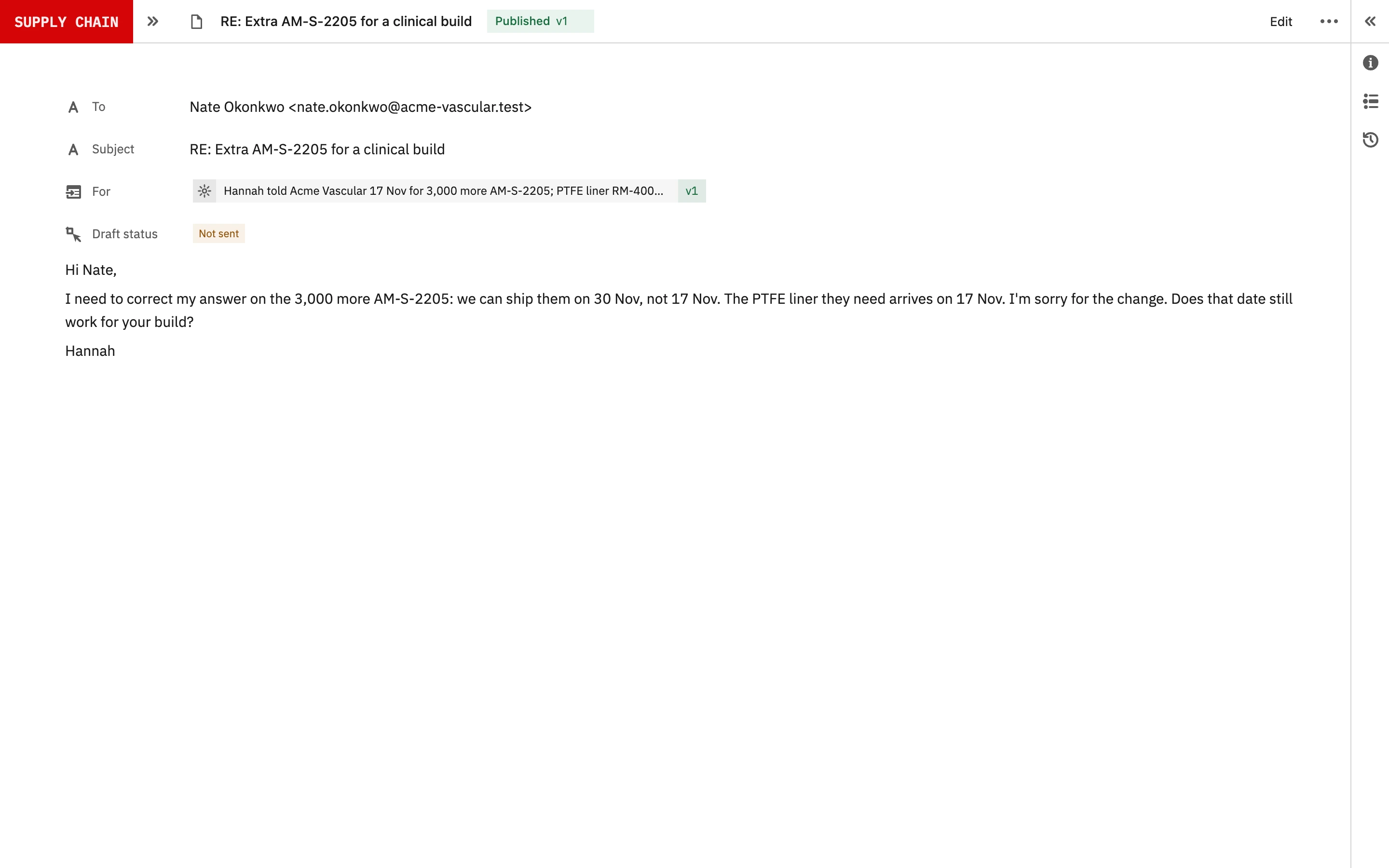
    A draft reply in Seal to Nate Okonkwo at Acme Vascular, linked to its finding and not sent, correcting the date on AM-S-2205 from 17 November to 30 November.
    1. What it says30 November, not 17, because the liner arrives on the 17th.
    2. Linked to its findingThe working stays one click from the reply.
    3. Not sentA customer hears from a person.

A date you can’t keep costs more than the order.

At the median, one order in eight isn’t perfect, and announced delays show up in the numbers investors watch.

When the date slipsPublished figures

88.0%
median perfect order rate: complete, on time, undamaged and correctly documented.APQC, 13,590 organisations
−10.28%
abnormal fall in shareholder value after a production or shipment delay was announced.519 announcements, 1989 to 2000, J. Operations Management, 2003
−107%
change in operating income against matched firms, in the year before a delay was announced.885 delays, Management Science, 2005

With NeilTest run, 5 November 2026

6
asks in 10 emails, each worked through stock, open orders and the schedule.Acme Medical’s customer service mailbox
4 of 4
planted problems found, one of them a yes already sent.Built into the test run for Neil to find
35 of 35
numbers in the findings match the answer key.Dates, hours and quantities
0 of 3
decoys raised: a yes that stands, an order its work orders cover and a question about prices.Built into the test run for Neil to set aside

Customer service gives the date.

Neil reads, works out the date and drafts the reply. It never books an order or changes the schedule, and a customer hears from a person.

See how the schedule’s plans line up

Summary

The problem
The ERP’s available date is today plus a lead time. It doesn’t know that the resin is short or the line is full, so a customer can be told a date the plant can’t keep.
Seal’s approach
Neil reads each ask in the customer service mailbox, then works out in code when every material is in hand and when the run fits on the line, from the same morning’s projection and schedule.
What changes
Customer service answers with a date the plant can keep, and hears about one it already gave before the customer does.
Where to start
One quarter of the customer service mailbox, with stock, open orders, bills of materials and the schedule. Book a demo.

1The ERP’s date is arithmetic.

A customer asks for 12,000 more by the third of next month. The system answers with today plus the part’s lead time, and that date goes back by email. The lead time doesn’t know the resin is short or the line is booked, so the date is often wrong the day it is given. Whoever finds out first is usually the customer.

Across 13,590 organisations in APQC’s benchmark, the median perfect order rate is 88.0%.¹ Firms that announced production or shipment delays lost 10.28% of shareholder value, on average, in 519 announcements from 1989 to 2000.²

2Check material first, then the line.

Neil reads each email in the customer service mailbox: what is asked for, how much and by when, and what has been answered, each with the words it comes from. Code then finds the first week every material is in stock, through to when an order placed today could arrive, using the supplier’s current quote rather than the ERP’s lead time. Then it adds up free hours on the part’s line and the braider, week by week, until the run fits. The run finishes that Friday and ships after release.

3Four asks at Acme Medical.

On Thursday 5 November 2026, fictional Acme Medical’s mailbox held six asks. Two stood as they were: a yes already given, and an order its work orders cover.

CustomerThe askThe ERPThe plant
Acme Vascular12,000 more AM-S-2210 by 3 December15 November8 February 2027: PEBA 72D has to be ordered
Acme Vascular3,000 more AM-S-2205, told yes for 17 November15 November30 November: the liner docks 17 November
Acme Cardio150,000 ft more AM-T-1070 by 13 November10 November23 November: Line 1 has 23.0 free hours next week
Acme Endoscopy30,000 ft more AM-T-4410 by 20 November10 November16 November: yes

4Customer service answers.

Neil drafts each reply, including the correction to a date already given. Customer service edits it and sends it, and the planner adds the run. Neil never books an order or changes the schedule.

5Start with one quarter of asks.

Bring one quarter of the customer service mailbox, exported, with stock, open orders, bills of materials and the schedule from the same period. Compare Neil’s dates with what actually shipped.

References

  1. 1APQC, Perfect order performance, measure 101741, sample 13,590, read from an archive copy of 12 October 2026. APQC
  2. 2Hendricks and Singhal, Journal of Operations Management, 2003: an abnormal decrease in shareholder value of 10.28% after supply chain glitch announcements. DOI

ACapabilities

CapabilityWhat it covers
Ask readingRead what each customer asks for, how much and by when, and what has been answered.
Material checkFind the first week every material is in stock, using the supplier’s current quote.
Line checkAdd up free hours on the line and the braider, week by week, until the run fits.
ERP comparisonShow the ERP’s date beside the plant’s, and what holds it.
CorrectionsRaise a date already given that the plant can’t keep.
Drafted repliesDraft each reply for customer service to edit and send.

BConnected records

Entity
What it records
Kind
Customer Ask
What a customer asked for, as read from their email.
type
Order Promise
The ERP’s date, the plant’s date and what holds it.
type
Material
Stock and open orders for what the run needs.
type
Production Line
Free hours by week, from the schedule.
type

CQuestions and answers

Does Neil reply to customers?

No. It drafts the reply. Customer service edits it and sends it, and a customer hears from a person.

Is this a planning system?

No. Neil reads your ERP’s exports and the schedule as they are, and works out one date per ask. The plan stays where it is.

What if our schedule lives in Excel?

That is where Acme Medical’s lives. Neil reads the workbook as well as the ERP.

What data does a proof need?

One quarter of the customer service mailbox, with stock, open orders, bills of materials and the schedule. No live access is needed.

See your process in Seal.

Bring a procedure or a recurring problem. See how your team configures it with Neil and improves the next run.

Book a demo