Every version, and where it runs.

Product lifecycle management (PLM) that turns process definitions into executable protocols without retyping. Each site keeps the version it ran.

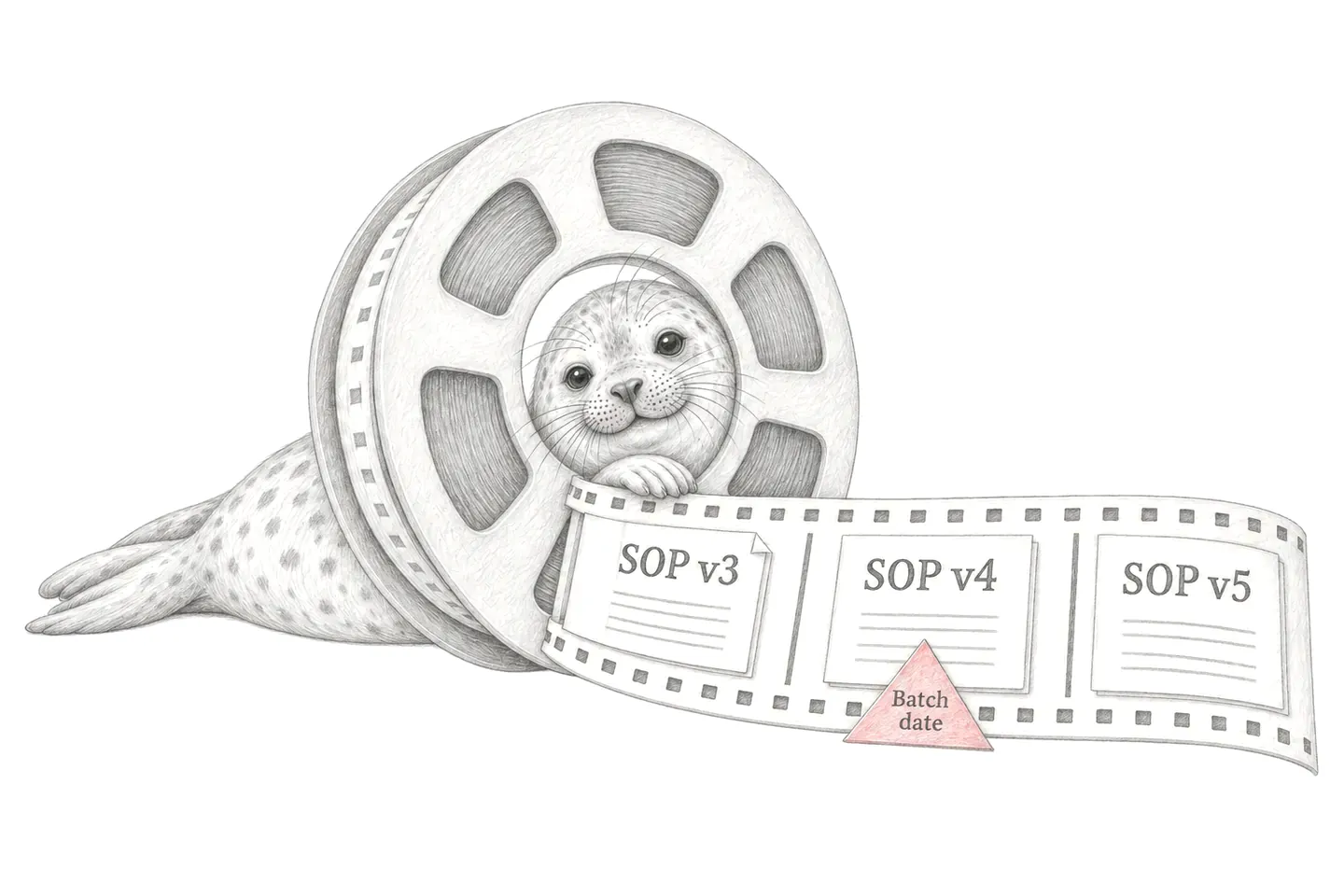
Illustration of a seal following successive procedure versions and the version used for a batch.
Life Sciences Product Lifecycle Management (PLM) Software

Summary

Neil
Neil can assemble the processes, materials and site versions a proposed change may affect and point out site differences or single-source materials for review. Your team assesses the impact and decides. About Neil.
Where to start
One process version and a real difference between development and a receiving site. Book a demo.

1One process definition. A connected lifecycle.

Keep the recipe, the scientific rationale and each site’s execution connected, from process development to manufacturing, MSAT and CMC.

When process knowledge travels between development, tech transfer and manufacturing as documents and is re-entered into each site’s MES, the executable process and its scientific basis drift apart. Seal links each site’s version to the process definition and its supporting evidence, and configures the executable protocol from the definition rather than retyping it.

A proposed revision is a new version with its own evidence and approval, assessed against each site, while every executed batch keeps the version it ran.

2Development: keep the science behind each setting.

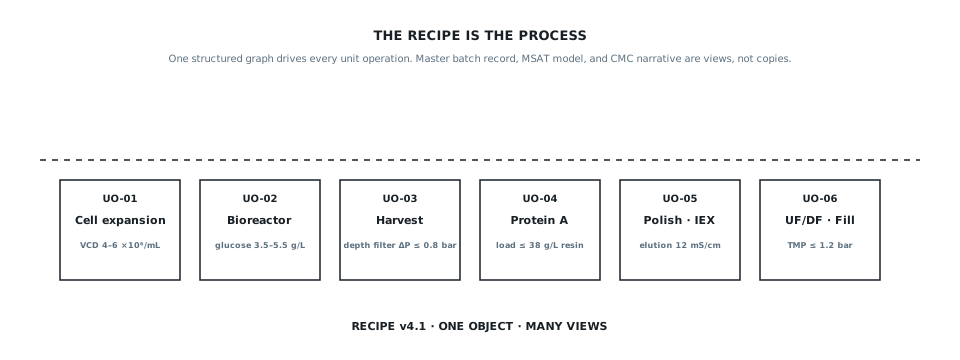
Configure the unit operations, materials, equipment requirements and parameter ranges together. Run development protocols against a named recipe version; connect each proposed control to its experiments, quality attributes and reviewed rationale.

Carry the definition and its evidence into the next study or site assessment, including what is not yet established.

3Manufacturing: run the intended version at the intended site.

Configure the local protocol from the process definition: instructions, fields, calculations, material references and review steps. Retain actual lots, cell-bank lineage where relevant, equipment and results with the version used for the batch.

Transfer the selected structure to a receiving site, then assess local equipment, scale and material differences before use.

4MSAT: follow a finding back to the process it concerns.

Compare campaign performance by process version and site. Keep deviations, continued process verification (CPV), material changes and comparability evidence linked to the affected operation. Assess the next revision without rewriting earlier executions.

Route the proposed change and required evidence to the responsible site and quality reviewers. Implementation remains an explicit decision.

5CMC: describe the process that the evidence actually supports.

Connect process descriptions, material controls, parameter justifications and validation summaries to their underlying versions. Keep the submitted baseline distinct from a working revision so regulatory authors can review what changed and which statements need attention.

Regulatory reviewers assess filing impact and applicable commitments. A new process proposal is not automatically an updated submission.

6A recipe carries its scientific basis.

Keep the study, risk assessment and quality response behind each proposed control.

Connect a parameter to the quality attributes it may affect without treating every parameter as critical. Preserve the rationale, uncertainty and applicable scale or material coverage alongside the setting.

7Transfer the structure, then resolve the differences.

Reuse the process definition and record what must change at the receiving site.

Equipment, scale, materials, methods and local procedures can change the meaning of an instruction. Keep those differences explicit and route the agreed qualification, verification and training work before implementation.

AConnected records

Entity
What it records
Blueprint
Kind
Product
The biologic, such as a mAb, fusion protein, AAV, cell therapy or vaccine, or the device constituent of a combination product.
Life Sciences Product Lifecycle Management (PLM) Software
type
mAb-Alpha
Anti-cytokine monoclonal antibody in a Phase 3 programme preparing for launch, made by the sponsor and a CMO.
Life Sciences Product Lifecycle Management (PLM) Software
instance
Process
The manufacturing process as linked records: unit operations, parameters, materials and equipment, versioned for each site.
Life Sciences Product Lifecycle Management (PLM) Software
type
PD Process
Bench-scale process under design. Wide ranges, design-space exploration, scale-down model qualification.
Life Sciences Product Lifecycle Management (PLM) Software
template
GMP Clinical Process
Process fixed for a clinical campaign, with an approved master batch record and established CPP ranges.
Life Sciences Product Lifecycle Management (PLM) Software
template
Process v3.2
Version transferred to the CMO and used for its master batch record. The CMO did not receive the v3.3 to v3.5 revisions.
Life Sciences Product Lifecycle Management (PLM) Software
instance
PPQ / Validation Process
Commercial-scale process in PPQ, with the planned validation lots and comparability to clinical material.
Life Sciences Product Lifecycle Management (PLM) Software
template
Commercial Process
Approved commercial process under CPV and MSAT stewardship, with changes assessed for regulatory impact.
Life Sciences Product Lifecycle Management (PLM) Software
template
Process v3.5
MSAT revision with tightened CPP ranges from internal data, described in the CMC submission but not transferred to the CMO.
Life Sciences Product Lifecycle Management (PLM) Software
instance
Unit Operation
Cell culture, harvest, capture, polish, UF/DF, formulation or fill, linked to its CPPs, materials, equipment and the CQAs it may affect.
Life Sciences Product Lifecycle Management (PLM) Software
type
Upstream Unit Op
Cell expansion, bioreactor, harvest. CPPs include feed strategy, DO, pH, temperature, harvest criteria.
Life Sciences Product Lifecycle Management (PLM) Software
template
Downstream Unit Op
Capture chromatography, polish, viral inactivation, UF/DF. CPPs include load criteria, gradient, residence time.
Life Sciences Product Lifecycle Management (PLM) Software
template
Fill / Finish Unit Op
Formulation, sterile filtration, fill, lyophilisation, inspection. CPPs include fill volume, lyo cycle, container closure.
Life Sciences Product Lifecycle Management (PLM) Software
template
Critical Process Parameter
Parameter with a controlled range. Linked to the CQA it impacts and the design-space evidence that established the link.
Life Sciences Product Lifecycle Management (PLM) Software
type
Critical Quality Attribute
Purity, potency, aggregates, HCP, residual DNA or glycans, linked through CPPs to the associated risk assessment.
Life Sciences Product Lifecycle Management (PLM) Software
type
Raw Material
Media, buffer components, resins, filters or single-use bags, with approved sources, qualification, animal-origin status and change-notification agreements.
Life Sciences Product Lifecycle Management (PLM) Software
type
Cell Culture Media
Defined or hydrolysate-based media, with animal-origin status, lot-to-lot variability and single-source risk recorded.
Life Sciences Product Lifecycle Management (PLM) Software
template
Chromatography Resin
Protein A, IEX, HIC or mixed-mode resin, with lifetime cycles recorded and manufacturer change notifications linked to where it is used.
Life Sciences Product Lifecycle Management (PLM) Software
template
Resin: ProteinA-X
Single-source chromatography resin with a CMC commitment and a manufacturer change-notification agreement on file.
Life Sciences Product Lifecycle Management (PLM) Software
instance
Single-Use Assembly
Bag, tubing and connector assemblies under configuration control, with film qualification and extractables/leachables data on file.
Life Sciences Product Lifecycle Management (PLM) Software
template

Capabilities

Also includedWhat it covers
Versioned process definitionUnit operations, parameters, quality attributes, materials, equipment requirements and methods in one versioned definition that can inform the master batch record, site versions and CMC content.
Recipe-driven developmentDevelopment experiments can run against a draft process version. DOE results link to the parameter ranges they informed, so the justification for a setting stays with the studies behind it.
Structured tech transferCreate the receiving site’s version from the sending definition. Record site differences with their rationale and use them to scope the comparability plan and engineering-batch work. The transferred definition is not evidence that the site is ready.
Established conditions / ICH Q12Tag established conditions on the process elements they apply to. A proposed change can show which tagged elements it affects, to inform the reporting category your regulatory team assigns.
MSAT continuity and CPVLink campaign learnings to the unit operation, parameter, material or equipment they concern. Continued process verification can refer to the same process version and its history.
CPP / CQA / QbD traceabilityLink each critical process parameter to the quality attributes it may affect and the evidence behind its range, including the rationale, uncertainty and scale it covers.
Cell line and bank lineageResearch cell line, MCB, WCB and end-of-production cells as linked records, with characterisation, stability and passage history.
Raw material AVL and single-source riskApproved sources on each material, with animal-origin status, grade, qualification and audit history. Sole-source critical materials can be identified from the same records.
Multi-site comparabilityEach site runs a versioned instance with its recorded differences. Comparability evidence links to the versions it bridges.
CMC content from the process recordDraft Module 3 process sections, such as 3.2.S.2.2 and 3.2.P.3.3, from the current process definition, and compare a proposed version with the one previously filed. Regulatory authors review the content before submission.
Change impact reviewBefore approval, a proposed change can list the sites, transfers, CMC sections, validation evidence and comparability scope linked to the affected elements.
AI impact review / NeilNeil can assemble the processes, materials and site versions a proposed change may affect and point out site differences or single-source materials for review. Your team assesses the impact and decides.

See your process in Seal.

Bring a procedure or a recurring problem. See how your team configures it with Neil and improves the next run.