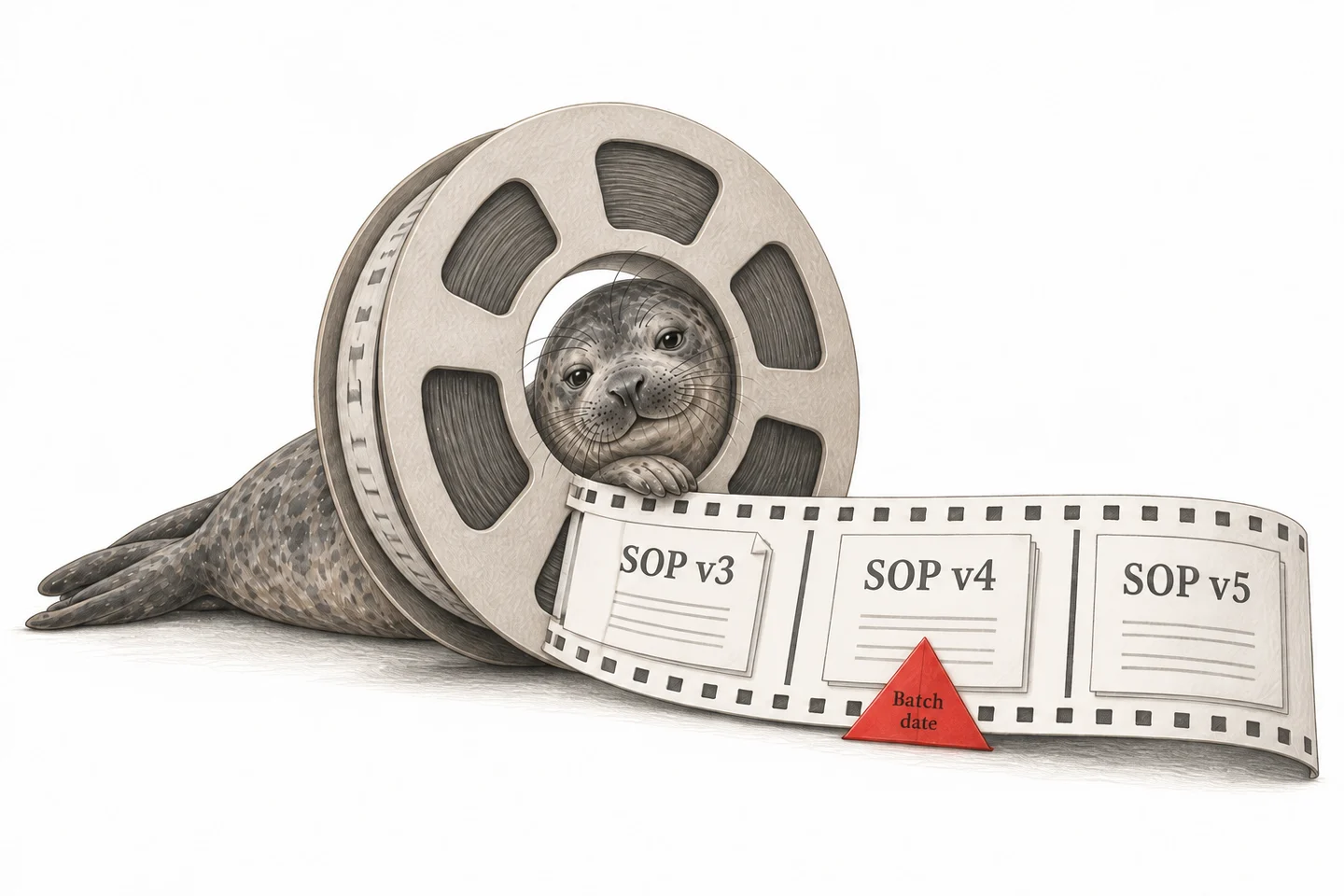
1Three assigned operators have different evidence for revision 4.
The native Seal demonstration contains three qualification records for AM-014. Revision 4 is the applicable procedure. J. Patel has the assessed practical evidence and recorded authorisation; M. Chen retains revision-3 acknowledgement and needs reassessment; A. Lewis has read revision 4 but has no practical assessment recorded. The same query also contains separate AM-022 records.
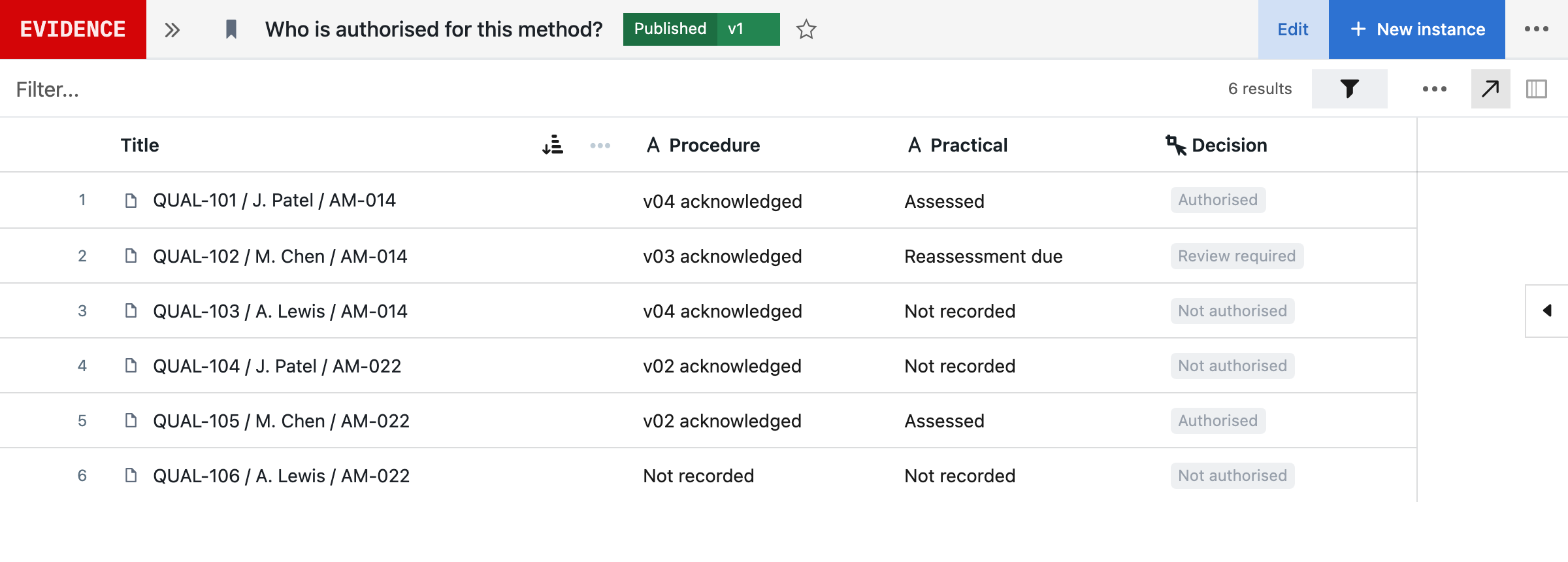
| Person | Procedure evidence | Practical evidence | Recorded decision |
|---|---|---|---|
| J. Patel | v04 acknowledged | Assessed | Authorised |
| M. Chen | v03 acknowledged | Reassessment due | Review required |
| A. Lewis | v04 acknowledged | Not recorded | Not authorised |
One of three AM-014 assignments has a recorded authorised outcome. A current acknowledgement alone does not satisfy the practical requirement. In the separate AM-022 population, J. Patel is not authorised: permission for one method does not establish permission for the other.
2Review output and next actions
One of three AM-014 assignments has an authorised outcome. The next work is different for the other two people; sending both another generic acknowledgement task would fail to address the missing practical evidence.
Training assignment owner
Resolve M. Chen’s revision-4 requirement under the impact plan.
Evidence needed: Applicable revision evidence and the required reassessment, or a supported equivalence decision where the plan permits it.
Practical assessor
Assess A. Lewis against the required observed task.
Evidence needed: Accepted assessment evidence; an uploaded but unreviewed practice record leaves the assessment outstanding.
Task owner
Check the actual method when assigning work to J. Patel.
Evidence needed: The AM-014 decision applies to that method. The demo’s AM-022 assignment remains unauthorised.
The filled review worksheet: AM-014 revision-4 readiness matrix
This is a fictional worked assessment to adapt to your procedure and actual evidence.
Source pack
- The revision-impact assessment and the task population it covers.
- Each person’s procedure acknowledgement, required practical evidence and recorded assessment outcome.
- Population
- Three AM-014 assignments. AM-022 is a separate method population even where the people are the same.
- J. Patel
- Revision 4 acknowledged; practical assessment recorded; authorised for AM-014 in the demo.
- M. Chen
- Revision 3 acknowledgement; reassessment due; review required.
- A. Lewis
- Revision 4 acknowledged; required practical assessment not recorded; not authorised.
3Decisions and exceptions
| Situation | Response | Consequence |
|---|---|---|
| Earlier revision completed | Compare it with the assessed revision-4 requirement | Retain earlier completion without assuming equivalence |
| Revision-4 acknowledgement only | Record what it establishes and the remaining practice requirement | No automatic conversion to a witnessed assessment |
| Person outside the changed task | Retain the exclusion reason | Do not count that person as a completion |
4Begin with the changed task, not a list of document readers.
Compare revisions 3 and 4 and describe the change in terms of the work performed. Identify the roles or named people who perform that task, supervise it or make a decision affected by it. A broad document distribution list may contain readers who do not perform the task, while missing a temporary or newly assigned operator who does.
The responsible team selects the learning and assessment method based on the change and its procedure. Record that decision with the impact assessment. A spelling correction and a changed equipment setup can require different treatment. The example’s witnessed practice requirement is an input from its plan, not a claim that every revision requires practical training.
5Match completion to the person, revision and requirement.
M. Chen’s revision-3 record remains valid evidence of earlier training. It does not establish completion of the revision-4 requirement unless the impact assessment explicitly accepts it for that purpose. Preserve the earlier record and create the new assignment or documented equivalence decision required by the plan.
A. Lewis has acknowledged revision 4. That establishes a different fact from a witnessed practice assessment. Keep evidence type and outcome visible so a generic “completed” status cannot collapse them. Similarly, submitting a practice record for review is not the same as the assessor accepting it.
6Keep the readiness population understandable as staffing changes.
For AM-014, report one recorded authorised assignment and two outstanding out of three. Keep the named person-and-method population behind that fraction. The six-row query spans two methods; treating all six records as six people, or carrying one method’s decision across to another, would answer the wrong question.
If a new operator is assigned after the impact assessment, identify the new requirement through the defined assignment process. Retain the earlier readiness assessment and show the new outstanding assignment in the current view. A person leaving the task can be removed from the current population with a supported reason, while the original assignment and its outcome remain available.
7Turn the changed step into something an assessor can observe.
For a separate fictional training exercise, suppose the AM-014 revision-4 impact plan adds an equipment-configuration check before starting the method. Describe the changed task, the evidence an assessor must see and the response to an incorrect configuration. The rubric below illustrates that design; it is not the content of the method or a practice assessment shown in the native demonstration screenshot.
Apply the agreed rubric to each person-method assignment. J. Patel’s recorded authorisation should link to the accepted evidence required by the plan. M. Chen’s revision-3 completion does not demonstrate the new task. A. Lewis’s revision-4 acknowledgement establishes reading, while the required practice assessment remains outstanding. An assessor can accept evidence only after evaluating it; an uploaded file or attendance timestamp does not supply the result of that evaluation.
If practice reveals a missed step, record the observed gap and the next learning or reassessment action. Preserve the initial outcome when a later attempt succeeds. If the impact owner accepts earlier evidence as equivalent, retain the comparison to the changed requirement and the decision’s scope so the next reviewer can understand why another attempt was unnecessary.
| Observed task | Evidence to retain | Outcome requiring more work |
|---|---|---|
| Locate the assigned instruction | Person, method and exact revision used in the exercise | Uses a superseded revision or cannot identify the assigned one |
| Check the configured setup against the instruction | Observed comparison, equipment identity and assessor notes | Accepts a deliberately mismatched test configuration |
| Respond to a setup mismatch | Observed stop/escalation under the chosen training procedure | Proceeds without resolving the mismatch |
| Record the exercise result | Dated assessor decision tied to this attempt and rubric | Evidence submitted but no assessment decision yet |
EU GMP Chapter 4 §§4.8–4.10 expects records to be made when each action is taken and alterations to leave the original information readable. The worked matrix applies that principle to training evidence: an earlier completion stays visible when a revision changes the requirement. The chapter does not prescribe this matrix or the training a revision needs.
8Questions this example raises
Does every SOP revision require retraining?
The impact assessment determines the requirement for the changed work. An editorial correction and a changed operating step can need different treatment. Record the rationale and affected task population rather than assigning identical training automatically.
Can an older training completion satisfy the new revision?
Only when the assessed requirement and a supported equivalence decision allow it. Retain the older completion and the basis for accepting or excluding it; matching procedure names alone does not establish equivalence.
9Proposed record fields
Start from the Document control blueprint. The fields below are a proposed design for this case, using Seal’s documented field types and references.
Download the proposed field list
Procedure training impact
Define what changed, who is affected and what evidence the plan requires.
- Procedure revisionPinned Reference
- The specific revision 4 assessed for AM-014.
- Changed taskText / Reference
- The task marked for practical reassessment by the revision-impact assessment.
- Required learning evidenceText / References
- Witnessed practice under this illustrative plan, with its assessment criteria.
- Assessed populationReferences
- The people assigned to the changed task at the assessment point.
- Exclusions and reasonText / References
- Any task scopes outside the current assessment, with the reason retained.
Individual assignment
Turn the assessed need into work for a named person.
- Assigned personUser
- The individual expected to complete the task-specific requirement.
- Applicable procedurePinned Reference
- Revision 4, not an unspecified current document.
- Required evidenceReference
- The learning or assessment requirement selected in the plan.
- Due basisTime & date / Text
- The planned timing and its relationship to intended task execution.
- Assignment stateSelect
- Open, evidence submitted or assessed as defined by the process.
Completion and readiness assessment
Retain the evidence and judgement without overwriting earlier training.
- AssignmentReference
- The person, procedure revision and task requirement being answered.
- Completion evidenceReferences
- The witnessed practice record and recorded outcome.
- AssessorUser
- The person responsible for assessing that evidence.
- Assessment outcomeSelect / Text
- Whether the stated requirement is met and any remaining work.
Seal can connect the revised procedure, task responsibilities, training assignments and evidence of completion. That lets the change owner ask a useful question: who is expected to perform the changed task, and what evidence establishes readiness for this revision? The example follows fictional records in the actual Seal interface. The practical requirement is an input from that demonstration’s plan.
10Configure linked assignments and distinct review decisions in Seal.
Use a training-impact Template connected to the procedure revision and separate individual assignment records using User and Reference fields. Pin the applicable procedure revision for the historical assignment. Configure a Select state that distinguishes an open requirement, submitted evidence and an accepted assessment. The learning requirement itself should remain visible beside the completion evidence.
A proposed readiness Check can require the applicable assignment and accepted evidence for the task being assessed. Configure reviewer responsibilities and signature meanings on the relevant Template. Seal review phases are not sequential, so display order alone cannot enforce an assessment prerequisite. If reminders are needed, use the documented manual reminders or a separately configured and verified automation; an open assignment does not imply automatic chasing.
11Configuration references
The record design above is illustrative. These product documentation pages explain the Seal capabilities used in it. They open in the signed-in Seal platform.
12Acceptance tests
These are proposed acceptance tests for the configured workflow. They describe expected behaviour to verify, rather than results of a customer implementation.
Download these acceptance cases
An old completion has the same procedure name
Input: Link M. Chen’s revision-3 completion to the revision-4 readiness view.
Expected: The view shows the actual revision and identifies the outstanding requirement unless a supported equivalence decision applies.
Evidence is submitted but not assessed
Input: A. Lewis uploads a practice record that is still awaiting its required assessment.
Expected: The assignment shows submitted evidence and outstanding assessment, rather than an accepted readiness outcome.
A new person joins the task
Input: Assign a new operator after the original three-person assessment.
Expected: The current task population includes the new operator’s applicable requirement while the earlier assessed population remains identifiable.
13Apply this to your records
Use one changed procedure and its actual task assignments. Turn the revision difference into an evidence requirement before assessing individual completions.
Download the blank working review
Write your working notes here
Notes stay in this tab and are not submitted. Download them before leaving to keep a copy. Use record references to identify your evidence.
Identify the old and new procedure revisions and the affected step. Describe what a person must now do differently, the learning or assessment required and the impact owner’s rationale. Separate an editorial change from a changed operating task.
List each person-method assignment in scope, including temporary staff and recent task assignments. Record exclusions and their reasons. If a person performs two methods, assess each applicable requirement separately.
Describe the observable actions, source instruction, exercise conditions and acceptance criteria. For a setup change, include how the person identifies the assigned revision, checks the configuration and responds to a mismatch.
For each person and revision, link the acknowledgement, practice attempt, assessor’s observations and accepted outcome as distinct evidence. Record failed or pending attempts. If earlier evidence is accepted as equivalent, cite the supported equivalence decision.
Record which person-method assignments satisfy the plan, which evidence or assessment remains outstanding, and who owns the next action. Note changes since the earlier population was reviewed; do not rewrite that historical assessment.
Unanswered sections remain marked ‘Not recorded’ in the download.
Evidence needed to finish
Every in-scope assignment has a revision-specific requirement and traceable evidence state. Accepted readiness is supported by the assessment the plan actually requires. Outstanding practice, pending assessment and exclusions remain visible individually.
14Review the evidence with Neil
Review AM-014 revision 4 against the training-impact plan and current task assignments. For each assigned person, show the applicable revision, required evidence, evidence received and assessment state. Retain exclusions with reasons and identify new assignments after the earlier assessment. Prepare an outstanding-work brief without treating acknowledgements or older completions as equivalent to the required witnessed practice.
Review the proposed output against these deliverables:
- A person-by-task readiness table tied to the actual revision and requirement.
- Outstanding evidence and assessment work, separated from exclusions.
- Changes between the historical assessed population and current task assignments.
15Configure this process with Seal
Use a representative source record and an exception your current process struggles with. We can work through the record design, review responsibilities and connection requirements with you.