All use cases

Investigate a drop in yield.

Compare runs, connect the evidence and identify what to investigate next.

Book a demo
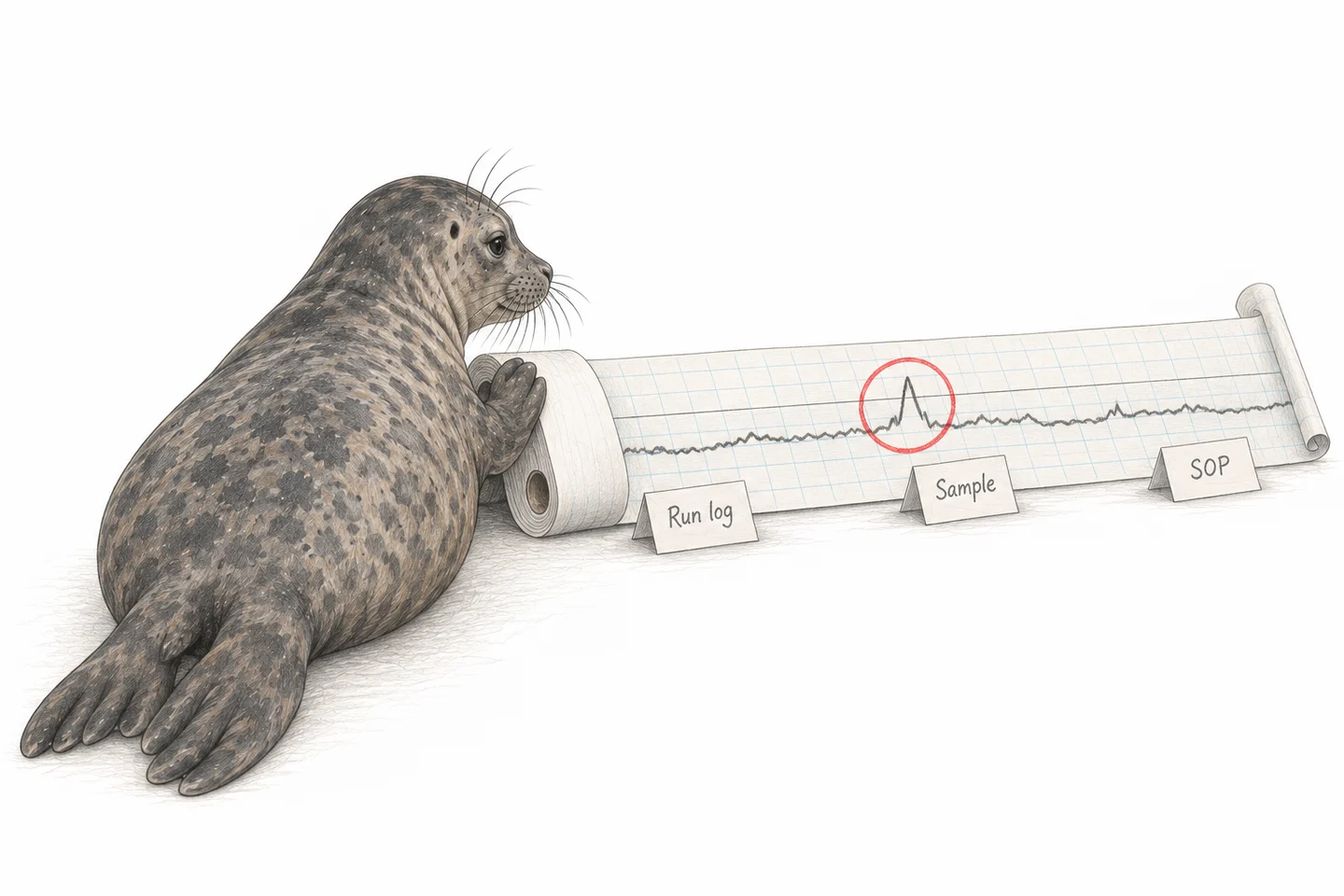
Illustration of a seal examining a circled change in a trace alongside run, sample and procedure records.

You: Yield fell after the transfer. Can you compare the runs and tell me what to investigate first?

neil

The longer holds coincide with lower yields. RUN-214 has the longest hold and lowest yield of these manufacturing runs. I would investigate the hold, but I cannot yet separate its effect from the other transfer changes.

Hold duration versus yield. Development median: 0.8 hours, 90 percent. RUN-201: 6.4 hours, 79 percent. RUN-207: 6.9 hours, 77 percent. RUN-214: 7.8 hours, 75 percent. Different populations; cause unconfirmed.Yield (%) 708090 048 Hold duration (hours) Development median 201 207 RUN-214

You: So should we shorten the hold limit?

neil

Not on this comparison alone. The development median is a different population, and three manufacturing runs do not establish causation. I would first compare temperature, vessel conditions and the yield calculation on matched runs, then define a study that tests the hold-time explanation.

You: Write this up for review, with the sources and the follow-up work we need.

neil

Here is the draft. I have kept the supported finding separate from the open questions, and prepared the evidence requests for the responsible roles.

Transfer yield investigationReview draft · source evidence and assessment

Transfer yield investigation

The manufacturing runs combine longer holds with lower yields, but the development median is a different comparison population. Hold duration is a candidate explanation, not an isolated variable. Compare temperature traces, vessel conditions and the calculation basis for each run; then identify which differences remain after those conditions are matched. A process change needs evidence beyond the association shown here.

Source evidence and search scope

Development summary; RUN-201, RUN-207 and RUN-214 execution records.

Development median / Evidence excerpt

Hold
0.8 h
Yield
90%

RUN-201 / Evidence excerpt

Hold
6.4 h
Yield
79%

RUN-207 / Evidence excerpt

Hold
6.9 h
Yield
77%

RUN-214 / Evidence excerpt

Hold
7.8 h
Yield
75%
Inputs needed for your own records
  • Development and manufacturing run records
  • Process parameters, timestamps and yields
  • The procedures and limits used for those runs

Your process owner assesses the explanations and decides what to test. A correlation between hold time and yield does not establish a cause.

Fictional source snapshots. No live query, assignment or approval.

Follow-up work and evidence requests2 proposed tasks · not assigned

Evidence to request

Compare matched manufacturing runs
Process scientist
Obtain hold start/end events, temperature traces, vessel conditions and the same yield calculation basis. Record which transfer differences remain confounded.
Design the discriminating study
Process development lead
Specify controlled conditions, hold durations, sampling and a pre-agreed analysis. A revised limit needs the resulting evidence and change review, not this association alone.
Example conversation · prepared replies

See this job with your team.

Tell us how your team handles this job today. We’ll walk through the analysis, supporting evidence and review steps in a demo.

Book a demo
What to bring for this job
  • Development and manufacturing run records
  • Process parameters, timestamps and yields
  • The procedures and limits used for those runs

Source access, permissions and permitted actions are agreed for your environment.

Source excerpt

Development median

Evidence excerpt

Hold
0.8 h
Yield
90%

Selected fictional record, not a live source-system view.