All use cases

Investigate recurring equipment failures.

Compare failure history with operating exposure, installed parts and service procedures to define a testable equipment investigation.

Book a demo
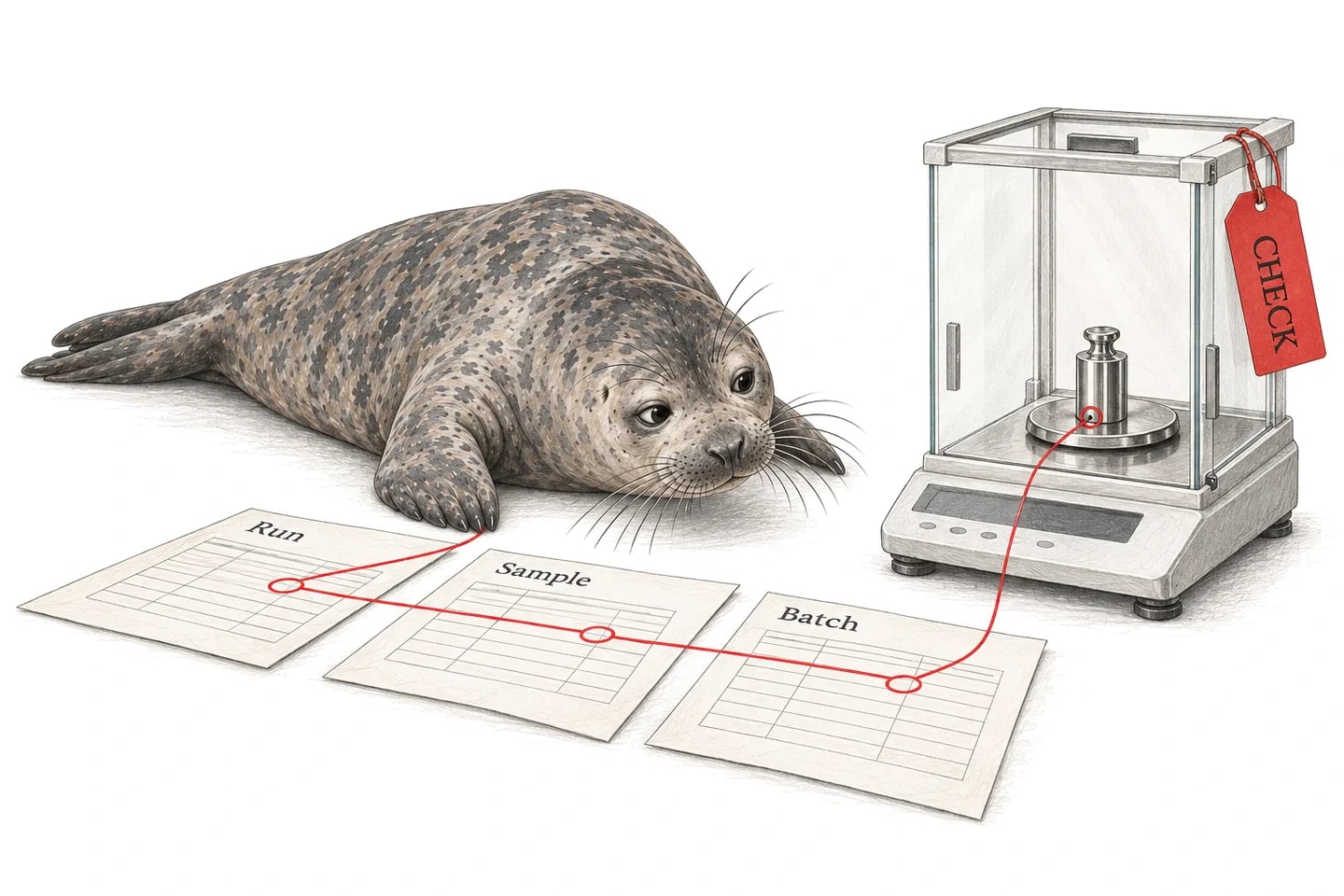
Illustration of a seal linking a balance check to run, sample and batch records.

You: Both pumps used seal-kit lot SK-17 and then had low flow. Is the part lot the likely cause?

neil

The shared part lot is worth investigating, but these records do not establish a lot defect. P-207A has two events in 2,000 hours; P-207B has one in 400. Their observed rates are 1 and 2.5 events per 1,000 hours, with very small counts.

Events per 1,000 operating hours
Events per 1,000 operating hours. P-207A, P-207B: 1, 2.5. Example records.1P-207A2.5P-207B

You: What comparison would test the part-lot explanation?

neil

I would find unaffected pumps using SK-17 and comparable pumps using other lots, then compare installation, service procedure, configuration and operating exposure. The current failure-only set lacks that control population, so it cannot distinguish a lot effect from service or operating conditions.

You: Write this up for review, with the sources and the follow-up work we need.

neil

Here is the draft. I have kept the supported finding separate from the open questions, and prepared the evidence requests for the responsible roles.

SK-17 fleet failure investigationReview draft · source evidence and assessment

SK-17 fleet failure investigation

P-207A records 1.0 event per 1,000 operating hours, compared with 2.5 for P-207B. Those rates expose a difference hidden by the raw counts, but the event numbers are small and the pumps may operate under different conditions. Obtain both unaffected SK-17 recipients and comparable pumps using other lots before treating the shared replacement lot as a causal explanation.

Source evidence and search scope

P-207A (Pump history); P-207B (Pump history); PART-207 (Installed parts)

P-207A / Pump history

Recorded evidence
Two low-flow events; 2,000 operating hours

P-207B / Pump history

Recorded evidence
One low-flow event; 400 operating hours

PART-207 / Installed parts

Recorded evidence
Both pumps received lot SK-17; unaffected population not supplied
Inputs needed for your own records
  • Work orders, original findings and return-to-service records
  • Installed-part lot history and equipment configurations
  • Operating exposure and controlled maintenance-plan versions

Engineering assesses failure mechanisms and approves any maintenance change. A shared part lot is a lead, not an established root cause.

Fictional source snapshots. No live query, assignment or approval.

Follow-up work and evidence requests2 proposed tasks · not assigned

Evidence to request

Define the exposed and comparison populations
Reliability engineer
Identify affected and unaffected assets by part lot with operating hours, configuration, installation and service history.
Test competing explanations
Maintenance investigator
Compare lot, procedure and operating-condition hypotheses with evidence for and against each. Define inspections or measurements that could distinguish them.
Example conversation · prepared replies

See this job with your team.

Tell us how your team handles this job today. We’ll walk through the analysis, supporting evidence and review steps in a demo.

Book a demo
What to bring for this job
  • Work orders, original findings and return-to-service records
  • Installed-part lot history and equipment configurations
  • Operating exposure and controlled maintenance-plan versions

Source access, permissions and permitted actions are agreed for your environment.

Source excerpt

P-207A

Pump history

Recorded evidence
Two low-flow events; 2,000 operating hours

Selected fictional record, not a live source-system view.