Summary
- The problem
- A course completion record does not show whether someone was qualified for a particular method version, at that site, when they did the work.
- Seal’s approach
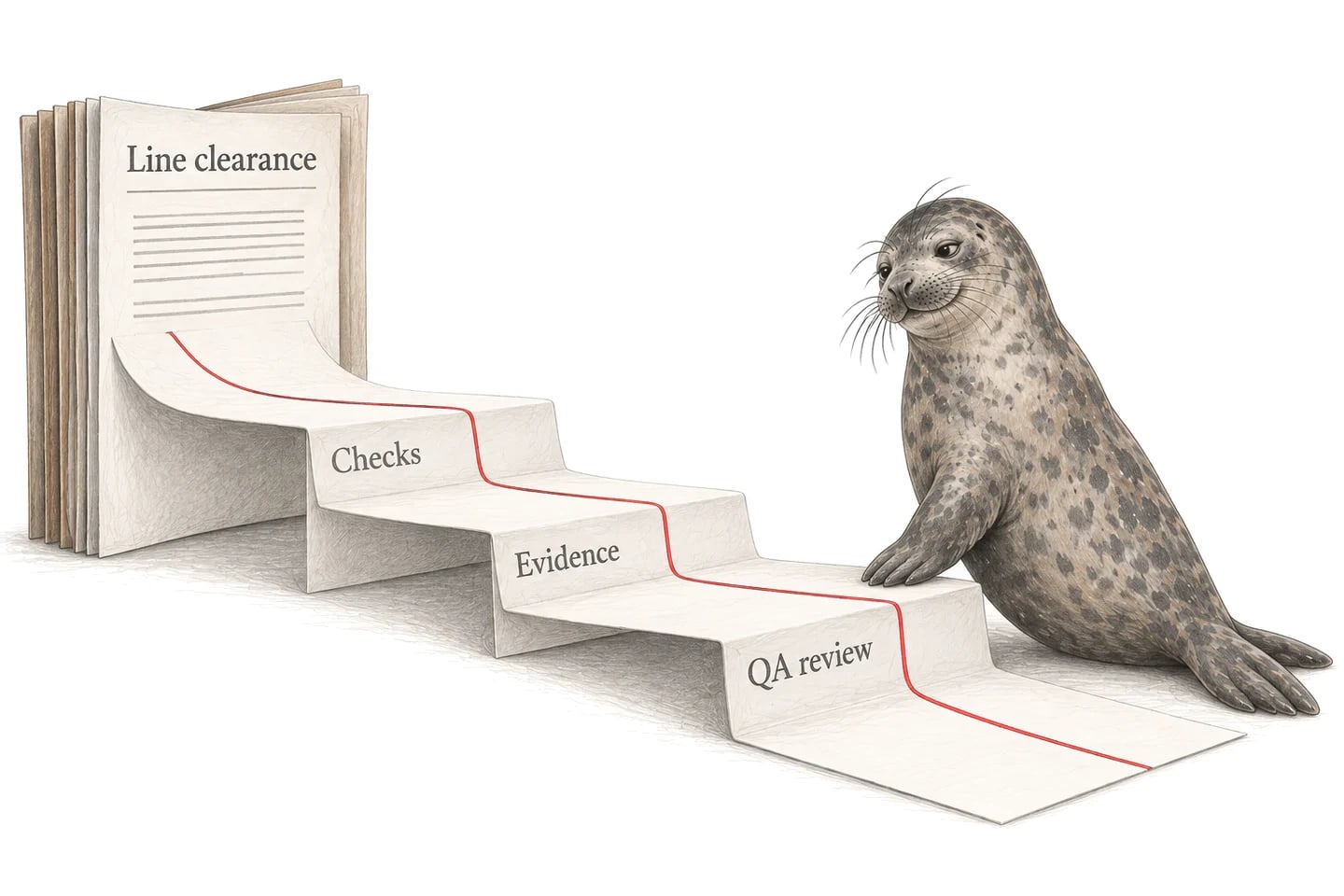
- Procedures, training, practical assessment and qualification share records with laboratory and manufacturing work. Qualification is scoped to what was demonstrated, and revisions identify affected people.
- What changes
- Eligibility is checked against the exact requirement before work is assigned or signed, and records show why a person was authorised when the work occurred.
- Where to start
- One qualification pathway, such as an analyst method or a single procedure revision. Book a demo.
1The qualification belongs with the batch, sample or method.
Training completion is not permission to perform regulated work. A person may have read an SOP and passed a quiz but still lack supervised practice, a successful demonstration or authorisation for the exact method, instrument, suite and role. A separate LMS can show that a course was completed. The operational question is more specific: was this person qualified for this method version, at this site, when they performed the work?
Seal puts the procedure, training assignment, practical assessment and qualification on the same platform as laboratory and manufacturing execution. A procedure revision can identify the affected assignments. A sample or batch review can follow the qualification evidence used at execution. Managers can see the requirement behind a gap, rather than only an overdue-course count.
1.1Why teams choose Seal for learning management
A traditional LMS sits beside the regulated work: it assigns courses, records completions and reports compliance percentages, while the question of who may perform a method or step is answered elsewhere. With the procedure, the training, the practical assessment and the work that requires them on one platform, eligibility is checked at the point of work and a procedure revision identifies the people it affects. Neil helps configure the requirements; competence is assessed and approved by people.
2Derive requirements from the work people perform.
A role, task, procedure, method, instrument family, cleanroom or product can each impose a learning or qualification requirement. Applicability rules resolve who needs which requirement by site, role, date and work scope, and the record keeps the reason an assignment exists. An owner can then distinguish a true gap from an accidental assignment.
| Requirement | QC analyst | Manufacturing operator | Quality reviewer |
|---|---|---|---|
| GMP fundamentals | Required | Required | Required |
| Analytical method | Practical qualification | Not in this role | Review training |
| Aseptic operation | As assigned | Practical qualification | Review training |
| Batch disposition | Not in this role | Not in this role | Authorised scope |
GMP fundamentals
- QC analyst
- Required
- Manufacturing operator
- Required
- Quality reviewer
- Required
Analytical method
- QC analyst
- Practical qualification
- Manufacturing operator
- Not in this role
- Quality reviewer
- Review training
Aseptic operation
- QC analyst
- As assigned
- Manufacturing operator
- Practical qualification
- Quality reviewer
- Review training
Batch disposition
- QC analyst
- Not in this role
- Manufacturing operator
- Not in this role
- Quality reviewer
- Authorised scope
Define applicability by activity, site and role. A requirement being assigned does not mean the person is qualified.
Each person has one record across employment contexts: employee, contractor, temporary worker, trainer or external partner, with dated roles, sites and access. A role change produces a dated comparison between current qualifications and the new requirements. A site transfer keeps the history while assigning the local curriculum, and leaving the organisation removes future eligibility without erasing evidence.
Curricula set out the path to capability. A new analyst might move from GMP fundamentals and laboratory safety through instrument and method training to supervised runs, observed execution and independent authorisation. Courses, documents, videos, question banks and practical checklists stay under version control, so a later course revision does not rewrite the evidence behind a past qualification. Files from external authoring tools can be stored on the course as supporting material. Each knowledge-check attempt keeps the questions presented, the answers, the score and the content version.
3Qualification is scoped to what was demonstrated.
Learn the controlled version
Assign the procedure and knowledge check required for the task. Retain the content version, attempt and outcome.
Demonstrate the work
Record supervised practice and observed execution against the assessment criteria. Keep assessor identity and observations.
Approve the scope
Review the evidence and grant the specific method, equipment and site scope. Retain restrictions, expiry and requalification requirements.
A qualification plan combines prerequisite training, knowledge checks, supervised practice, successful repetitions and a practical demonstration against defined criteria. The resulting grant covers what was actually demonstrated: a method version, instrument family, production operation, cleanroom grade, review level or site. Provisional, restricted, expired, suspended and revoked states are explicit rather than implied by a date.
Trainers and assessors are qualified too. A trainer authorisation states what the person may teach or assess, where and until when, based on which evidence. Witnessed assessments retain rubric-level observations and contemporaneous signatures, not just a final pass.
A failed test or demonstration can assign the specific learning, coaching or reassessment that addresses the observed gap, rather than repeating a whole curriculum. The failure, action, trainer, attempts and outcome stay on the record, and repeated failures can prompt a restriction or a review of the curriculum itself.
4A document revision assigns the training it requires.
The procedure changes
AM-104 v08 changes a preparation step. The change identifies the affected activity and the reason for revision.
Assess who is affected
Review mapped roles, sites and current assignments. Define the required reading, practical assessment or requalification.
Coordinate the effective date
Track the required evidence against release of v08. Keep pending qualifications visible and the v07 history intact.
An approved revision is assessed against its mapped roles, tasks, sites and active personnel. Not every change needs the same response: an editorial correction differs from a change that requires reading, assessment, retraining or requalification. Assignments keep the changed version, the impact rationale, the required learning mode and the due date.
Method changes, equipment upgrades, deviations, CAPAs, role changes and long inactivity can trigger targeted work in the same way. Due dates are coordinated with the source record’s effective date, so the organisation can decide whether to train before the revision takes effect, restrict work or apply a documented temporary control. Where prior experience or an external certificate may already cover a requirement, an equivalency decision records the compared requirements, accepted evidence, gaps, approver and expiry.
5Check eligibility at the point of work.
Before regulated work is assigned or signed, a configured check can evaluate the required role, activity, site, document version, qualification scope, validity dates, restrictions and temporary exceptions. It returns eligible, conditionally eligible or blocked, with the exact missing requirement. Supervisors see gaps before scheduling.
The same records answer the question afterwards. For each person who touched a batch, sample, result or release, Seal can show the requirement in force, the content version, the practical evidence, the qualification scope, the trainer’s authority and any exception at the time of work. That answers the harder question: not only whether training is complete today, but why the person was authorised when the work occurred.
6Review the programme with its denominators.
A training-compliance rate means little without a defined population, requirement set, snapshot time, exclusions and treatment of leave or inactive staff. Keep those definitions with the counts, and let a manager move from a site-level rate to the person, requirement, due date and blocker behind it. Cancellations and due-date extensions carry reasons and authorisation; neither erases the original expectation.
To judge whether the training works, link learning populations to deviations, right-first-time results, assessment outcomes and supervisor observations. Record the cohort, period, exclusions and conclusion. That context helps reviewers distinguish an individual performance issue from a weak procedure, poor course or unsuitable assessment. A correlation between training and an outcome does not, by itself, establish a cause.
7Neil helps configure the requirements; it does not grant competence.
Bring a procedure, role matrix or qualification plan. Neil helps translate the source into a proposed configuration: applicable roles, required content, assessment steps, due dates and review gates. Check the interpretation against the source, resolve ambiguity and approve the workflow before use.
Once the work is connected, ask which qualifications a proposed method revision affects, what evidence is missing, or which assignments relate to a recurring quality event. Neil can assemble the permitted records for review. It does not observe practical performance, sign for an assessor or grant itself approval authority.
8Change the training process with its evidence attached.
The learning programme will evolve with the operation. Keep the proposed configuration, requirements, configuration specification, verification evidence and approval in Seal. Continuous validation and change control support revisions without rewriting completed training or past qualification decisions.
Exercise the important cases when the workflow changes: an expired grant, an incomplete practical assessment, an out-of-scope trainer and a future procedure version. Automated verification and repeatable UAT checks support the evidence review; authorised people approve release. See the platform assurance approach.
9Start with one qualification pathway.
Choose an analyst method qualification, an operator task or one procedure revision. Bring the requirement, assessment criteria and representative evidence. Demonstrate a complete case and a missing prerequisite, then follow a revised procedure through its impact on existing qualifications.
Agree the scope, access permissions and acceptance criteria before extending the programme. Book a demo.
ACapabilities
| Capability | What it covers |
|---|---|
| Learning paths | Structured curricula with prerequisites, assigned by role, with progress and completion visible to learners and managers. |
| Multi-modal delivery | Manage eLearning, classroom and on-the-job training in one record, including supporting course files, attendance and trainer sign-off. |
| Competency assessment | Pair training with practical demonstrations and observed assessments against defined criteria. The qualification grant covers what was demonstrated. |
| Role-based curricula | Applicability rules derive requirements from role, task, site and work scope, and each assignment records why it exists. A role change produces a dated comparison with the new requirements. |
| Document-triggered training | Assess a procedure revision against mapped roles and activities. Assign the required learning and track its evidence against the effective date. |
| Effectiveness analysis | Link learning populations to deviations, assessment results and quality events, with the cohort, period and exclusions recorded. |
| External training | Record certifications, vendor training and conference attendance, with expiry and renewal tracked. Equivalency decisions record accepted credits and remaining gaps. |
| Training reporting | Report training currency with its population, snapshot time and exclusions defined, and show the qualification evidence behind each batch, sample or result. |
BConnected records
CQuestions and answers
Does completing training automatically authorise someone to work?
Not necessarily. Define the required knowledge, practical assessment, qualification scope and approval for the activity. Completion is one part of that evidence. Eligibility also depends on the relevant version, site, role, expiry and other configured work controls.
What can Neil do with our training requirements?
Neil can help interpret procedures and role matrices into a proposed workflow, identify related assignments and assemble evidence gaps for review. Your team verifies applicability and assessment criteria. Practical observation, assessor signatures and qualification decisions remain with the authorised people.
What happens when the method or qualification process changes?
Assess the impact on the affected roles and existing grants. Define any new reading, practical assessment or requalification and coordinate it with the effective version. A workflow revision carries its configuration specification, verification evidence and approval in Seal. Completed work retains the evidence and version that applied at the time.
How does this differ from the Training blueprint?
Training covers GMP requirements such as document-triggered training and qualification checks for regulated activities. LMS adds the wider learning programme: course authoring, curricula, competency frameworks, trainer authorisation and effectiveness analysis. Both use the same person, requirement and qualification records.
Can we author courses in the system?
Yes. Simple courses built from documents, videos and quizzes can be authored directly. Files from external eLearning authoring tools can be stored as supporting material on the course, and the course record stays under version control.
How do practical assessments work?
Define the criteria for each practical demonstration. A trainer authorised for that scope observes the performance, records rubric-level observations and signs the result. A failed assessment can assign the specific learning or reassessment that addresses the gap.
What about contractor and temporary worker training?
External personnel can have accounts with appropriate access, and training is assigned from their roles and work scope. Their records are retained for the required period after they leave, and leaving removes future eligibility without erasing history.
Can managers see their team’s training status?
Yes. Managers can see training currency for their reports, who is behind and who is approaching expiry. They can move from a team rate to the person, requirement, due date and blocker behind it.
How do you handle training for new procedures?
An approved revision is assessed against its mapped roles, tasks, sites and active personnel. The assessment decides whether the change needs reading, assessment, retraining or requalification, and assignments are coordinated with the document’s effective date.
What happens when someone fails a qualification?
The failure can assign targeted training and schedule reassessment, with the attempts, trainer and outcome kept on the record. Where eligibility checks are configured, the person cannot be assigned or sign for the activity until qualified. Repeated failures can prompt a restriction or a review of the curriculum.
How do you track training effectiveness?
Compare defined cohorts, time periods and relevant outcomes such as errors, assessment results or quality events. Retain denominators, exclusions and confounding factors alongside the analysis. Review whether the evidence supports an improvement; an association alone does not establish that training caused it.