Summary
- The problem
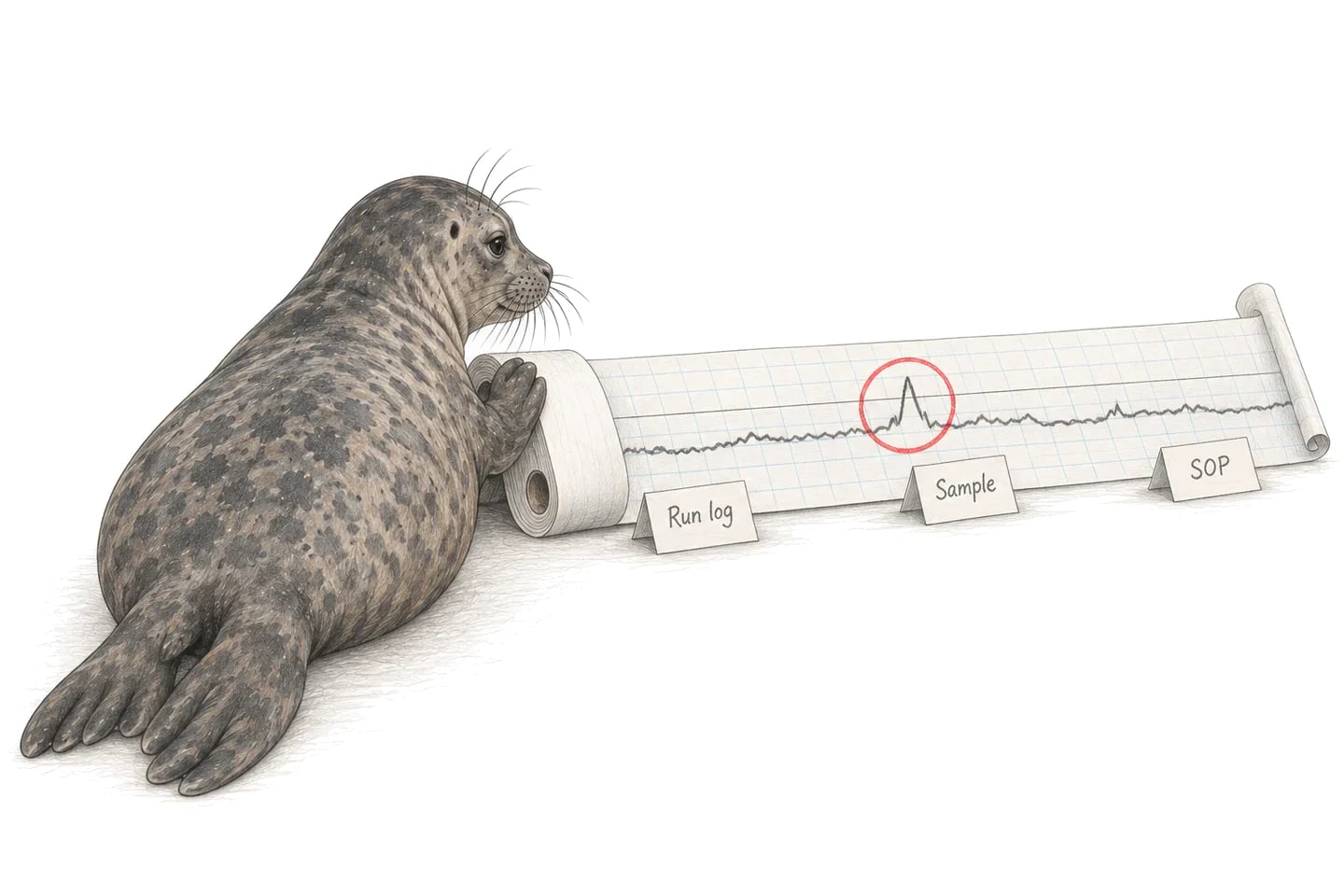
- An OOS case is rebuilt from laboratory, quality and manufacturing systems, and the pressure to find a passing result can blur retests, resamples and invalidation. Reviewers then struggle to see which result came first and why further work was authorised.
- Seal’s approach
- One investigation record connects the original result and raw data to the sample, method, instrument, batch history, hypotheses, additional testing, impact decisions and CAPA. Hypothesis tests and retests run only under a plan approved before results are known.
- What changes
- The original result is never replaced, Phase I evidence carries into the full investigation, and batch impact is an explicit, attributed decision rather than a side effect of closing a task.
- Where to start
- One difficult investigation end to end: an inconclusive Phase I, a bounded retest plan, manufacturing expansion and batch disposition. Book a demo.
An out-
Seal keeps one investigation record from the original observation to disposition. It connects the raw data, sample, method, instrument, analyst, specification, batch history, hypotheses, additional testing, impact decisions and CAPA, so a reviewer can reconstruct the conclusion without rebuilding the case from laboratory, quality and manufacturing systems.
1Preserve the original result and what it means.
OOS, OOT, atypical and invalid are different states. The effective specification determines OOS. A governed statistical or scientific rule identifies OOT. An analyst or reviewer can flag an atypical observation before a formal limit is crossed. Invalid is a conclusion about the test, supported by evidence, not a label for an inconvenient result.
Seal records the initial classification, the triggering rule, the specification and method versions, detection time, reporter and immediate actions, and any later reclassification with its rationale. The workflow can differ by state without collapsing them into a generic deviation.
The first reportable value stays permanent, with every underlying injection or observation, calculation, audit trail, instrument file, preparation and analyst entry. Corrections and reprocessing create traceable versions. No later passing result replaces the original failure: reviewers see which result came first, what changed, who authorised further work and how every valid result contributed to the conclusion.
1.1Why teams choose Seal for OOS and OOT investigations
An inspector reviewing an OOS investigation asks whether each retest was planned and approved before its result was known, which is hard to show when the investigation is a QMS form filled from LIMS exports, chromatography printouts and batch-record copies, with retests tracked in the analyst’s notes. Seal opens the investigation from the result itself, with its sample, raw data, method, instrument and batch already linked, and each retest or resample is a planned, approved step on the same record. When the investigation points to a method or procedure weakness, the corrected method or procedure governs the next analysis, rather than a revised document waiting to be implemented.
2Phase I is a bounded laboratory assessment.
FDA guidance distinguishes the initial laboratory assessment from a full-scale investigation.³ Phase I checks the assignable laboratory conditions: sample identity and custody, preparation, calculations, standards and reagents, system suitability, instrument state, method execution, source files and contemporaneous anomalies.
Water content
0.22 percentage points above the limit
The original result stays in the record.
What supports this reported value?
Follow the result to its original acquisition and processing history. Keep the reported value alongside the evidence used to assess it.
- Original determination and calculation inputs
- Blank, drift and suitability evidence
- Relevant processing and audit-trail entries
“Bring together the source evidence for this result. What is missing from the review?”
A source-linked evidence brief, with gaps called out for the investigator.
Neil works within your access. Your team assesses the evidence and approves the decision.
Tasks are specific and carry evidence. “Check instrument” becomes a review of qualification, calibration, maintenance, alarms, sequence events and the acquisition and processing methods. A checklist item can be configured so that it cannot close without that evidence or an explicit not-applicable rationale. Seal supports this operating model; the manufacturer’s procedures and scientific judgement remain controlling.
3Additional testing runs under a plan approved in advance.
A hypothesis states the suspected mechanism, the evidence behind it, the experiment, the outcome that would discriminate, the material and method to be used, the replicate plan and the acceptance logic. It is approved before execution. Seal then reconciles planned against actual injections, preparations and results, so exploratory injections stay visible and cannot quietly become reportable or disappear from the sequence. This is how the workflow guards against testing into compliance.
Retest and resample mean different things. A retest examines another portion of the original homogeneous sample under an approved plan that fixes analysts, preparations, replicates, instruments and stopping rules before results are known. A resample takes new material from the batch, which can introduce sampling uncertainty, and requires documented evidence that the original sample may not represent the batch. The record shows which occurred, why, who authorised it and how all results are evaluated.
4The full investigation carries Phase I forward.
When Phase I demonstrates no conclusive laboratory cause, the case expands into manufacturing and product history without discarding the laboratory evidence. Seal opens a governed scope across batch execution, materials, equipment, environment, process data, deviations, changes, cleaning, personnel and comparable lots.
The scope records potentially affected batches and products before the root cause is known. Narrowing it later requires evidence and approval, and does not rewrite the initial assessment.
Batch phase, recipe version, material lots, equipment state, alarms, holds, process values and interventions attach through shared identifiers and time windows, so reviewers do not export and align histories by hand. Direct evidence stays distinct from inference: a historian interval can support a process observation and a correlation across lots can suggest a hypothesis, but neither becomes a confirmed cause without approved reasoning and review.
5Conclusions keep their uncertainty. Disposition is a separate decision.
A conclusion can be confirmed laboratory error, confirmed manufacturing cause, probable cause, no assignable cause or another governed category. Each requires evidence and can carry its confidence, limitations, dissenting review and residual risk. “Human error” is not accepted as a final mechanism without examining the instruction, interface, workload, training, equipment and control design that made the action possible.
Investigation status and batch disposition are related but separate. The impact assessment weighs the original result, valid additional results, product and process knowledge, other attributes, stability, related and distributed lots, and uncertainty. Seal records which lots are held, rejected, released or require further action, who decided and on what evidence. Closing a laboratory task cannot release material.
6Trend rules and recurrence need a defined population.
OOT signals can come from trend limits, regression models, stability expectations, control-chart rules and prior-lot comparisons. Each rule is versioned, with its product, test, method, timepoint or stage, population, calculation, minimum data, effective dates and owner. Method, specification, site, process and instrument changes create visible population boundaries, so a signal does not arise from mixing incompatible cohorts.
Structured factors such as product, method, analyte, instrument, column, material, root-cause family and failure mechanism support analysis across cases, while text search keeps the nuance of the narratives. Related cases can be linked without prematurely declaring a common cause; a pattern review records its population, inclusion logic, evidence and conclusion.
7Actions, accountability and retrieval start from the mechanism.
A CAPA starts from the confirmed or probable mechanism, the affected control, risk, owner and effectiveness measure. Method revisions, instrument remediation, training, supplier action and process or specification changes follow their own governed workflows. Effectiveness criteria are set before implementation over a bounded future population; “no repeat observed” is not enough unless there was an opportunity for the failure to recur.
Notification, supervisor assessment, QA involvement, manufacturing response, impact review and disposition each have an accountable role and time expectation. Paused clocks keep their reason, and escalation does not change the original due history. The analyst who ran the test can contribute evidence without being made to approve the conclusion.
Metrics measure investigation health rather than closure speed: time to containment, Phase I completeness, recurrence, ageing by state, invalidation rate by method, retest frequency, no-cause rate and open product exposure, each with its denominator. From an OOS result, an inspector can follow the raw data, Phase I tasks, hypotheses, additional testing, scope, rationale, impact decision and signatures; from a batch, every laboratory signal affecting disposition. Approved exports freeze the evidence reviewed at decision time.
8Prove one difficult investigation end to end.
Start with an original failing result, an inconclusive Phase I, an approved hypothesis that does not explain the failure, a bounded retest plan, manufacturing expansion, an affected-lot population, a no-assignable-cause conclusion, batch disposition, CAPA and trend review.
Then rehearse a clear calculation error, an OOT stability result, an instrument data-transfer failure, a suspected sample mix-up, invalid system suitability and a passing retest after OOS. The workflow is ready when every path preserves the original evidence and reaches the right accountable decision.
References
- 121 CFR 211.192, Production record review: an unexplained discrepancy must be thoroughly investigated, with a written record of the conclusions and follow-up. eCFR
- 2EudraLex Volume 4, Part I, Chapter 6, Quality Control (2014), section 6.35: out-
of- specification results or significant atypical trends should be investigated. European Commission - 3FDA, Investigating Out-of-Specification (OOS) Test Results for Pharmaceutical Production, guidance for industry, Revision 1 (2022), sections III (Phase I laboratory investigation) and IV (Phase II full-scale OOS investigation). FDA
ACapabilities
| Capability | What it covers |
|---|---|
| Signal classification | OOS, OOT, atypical and invalid are recorded as different states, each with its triggering rule and the specification and method versions in effect. A later reclassification keeps its rationale. |
| Immutable original evidence | The first reportable value stays permanent with its injections, calculations, audit trail and instrument files. Corrections and reprocessing create traceable versions rather than replacing it. |
| Phase I laboratory assessment | Phase I checks sample identity and custody, preparation, standards and reagents, system suitability, instrument state and source files. A checklist item can be configured so that it cannot close without evidence or a not-applicable rationale. |
| Hypothesis and retest control | Hypotheses, retest plans, replicates and stopping rules are approved before results are known. Planned and actual testing are reconciled, so exploratory injections stay visible. |
| Manufacturing investigation | When Phase I finds no conclusive laboratory cause, batch execution, materials, equipment, process data, deviations and comparable lots attach through shared identifiers and time windows. Direct evidence stays distinct from inference. |
| Product impact and disposition | Potentially affected lots are scoped before the cause is known, and narrowing that scope needs evidence and approval. Disposition is a separate, attributed decision; closing a laboratory task cannot release material. |
| Cross-case trending | Versioned trend rules define their product, test, population and effective dates, so a signal does not arise from mixing incompatible cohorts. Structured factors support analysis across cases without prematurely declaring a common cause. |
| CAPA and effectiveness | A CAPA starts from the confirmed or probable mechanism, the affected control, risk and owner. Effectiveness criteria are set before implementation over a bounded future population. |
BConnected records
CQuestions and answers
What is OOS investigation software?
It keeps one record from an out-
What is the difference between OOS and OOT?
OOS is determined against the effective specification. OOT identifies unexpected behaviour against a governed trend rule, model, prior result or scientific expectation, even when the value remains within specification.
Can a passing retest replace an OOS result?
No. Seal preserves the original failure and every later result. The approved plan and scientific assessment determine how the complete valid dataset contributes to the conclusion and disposition.
How does the workflow guard against testing into compliance?
Hypotheses, retest or resample rationale, replicates, analysts, instruments and stopping rules are approved before execution. Planned and actual testing are then reconciled, so exploratory injections stay visible and cannot quietly become reportable.
Does the workflow support Phase I and Phase II investigations?
Yes. The initial laboratory assessment is bounded and evidence-specific. If it demonstrates no conclusive laboratory cause, the case expands into manufacturing and product history without discarding the Phase I evidence.
How are chromatograms and raw data attached?
Seal can reference or ingest source files and metadata from instruments, a chromatography data system or an SDMS. The sequence, injection, processing, audit-trail and calculation context stays with the result.
Can Seal manage retest and resample plans?
Yes, as distinct plan types. A retest examines another portion of the original homogeneous sample under a plan that fixes analysts, preparations, replicates and stopping rules in advance. A resample takes new material and needs documented evidence that the original sample may not represent the batch.
How are affected batches identified?
The investigation follows the sample and batch to shared materials, equipment, methods, process versions and time windows. The initial scope is recorded before the root cause is known, and narrowing it later requires evidence and approval.
Can an investigation close with no assignable cause?
Yes, where the procedure allows it and a complete investigation supports it. The conclusion keeps its uncertainty, residual risk and product-impact rationale, together with any monitoring or preventive actions.
How does OOS connect to CAPA?
The confirmed or probable mechanism, affected control, risk and population carry into the CAPA or change record. Effectiveness criteria and a future observation cohort are defined before implementation, because “no repeat observed” means little without an opportunity for the failure to recur.
What OOS metrics should be tracked?
Measure investigation health rather than closure speed: time to containment, Phase I completeness, ageing by state, invalidation and retest rates, recurrence, no-cause rate and open product exposure. Each metric needs its denominator and links to the source cases.
What should the first implementation prove?
Start with a difficult case: an original failure, an inconclusive Phase I, a rejected hypothesis, a bounded retest, manufacturing scope, lot impact, disposition, CAPA and trend review. Then rehearse edge cases such as a data-transfer failure and a suspected sample mix-up.