Summary
- The problem
- Reports arrive through many countries and channels with different descriptions. Duplicates, changing follow-up information and jurisdiction-
specific clocks make it hard to know which cases are valid, what is due where and whether a pattern is new safety information. - Seal’s approach
- Each case keeps its source, first awareness, versions, coding with dictionary version and separate medical judgements. Reportability is calculated per destination from configured rules, and ICSR messages, aggregate reports and signals retain their population and decisions.
- What changes
- Reviewers can see the rationale behind every due date and submission, aggregate tables are reproducible against a frozen population, and a signal decision links to the benefit-risk action and markets it affects.
- Where to start
- One representative case from first awareness to ICSR acknowledgement, including a follow-up that changes seriousness and a duplicate to be linked. Book a demo.
1Similar reports are not yet a signal.
Several reports arrive through different countries and channels with different verbatim descriptions. They may be duplicates, background disease, a known adverse reaction, a product-quality issue, a reporting artefact or new safety information. A count alone does not settle which.
Seal keeps each report, its source and every later judgement on connected records, so reviewers can see what the evidence supports and what it does not. The same records carry the case from first awareness to a valid case, a report for each destination, an aggregate analysis and, where the evidence warrants it, a governed signal and a benefit-risk action.
1.1Why teams choose Seal for pharmacovigilance
A standalone safety database holds the case while clinical events, complaints, deviations, product registrations and approved documents live in other systems, so every aggregate report and signal assessment starts by collecting evidence again. Seal puts the safety case, reportability decisions, ICSR lifecycle, aggregate analysis and signal governance on the same record model as that evidence, and a reporting rule changes as versioned configuration. A due date can be explained from the rule that produced it, and a signal review starts from connected evidence rather than a fresh collection exercise.
EDC and CTMS supply clinical context, complaints and deviations supply product-quality evidence, and regulatory records supply products, markets and commitments.
2Build a valid case from the source.
Intake keeps the channel, sender, country, language, source document, verbatim narrative and attachments as received. Transcription and translation sit beside the original rather than replacing it, and the record shows when the organisation first had enough information to begin evaluation, because reporting clocks depend on that date.
Minimum criteria (an identifiable patient and reporter, a suspect product and an adverse event) are assessed according to the applicable process, and each outcome keeps its rationale: valid, potential, invalid, product complaint, medical information or follow-up needed. Seriousness, pregnancy, medication error, lack of effect or a suspected quality defect can drive priority and routing.
Duplicate management protects case counts. Candidate matches come from patient characteristics, dates, products, events, narrative similarity and external identifiers. A decision to merge, link, keep separate or nullify preserves the source reports, submitted identifiers and reviewer rationale.
Follow-up is specific to the question and the source: what information is missing, who was asked, by which route and what came back. New information creates a case version, which may change seriousness, expectedness, causality, reportability, due dates or prior submissions.
3Keep coding and medical judgement separate.
Coding keeps the reported term beside the MedDRA lowest-level and preferred terms, the dictionary version and any recoding. When the dictionary is upgraded, the change is assessed, and historical submissions retain the terms and version actually used.
Medical assessment records seriousness, expectedness against the applicable reference, reporter causality and company causality as separate judgements, each with its evidence: temporal relationship, dechallenge and rechallenge, alternative causes, medical history and concomitant therapy. An algorithm may support consistency, but the judgement stays with qualified reviewers.
Case quality is reviewed against the same record: completeness, coding, chronology, narrative, assessment, reportability and due-date logic. Sampling and error trends can target training or process change without obscuring individual corrections.
4Report by destination and track every message.
Reportability depends on context: clinical or postmarketing status, authority and country, seriousness, expectedness, causality, the clock-start rule, the reporting party, partner agreements and the version of the rule applied. Seal calculates each destination’s obligation from configured requirements and shows the rationale behind the due date, rather than applying one global seven- or fifteen-day rule.
Case AE-0614
Fatal outcome, day 0
Serious, unexpected, company product
Due date from each rule
- FDA / US
- MedWatch 3500A
- EMA / EU
- E2B(R3)
- PMDA / JP
- E2B(R3)
- TGA / AU
- CIOMS I
Each ICSR message has its own lifecycle: identifiers and version, message type, sender and receiver, E2B data elements, validation errors and warnings, transmission, acknowledgement, rejection and resubmission. An accepted acknowledgement closes the technical loop. It does not replace medical review of the case or outstanding follow-up.
5Analyse a frozen population, then govern the signal.
An aggregate report is defined by its product and authorisation scope, reporting interval, data-lock point, case inclusion rules and exposure source. Line listings and summary tabulations are reproducible queries against that frozen population. Safety scientists remain accountable for the medical analysis, limitations, benefit-risk interpretation and conclusions.
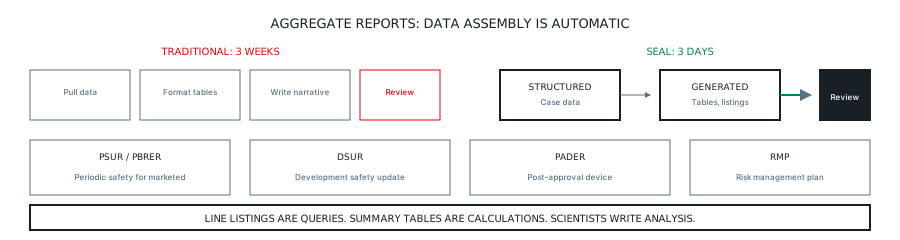
Signal management begins after detection. A disproportionality score is one detection input, not proof of a signal.¹ The signal record keeps the data source, search strategy, MedDRA scope, case series, literature and confounding considered, and moves through potential, validated, refuted, closed and reopened states with the evidence and governance decision behind each.
When assessment leads to action (a new study, a labelling change, a risk-minimisation measure, a healthcare communication, a product-quality action or a deliberate decision to change nothing), implementation and effectiveness remain linked to the signal and to the markets it affects.
6Keep partners on the same case history.
A pharmacovigilance agreement defines who does what: product and territory scope, day-zero exchange, case and follow-up transfer, submissions, literature, signals and aggregate reports. Exchange records and reconciliation show whether both parties hold the intended cases and versions, so a missing case is found during reconciliation rather than at an inspection.
7Start with one case through its full lifecycle.
Follow a representative case from first awareness through validity, duplicate search, follow-up, coding, medical assessment, reportability for each destination, ICSR generation and acknowledgement. Include a follow-up that changes seriousness or expectedness, and a duplicate that must be linked rather than counted twice.
Then extend the same records into aggregate reporting and signal management. Replacing an existing safety database depends on your products, countries, volumes, gateway arrangements, dictionaries, migrations and partner processes, so scope those before committing to a cutover.
References
- 1ICH E2E, Pharmacovigilance Planning (2004). ICH
AConnected across Seal
BCapabilities
| Capability | What it covers |
|---|---|
| Case management | Intake from call centres, healthcare professionals, literature and clinical trials keeps the source as received. Coding and causality assessment are recorded as separate judgements with the patient context beside them. |
| Expedited reporting | Calculate reportability, day zero and due date for each destination from configured requirements. Each report keeps its format, validation, transmission, acknowledgement and any late-report evidence. |
| Signal detection | Statistical, rule-based, clinical, literature and quality inputs create candidates for review. Qualified reviewers validate, prioritise and assess each one, and the signal record keeps the evidence behind each decision. |
| Aggregate reports | Define the population, interval and data-lock point, then produce reproducible line listings, tabulations and source-linked narratives. Safety scientists remain accountable for the medical analysis and approval. |
| MedDRA coding | Reported terms are kept beside the selected MedDRA lowest-level and preferred terms and the dictionary version. Dictionary upgrades are assessed, and historical submissions retain the terms and version actually used. |
| Benefit-risk assessment | Signal decisions link to the resulting benefit-risk action, such as a study, labelling change or risk-minimisation measure, and to the markets it affects, with implementation and effectiveness kept on the same record. |
| Regulatory submissions | Configured E2B(R3) ICSR messages are validated and transmitted through the applicable gateway or integration. Each message keeps its acknowledgement, rejection and resubmission history. |
| Quality integration | Adverse events link to product complaints, deviations and CAPAs, so a safety case and a quality investigation of the same concern share their evidence. |
CConnected records
DQuestions and answers
Can Seal replace an existing safety database?
Seal is designed to cover the core safety operating model: intake, case processing, reporting, aggregate analysis, signals, benefit-risk and quality integration. Whether it can replace an existing system depends on your products, countries, volumes, gateway arrangements, dictionaries, migration and partner processes. Scope those before committing to a cutover.
How do you handle E2B(R3) submissions?
Seal generates and validates configured E2B(R3) ICSR messages and transmits them through the applicable gateway or integration. Each message keeps its sender and receiver identifiers, acknowledgements and errors. Correction, follow-up, nullification and resubmission are controlled on the same record.
What about literature surveillance?
Literature cases are entered with the source article attached and follow the same intake, validity, duplicate and assessment workflow as spontaneous reports. Literature responsibilities between partners are set out in the pharmacovigilance agreement.
How does signal detection work?
Detection inputs, including statistical and rule-based methods, clinical review, literature and quality data, create candidates for review. Qualified reviewers validate, prioritise and assess each candidate. The signal record keeps the data source, search strategy, case series and governance decision behind each state.
Can we handle global safety reporting from one system?
Yes. Seal calculates reportability for each destination from configured requirements, so one case can lead to reports for several markets, each with its own format, due date and rationale. Cases entered by local affiliates sit on the same records used for aggregate analysis and signal management.
What about clinical trial safety?
Seal covers both clinical trial and post-marketing safety. SAE reporting, DSUR preparation and investigator notifications use the same case records. As a product moves from development to market, its safety history stays in one place.
Are all serious cases due in seven or fifteen days?
No. Timing depends on clinical or post-marketing context, product, report source, validity, seriousness, expectedness, causality, country, authority and reporting party. Seal shows the rule version and decision rationale for each destination.
Does a disproportionality score prove a safety signal?
No. It is one detection input. Before a governance decision, qualified reviewers consider case quality, duplicates, exposure, background rates, confounding, literature, class effects, clinical evidence, product quality and plausibility.
How are duplicate reports controlled?
Candidate matches come from patient and reporter characteristics, products, events, dates, country, narratives and external identifiers. A reviewer decides whether to merge, link, keep separate or nullify. The source reports, submitted identifiers and rationale are retained.
What establishes day zero?
Seal records first awareness, source receipt, when minimum case information was available and any partner handoffs. It retains the clock-start rule applied, the rationale and any later information that changes validity or reportability.