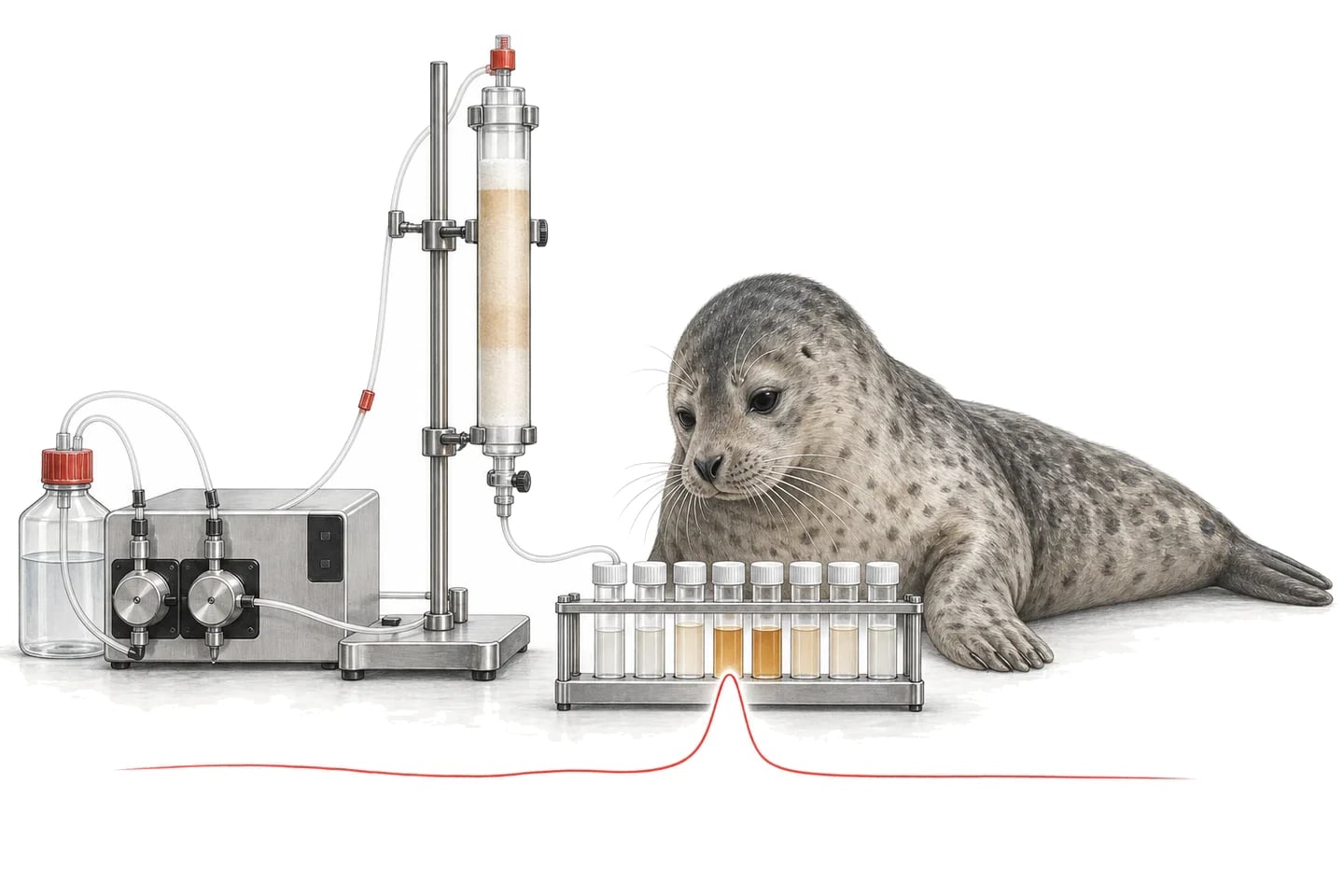
1A fraction becomes a LIMS sample
Illustrative identifiers show the relationships to configure; they are not a required Seal schema.
Run
PUR-042 / evaluation 2
Link column, method revision, curves, peak table and report.
Fraction
F-08 / 120–135 mL
Preserve the volume axis; do not reinterpret the bounds as minutes.
Pool
POOL-09 from F-08 and F-09
Keep both contributing fraction references and any required amounts.
LIMS sample
S-0182 from POOL-09
Retain the receiving system’s sample ID and requested test.
2Keep the purification run and its derived samples connected.
A purification run may produce several fractions, only some of which become samples for further testing. Preserve the run as its own record, then create fraction references where the team needs individual tracking. A LIMS sample should identify the fraction or pool it represents. Its display name alone is not a reliable link back to the chromatography run.
Agree which system assigns sample identifiers and which one owns the analytical request. Seal can hold the experiment, source Files and relationships while a LIMS owns laboratory sample status. Sending a fraction record to an external LIMS requires a separately configured receiving operation and permissions; file collection alone does not create a LIMS sample.
3Choose numerical evidence separately from the result archive.
The UNICORN connection profile describes ASCII curve and peak-table exports. Keep the complete result archive separately when it is needed for reopening in compatible UNICORN software. A rendered report is useful review evidence, but an image of a chromatogram is not a numerical replacement for exported coordinates.
Confirm the installed UNICORN version, export selections and evaluation revision. Record cropping, reduction and normalisation choices with the source File. Keep channel labels and units so downstream calculations do not confuse detector response, conductivity and concentration. Collection through an approved site computer leaves acquisition and evaluation in UNICORN.
4Retain boundaries and pooling decisions explicitly.
Use a source-system identifier plus run identity and evaluation revision to match an import. A fraction should retain its source identifier and collection boundaries with their axis and unit. Do not match a volume-based boundary against a time-based curve merely because both have two numeric endpoints. Conversion needs the appropriate flow information and an agreed calculation.
A pool is another relationship: record which fractions contributed and, where required, their contributed amounts. Link the resulting test sample to the pool rather than replacing all contributing fractions with one label. This lets a reviewer trace a purity or concentration result back through the pool to the original run.
5Separate transport retries from scientific changes.
Replaying the same completed export should resolve to the same import under the configured identity rule. A changed peak evaluation needs a distinct revision relationship and preserved evidence. Neither a new filename nor a later upload time proves that a new purification run occurred.
If the LIMS accepted a sample request but its response was lost, reconcile using the agreed external identity before submitting again. Keep pending, accepted and rejected exchanges visible. Define what happens when a revised evaluation arrives after a sample has been tested or a batch reviewed. An import must not silently imply approval of a scientific change.
6Test it with your data.
Use these cases to agree and test the connection’s behaviour. They are proposed acceptance checks, not completed tests or automatic connector features.
Two runs both contain fraction F-08
PUR-042 and PUR-043 each contain an F-08 fraction. The receiving request names only F-08.
- Expected behaviour
- Leave the request unresolved until the parent run is identified. Do not attach it to the first matching fraction.
- Evidence to keep
- Both source run identifiers, the ambiguous request and the eventual run-to-sample mapping.
A revised evaluation arrives after pooling
Evaluation 3 changes a fraction boundary after POOL-09 was recorded against evaluation 2.
- Expected behaviour
- Keep the pool’s original references. Show the changed boundary for impact assessment instead of silently rewriting the pool history.
- Evidence to keep
- Both evaluations, the contributing fraction references and the recorded assessment of the change.
More checks for this connection
- Trace a known LIMS result through its sample and pool to the original run evidence.
- Replay the same export and confirm no duplicate run or sample request.
- Re-evaluate a peak and confirm the prior evaluation remains identifiable.
- Test a missing fraction identity and a changed axis unit before unattended use.
7Before you connect
Does Seal directly control ÄKTA acquisition?
This workflow concerns exported evidence and record exchange. Acquisition and evaluation stay in UNICORN.
Can every fraction become a LIMS sample?
Configure that only when the process requires it and the LIMS supports the receiving operation. Many teams track all fractions but register only selected fractions or pools for testing.
8Check your system’s connection options.
Confirm the installed version, available exports and permissions. These pages cover the source interface and link to setup instructions.
For configuration: Seal Scripts and local-file collection.
9Start with one export.
Bring the source evidence and the records it needs to connect to. For this workflow, a useful starting pack is:
- A completed UNICORN export with its run, evaluation and channel identifiers.
- The fraction list, collection boundaries and a pooling record, if pooling is in scope.
- One receiving LIMS sample and the identifiers used to create or find it.