Summary
- The problem
- Each autologous therapy is a patient-specific case with a finite clock, but its order, custody, batch record, test results, quality events and release often live in separate systems. Every handoff between them costs time and puts identity at risk.
- Seal’s approach
- The treatment order creates one governed therapy case. Chain of identity and custody, the electronic batch record, QC and environmental testing, quality events, CoA and release operate on that case, and a mismatch at any critical handoff blocks progression.
- What changes
- Release evidence assembles as the patient lot progresses, and exceptions open with the case, material, schedule and remaining window already attached, so the network coordinates from one governed status instead of email.
- Where to start
- One representative therapy case from treatment order to treatment readiness, including an identity mismatch, an equipment-data failure and a courier delay. Book a demo.
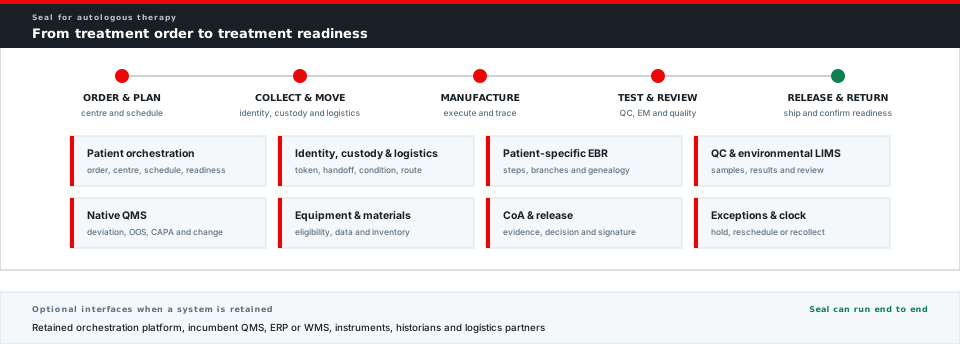
An autologous therapy is better understood as a patient-specific case with a finite clock than as a batch that happens to belong to a patient. The case begins with an authorised treatment order and ends when the released product is received into the correct treatment workflow.
Seal can run that case end to end. Patient orchestration, chain of identity and custody, electronic batch execution, material genealogy, QC and environmental testing, equipment evidence, quality events, CoA, release and return operate on one data model. Where another system is deliberately retained, its authority and interface are explicit; it is not a prerequisite for the operating model. For clinic workflows, hospital access and site rollout, see the patient orchestration blueprint.
Why teams choose Seal for autologous therapy
In many autologous operations, a treatment centre asking where its patient’s lot stands is answered from an orchestration portal stitched to a batch record, a LIMS and a QMS with interfaces and email, and each join is a place where identity can be re-keyed and time can be lost. Seal holds the treatment order, the patient lot, its samples, its exceptions and its release decision as records of one case, so the status the centre sees is derived from the same evidence QA reviews. As the process matures, later lots pick up each approved revision, and each patient lot keeps the process version it was made under.
1Make the therapy case the control object.
A treatment order creates the governed case: product, treatment centre, planned dates, collection requirements, chain-of-identity token, permitted patient attributes, responsible roles and current state. Scheduling resolves the collection slot, courier lane, suite, equipment, qualified people, materials, laboratory capacity and release window around that case.
Treatment centres, coordinators, logistics, manufacturing, QC and QA each see a role-appropriate view of the same state. A schedule change keeps the prior plan, the reason, the approval and its effect on the remaining vein-to-vein window. The status shown outside manufacturing comes from operational evidence, not from a parallel tracker.
2Enforce identity and custody at every handoff.
Operational views use controlled pseudonymous identifiers. Authorised roles receive only the patient context their work requires, and access to protected identity, failed checks and changes is audited.¹
Chain of identity relates the patient, collection, starting material, every intermediate and sample, the final product, the shipment and the treatment-centre handoff.² Chain of custody records who held each physical object, where, when and in what condition. At every critical handoff the expected identifiers and the physical object are verified. A mismatch blocks normal progression and opens containment. Reprinting, relabelling and manual recovery keep the prior value and the reason for the change.
3Let manufacturing adapt inside approved boundaries.
Starting-material receipt is an eligibility gate. Identity, custody, collection time, container condition, quantity, cell count and documents determine whether processing can begin. Borderline material keeps its observed state and follows the approved decision path: continue, rescue, recollect or cancel.
The electronic batch record controls the process version, calculations, limits, timers, branches, signatures, materials, equipment and samples. Variable starting material may select an approved path; it does not permit improvisation. In the example below, a Day 7 viable-cell count below target extends culture to Day 10 under rule BR-CT-04. The executed branch keeps its source result, governing rule, decision authority and effect on the patient’s clock.
Equipment qualification, calibration, cleaning and availability gate the relevant step, and personnel need current procedural, aseptic and task qualification. If an eligibility later proves unacceptable, the same records identify every therapy case affected since the last known acceptable state.
Every material that touches the patient lot, from media, cytokines and vectors to bags, labels and cryopreservation materials, stays linked to it. Sampling, splitting, loss, cryogenic storage, pack-out and dispatch are explicit genealogy events, so a component concern traces forward to every affected case. Freezing profile, storage location, temperature evidence and excursions stay attached to the final product; restored temperature does not erase prior exposure.
4Land equipment data in the record it proves.
Connection design starts with the actual device: vendor, model, software, output, network location and the record it should populate. Cell washers, counters, incubators, bioreactors, cytometers, environmental monitors and controlled-rate freezers keep their native controls.
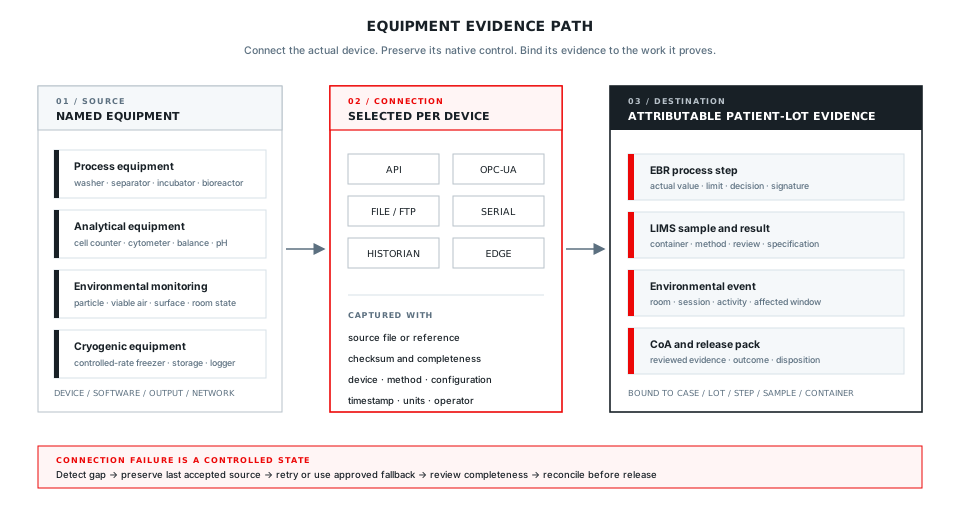
Where the equipment supports it, Seal collects through an API, OPC UA, a file share, a serial gateway, a historian or a local edge service. The captured evidence keeps its source file or reference, checksum where applicable, instrument, method, operator, timestamp, units and its patient-lot, step or sample context. Each connection defines acknowledgement, retry, clock handling, completeness checks and a governed manual fallback. If a connection fails, the record shows the gap rather than silently substituting transcription.
5Share the case context with the laboratory and quality.
Manufacturing creates in-process and release samples with the source container, collection time, priority, test panel, limits and the decision waiting on them. Cell count, viability, identity, purity, potency-related measures, microbiology and vector copy results return to the step they govern. Environmental samples keep their room, session, activity, limits and the manufacturing window they affect.
A deviation opens from the exact patient lot, step, equipment, sample, result and time that triggered it. Investigation, OOS, CAPA, change control and disposition operate on the same objects as the batch record and the laboratory, so quality receives the context without an interface. Where another QMS remains authoritative, Seal sends the event context, keeps the external reference and uses the approved outcome to gate execution or release. Every retained system follows the same rule: one authority for each state, with versioned messages, acknowledgement, reconciliation and audit evidence.
6Assemble release as the case progresses.
Seal evaluates execution, identity and custody, genealogy, equipment and personnel eligibility, environmental evidence, laboratory results, quality events and outstanding actions as the patient lot progresses, rather than in a final document hunt. The CoA is generated from the approved specification and reviewed results. Disposition records what was reviewed, by whom, under which version and with which conditions and signatures.³ Pending evidence never appears as passed.
Final labels render from governed product, case and container data. Dispatch verifies the released state, destination, treatment schedule, shipper and documents; treatment-centre receipt records time, condition, identifiers and any discrepancy before the case reaches treatment readiness. Seal governs the operational handoff; clinical administration and medical judgement stay with the treatment centre.
When something goes wrong, whether an identity discrepancy, growth failure, missed process window, failed test, cryogenic excursion or courier delay, the event opens with the case, affected material, schedule, evidence and remaining window attached. Actions are time-stamped and acknowledged, and every party receives the governed status it needs without email becoming the operating model.
7Prove one representative case.
- Define the case and authority. Configure the therapy case, identify any retained systems and give each state one authoritative owner.
- Run the complete course. Execute order, scheduling, collection, logistics, receipt, batch record, samples, QC, environmental monitoring, quality, CoA, release, return and treatment readiness.
- Connect the real equipment and systems. Test named interfaces, failure handling, security boundaries and manual fallback.
- Validate and scale. Trace requirements to configuration and tests, train users by role, rehearse cutover and expand by process, suite or product.
Include the failure paths: an identity mismatch, a schedule change, a borderline receipt, a process branch, an equipment-data failure, an OOS result, a cryogenic excursion, a courier delay, a recollection and a cancellation. The system is ready when every path preserves identity, custody, evidence, time and an accountable decision.
References
- 121 CFR 11.10, Controls for closed systems: procedures and controls must include system validation, limiting access to authorised individuals, and secure, computer-generated, time-stamped audit trails that record operator entries and actions without obscuring previously recorded information. eCFR
- 221 CFR 1271.290, Tracking: establishments must maintain a system that tracks each HCT/P from the donor to the consignee or final disposition, and back. eCFR
- 321 CFR 211.22, Responsibilities of quality control unit: a quality control unit must have the responsibility and authority to approve or reject components, in-process materials, packaging, labelling and drug products, and to review production records. eCFR
ACapabilities
| Capability | What it covers |
|---|---|
| Patient orchestration | Treatment orders, centres, schedules, capacity, collection, logistics, manufacturing status, release and treatment readiness operate as one therapy case. |
| Chain of identity and custody | Authorised identity, physical objects, senders, receivers, locations, conditions, verification and discrepancies are recorded at each handoff. |
| Electronic batch records | Approved calculations, limits, timers, decisions and branches adapt to variable starting material while preserving the governing process version. |
| Material and container genealogy | Source material, media, vectors, components, splits, pools, samples, losses, cryobags and custody events remain connected to the patient lot. |
| QC and environmental LIMS | Process, release, microbiology and environmental work share sample context, specifications, methods, instrument evidence, review and decisions. |
| Equipment and qualified operations | Eligible equipment and trained people gate execution while process and laboratory outputs arrive with source, integrity, timestamp, units and exact patient-lot context. |
| Cryogenic storage and logistics | Freeze programs, storage locations, temperature evidence, transfers, excursions, shippers, routes, custody and receipt stay with the product through to treatment readiness. |
| Native quality management | Deviations, OOS, CAPA, change control, effectiveness and disposition use the same patient lot, step, sample, equipment and evidence as EBR and LIMS. |
| CoA and patient-lot release | Reviewed results populate the CoA while EBR, identity, material, equipment, environmental, exception and signature evidence converge into disposition. |
| Patient-lot exception control | Identity, material, process, equipment, quality, environmental, cryogenic and timing failures retain the affected object and remaining patient-specific window. |
| Retained system interfaces | Any retained orchestration, QMS, ERP, warehouse, instrument, historian, logistics or partner system exchanges versioned state and evidence with explicit authority and recovery. |
| Validation and controlled change | Requirements, configuration, interfaces, tests, roles, signatures, cutover and later changes remain traceable through the validated state. |
BConnected records
CQuestions and answers
Can Seal run patient orchestration as well as manufacturing?
Yes. Seal can manage the patient-specific operating case from treatment order through centre coordination, scheduling, collection, chain of identity and custody, logistics, manufacture, QC, quality review, release, return shipment and treatment readiness. Those workflows share one data model with EBR, LIMS, QMS, equipment, materials and release.
What can Seal run in an autologous cell therapy facility?
Seal can run patient orchestration, chain of identity and custody, patient-specific EBR, material and container genealogy, QC and environmental LIMS, equipment and training controls, QMS, CoA, exceptions, release and return-to-centre milestones on one data model. Organisations can adopt that full operating stack or retain selected systems where migration, validation or ownership requires it.
Can Seal provide QMS as well as EBR and LIMS?
Yes. Seal QMS includes deviations, investigations, OOS, CAPA, change control, documents, training, audit, supplier quality and other governed workflows. Because it shares the data model with EBR and LIMS, a quality event can retain the exact patient lot, step, sample, equipment, result and source evidence without an internal integration.
How does Seal work with a dedicated patient-orchestration platform?
A dedicated orchestration platform is optional. Seal can manage treatment orders, chain-of-identity and custody controls, collection and logistics milestones and treatment-centre coordination itself. Where another platform is retained, it can remain authoritative for selected patient-journey states while Seal receives the authorised case and token and returns manufacturing, exception, release and dispatch states.
Can Seal work with an existing quality system?
Yes. Seal can provide the QMS natively or work alongside an existing one. Where the existing QMS remains authoritative, Seal sends the manufacturing context and source evidence, keeps the external event reference and uses the approved outcome to gate execution or release. The interface is confirmed during discovery.
What is chain of identity in cell therapy?
It is the permanent, verified relationship between the authorised patient identity and the collected starting material, each in-process container and sample, the final product, shipment and treatment handoff. It is built from controlled verification events, not a single barcode field.
What is the difference between chain of identity and chain of custody?
Chain of identity proves whose therapy the material and product belong to. Chain of custody records who controlled each physical item, where, when, in what condition and with what acknowledgement. Autologous therapy requires both.
Can Seal protect patient information?
Operational records can use controlled pseudonymous identifiers while authorised roles receive only the patient context needed for safe manufacturing. Role-based access and audit history apply to identity data, resolution events and outbound messages.
How does an electronic batch record handle variable starting material?
Approved ranges, calculations, decision tables, branches, repeat operations, samples and timing rules adapt the process. Each path retains the source condition and governing rule. Activity outside the approved design follows an exception workflow.
Can Seal integrate with specialised cell therapy equipment?
Connection design starts with the actual vendor, model, software, output, network boundary and intended record. Depending on the equipment, Seal can collect through an API, OPC UA, a file share, a serial gateway, a historian or a local edge service. The source reference, instrument, method, timestamp, units and patient-lot context stay attached, and a failed connection shows as a gap.
Can Seal run QC LIMS, environmental monitoring and CoA generation together?
Yes. Manufacturing can create process, release, microbiology and environmental work with source, priority, specifications, methods, limits, equipment, review and waiting decisions attached. Approved results populate the governed CoA and become part of the patient-lot release pack.
How are cryogenic excursions handled?
The excursion attaches to the exact container and interval with storage or shipment evidence, logger, route, custody, product state and affected therapy case. Assessment and disposition remain explicit; restored temperature does not erase exposure.
Can Seal support out-of-specification patient-lot pathways?
Where the product, approved procedure, applicable regulation and authorised clinical and quality roles permit an exceptional pathway, Seal preserves the result, evidence, patient-specific rationale, roles, conditions, notifications and follow-up. It does not determine medical benefit-risk.
How are materials traced to patients without exposing identity?
Manufacturing genealogy uses controlled manufacturing-case and chain-of-identity tokens. A material concern can trace to affected patient lots while protected identity resolution remains limited to the authoritative service and authorised roles.
What should the first implementation prove?
Execute one representative therapy case from treatment order, centre and schedule through collection, logistics, receipt, identity checks, dynamic EBR, equipment data, QC, environmental monitoring, CoA, quality-event handling, disposition, return shipment and treatment readiness. Include realistic mismatch, outage, missing-result, excursion and schedule-change paths.