Summary
- The problem
- An oligonucleotide batch turns a molecular definition into hundreds of repeated chemical cycles, then fractions, pools and final API. When sequence, reagent lots, cycle evidence and pooling decisions sit in separate records, a reagent alert or impurity question is hard to trace to exact positions and containers.
- Seal’s approach
- The approved sequence is the manufacturing authority: it generates a reviewed recipe, drives material issue by position and remains the analytical reference. Cycles, fractions, pools and quantity conversions are recorded as connected, first-class records.
- What changes
- A final container can be traced back to every base, cycle, fraction and pooling decision, and mass balance uses explicit molar and mass bases instead of manual conversions.
- Where to start
- One sequence-
to- container lineage, including a repeated coupling, a borderline fraction and a post-release amidite alert. Book a demo.
Oligonucleotide manufacturing turns a controlled molecular definition into hundreds of repeated chemical operations, then separates, pools and transforms the result into an API or drug substance. Sequence, position, chemistry, reagent identity, cycle performance, fractions, impurities and mass balance all have to stay connected.
Seal represents ASO, siRNA, aptamer, guide RNA and other synthetic oligonucleotide processes without reducing them to a generic chemical batch. The approved sequence becomes an executable manufacturing input and a persistent analytical reference.
Why teams choose Seal for oligonucleotide manufacturing
When the sequence lives in one document, reagent lots in another and cycle data on the synthesiser, a reagent alert or impurity question has to be traced by hand to positions, fractions and containers. The sequence generates a reviewed recipe, drives material issue by position and remains the reference for analysis, and a revised sequence or recipe is reviewed and approved before a batch uses it. Cycles, fractions, pools and quantity conversions are connected records, so a final container can be traced back to each base, cycle, fraction and pooling decision.
1Make the approved sequence the manufacturing authority.
The product definition includes sequence and direction, strand role, length, backbone, sugar and base modifications, protecting groups, conjugates, counterion, molecular formula and mass, impurity strategy, specifications and methods. A rendered sequence is never the sole authority: structured, position-
Sequence approval is independent of batch creation. Draft, reviewed, approved, effective and superseded versions keep their author, checker, comparison and signatures, and a change highlights insertions, deletions, substitutions, modification and conjugate changes. An active batch cannot use an unapproved molecular version.¹
The effective sequence and chemistry generate the cycle order, amidite positions, coupling, capping, oxidation or sulfurisation, detritylation, washes, repeat logic, expected consumption and instrument method. The generated output keeps its generator version, inputs, checksum, review and approval. Manual overrides are bounded fields with a rationale, and Seal compares the recipe with the molecular definition before release.
2Record synthesis by position and cycle.
Phosphoramidites, solid support, activators, capping, oxidising and deblocking reagents, solvents and cleavage reagents keep their lot, concentration, water content or other critical attributes, storage and status. Issue records the actual material and lot by cycle, so a later reagent alert identifies the exact positions, batches, fractions and final lots exposed.
Before start, Seal verifies the synthesiser, column or reactor, scale, software, method, calibration, cleaning and prior-product state, and reconciles physical bottle positions with the generated recipe. The synthesiser stays authoritative for valve actions and high-frequency signals. Seal records each cycle’s intended base and modification, reagent lots, key parameters, monitoring response, alarms, holds, repeats and source file. A repeated coupling keeps the initial event and its sequence position; it never overwrites them or silently shifts the rest of the sequence.
Cleavage and deprotection create new chemical states. Support identity, reagents, conditions, washes and recovery stay linked to the synthesis lot, and the crude material receives its own identity, quantity, container, status and hold. Hazard and containment controls follow the actual chemistry.
3Treat fractions and pools as first-class material.
Chromatography load, column, method, buffers, gradients, detector signals, fractions, volumes, concentrations and tests form one record. Each fraction keeps its lineage, and discarded, reprocessed, held and investigation fractions remain in the mass balance.
Pooling is a scientific and a quantity decision. The pool plan defines eligible fractions; the actual decision records purity, identity, impurity profile, quantity contribution, rationale, reviewer and the resulting pool calculation.
Many-to-one genealogy supports tracing back from final API to exact chromatographic intervals, and forward from a concerning fraction to every container derived from it.
4Keep stoichiometry and quantity basis explicit downstream.
Ligand conjugation connects conjugate lots, stoichiometry, conditions, yields and residual removal. For siRNA and other multi-strand products, sense and antisense lineages stay separate through manufacture and release, then converge at annealing with a molar ratio, temperature profile, hold and confirmation of identity.
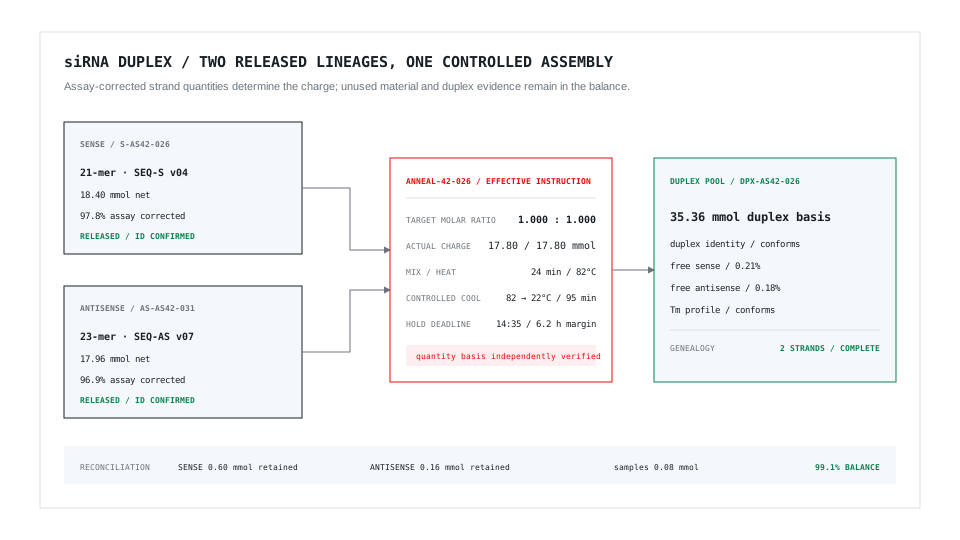
Ultrafiltration, desalting and counterion exchange record membrane identity, integrity, diafiltration volumes, conductivity, pH, concentration and yield, and each solvent or counterion transition becomes an explicit material state. Lyophilisation, precipitation, drying and packaging record equipment, conditions and exposure. Gross, tare, net, dry-
The batch reconciles theoretical loading, nucleotide equivalents, crude recovery, fractions, pooled amount, losses, samples, rework, dry content, assay correction and final containers. Molar and mass bases are explicit, and any conversion uses a versioned formula with its source values, units, precision and review. Open life, synthesis interruptions, crude storage, fraction age and pool holds each run on defined clocks, and an excursion attaches to the affected containers and downstream material.
5Resolve closely related impurities against their definitions.
Identity, assay, full-length product, deletion and addition sequences, oxidation, depurination, protecting-group residuals, conjugate-related species, residual solvents, water, counterion and endotoxin attach to exact stages. Each method keeps its sample preparation, instrument, sequence reference, impurity nomenclature, standards, source data, integration or deconvolution, calculation and review. A peak name stays traceable to the molecular and method versions that define it.
Shared synthesisers, columns, tanks and dryers keep product-contact history, cleaning procedure, residue limits, results and release, and sequence- or chemistry-specific worst cases can inform cleaning validation and campaign order.¹ Potent conjugates and novel modifications can add containment or segregation requirements, and equipment state gates the next product.
6Release against sequence, process, purity and quantity.
Disposition reconciles the molecular version, raw materials, generated recipe, cycle evidence, equipment, fractions, pool rationale, conjugation or duplexing, final processing, analytical results, mass balance, holds, deviations, cleaning and containers. The European Medicines Agency’s guideline on development and manufacture of oligonucleotides addresses the modality’s CMC considerations; Seal organises the executable evidence while the manufacturer’s process and control strategy remain authoritative.
Start with one modified sequence from approval through recipe generation, issue by position, synthesis with a repeated coupling, cleavage, chromatography, pool selection, ultrafiltration, lyophilisation, impurity analysis, mass balance and release. Include a wrong bottle-position scan, an instrument-data gap, out-of-hold crude, a borderline fraction, a pool amendment, an integration change, an assay-corrected quantity discrepancy and a post-release amidite alert. The model is ready when a final container can reconstruct every base, cycle, fraction and decision.
References
- 1ICH Q7, Good Manufacturing Practice Guide for Active Pharmaceutical Ingredients (2000), sections 12 (validation) and 13 (change control). ICH
ACapabilities
| Capability | What it covers |
|---|---|
| Sequence and modification control | Bases, sugar and backbone modifications, strands and conjugates are defined position by position, with checksums, comparisons and approval. Only the effective version can drive manufacture. |
| Deterministic recipe generation | A versioned generator turns the approved sequence into cycle order, reagent positions, coupling, capping, oxidation or sulfurisation and washes, and the result is reviewed before use. |
| Cycle-level synthesis evidence | Each sequence position keeps the actual reagent lots, parameters, monitoring response, alarms, repeats, source data and operator decisions. |
| Fractions, pools and mass balance | Chromatography fractions, pool decisions, discarded material, samples and waste reconcile to the final quantity on a stated molar or mass basis. |
| Conjugation and duplexing | Strand and conjugate lineages stay separate until a controlled step combines them, with stoichiometry, conditions, annealing and confirmation recorded. |
| Oligonucleotide analytics | Identity, assay, full-length purity, sequence-related impurities, residuals, water, counterion and microbial results attach to the stage they tested, with their source data. |
| Cleaning and campaign state | Synthesisers, columns, tanks and dryers keep product-contact history, cleaning, residue limits and results, which are checked before the next use. |
| Sequence-to-release genealogy | The molecular version, recipe, cycles, materials, intermediates, fractions, pools, containers, deviations and disposition can be followed in either direction. |
BConnected records
CQuestions and answers
What software is needed for oligonucleotide manufacturing?
A connected operation needs sequence control, recipe generation, batch execution, synthesiser data, raw-material genealogy and fraction and pool management. It also needs laboratory testing, equipment and cleaning control, quality workflows and batch disposition, all working from the same records.
Can Seal manage ASO and siRNA products?
Yes. Single-strand, multi-strand, modified and conjugated products can be configured with their own processes. They share the same principles for sequence, genealogy, testing and release.
How does the sequence drive the batch recipe?
A versioned generator processes the approved position-level definition to create the ordered cycles, reagent positions, chemistry parameters, expected consumption and instrument method. The generated recipe carries a checksum and is independently reviewed before use.
Can every synthesis cycle be traced?
Yes. Each position and cycle can keep its intended base and modification, the actual reagent lots and parameters, the monitoring response and timing. Alarms, holds, repeats, source files and operator decisions are recorded with it.
How are purification fractions managed?
Each fraction keeps its chromatographic interval, container, volume, concentration, test results, impurity profile and lineage. Pool decisions record the included fractions, exclusions, rationale and calculated quantity.
Does Seal support siRNA duplexing?
Yes. Sense and antisense strands keep separate manufacturing and release lineages until a controlled duplexing step combines them. Ratio, mixing, temperature profile, holds, confirmation and final testing are recorded.
How are sequence-related impurities represented?
Each impurity’s identity and nomenclature stay linked to the molecular version, method version and sample stage. The source data, peak or deconvolution evidence, calculation, specification and review are retained with it.
Can quantities be tracked in moles and mass?
Yes. Molar, nucleotide-
How are reagent lot issues traced?
Reagent use is recorded by synthesis cycle or process operation. A concern about an amidite, solvent, conjugate, membrane or buffer lot can be traced forward to the positions, batches, fractions, pools and final containers that used it.
Can synthesiser data remain in the equipment system?
Yes. The controller can remain authoritative for detailed actions and high-frequency signals. Seal keeps the cycle context, critical values, alarms, source references and the accountable execution record.
How does cleaning validation connect?
The product’s sequence and chemistry, equipment contact, residue risk and campaign position are linked to the executed cleaning, samples, results and limits. Equipment release for the next use draws on that record.
What should the first implementation prove?
Trace one approved sequence through recipe generation, material issue, synthesis with a repeated coupling, cleavage, purification fractions and pool selection. Continue through final processing, impurity testing, mass balance, containers and release.