Summary
- The problem
- A completed preparation form shows target quantities, a final pH and a signature. It rarely shows which recipe version governed the work, which lots were added or where the prepared containers were used.
- Seal’s approach
- Preparation runs from a versioned recipe with its quantity basis. Actual additions, checks, the review decision and each container’s storage, issue and use stay linked to the preparation lot.
- What changes
- An in-range result is not mistaken for an issue decision, and a questioned preparation traces to the runs that used it and the containers still unused.
- Where to start
- One preparation protocol, its recipe and a representative completed record. Book a demo.
From recipe to prepared solution.
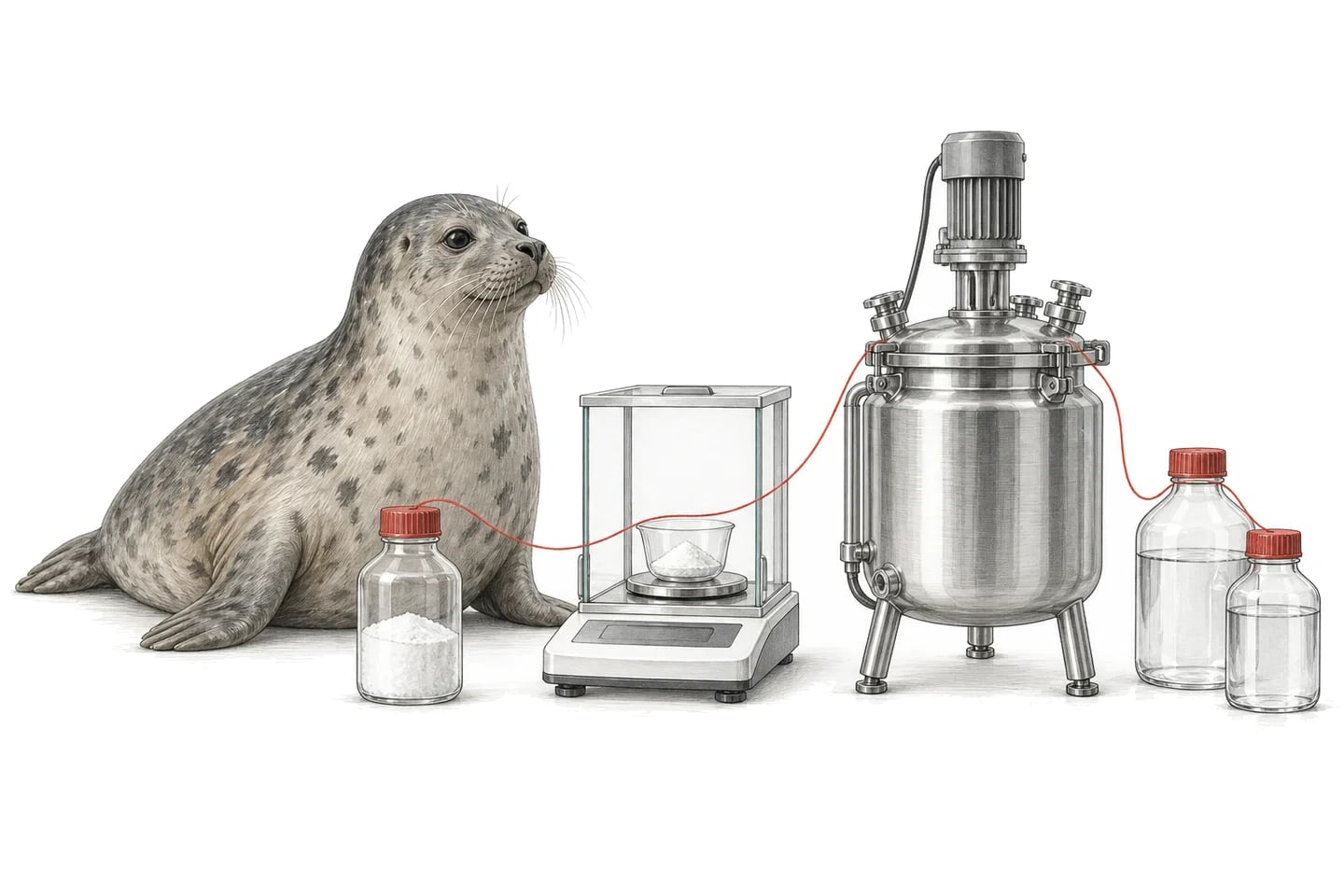
A preparation record on a paper form or a spreadsheet beside the batch record usually holds target quantities, a final pH and a signature, with the prepared containers tracked separately if at all. Seal runs the preparation from a versioned recipe on the same platform as inventory and the process runs that consume it. Actual additions, checks, the issue decision and each container’s use stay attached to the preparation, and a revised recipe applies to preparations made after it takes effect.
PREP-081
100 L preparation BM-01 / v03
The mixing log stays with the run.
Equipment, timing and protocol are recorded together. The technical review is still open.
Illustrative records. Selecting a stage inspects the example; it does not execute, verify or approve work.
The execution records 1.200 kg of dry-mix lot DM-024 and a final volume of 100 L, against BM-01 v03. Those are recorded values, not just the recipe targets. The preparation record stays linked to that recipe version.
The pH check is in range for this example, but the preparation review has no decision recorded. I’d check the full execution and the procedure’s remaining requirements before treating it as ready to issue.
Here’s a review draft with the execution and measurement sources attached. It leaves the issue decision with your reviewer; no status, label or approval has been changed.
PREP-081 / preparation review
DraftThe recorded quantities and pH can be checked. The issue decision remains open.
| Check | Required | Recorded |
|---|---|---|
| Dry-mix addition | 1.200 kg at 100 L | 1.200 kg / lot DM-024 |
| Final pH | 7.10–7.30 in this example | 7.18 at 22 °C |
| Mixing execution | Review against BM-01 v03 | MIX-081 / MX-02 / 09:20–09:40; technical review open |
| Issue decision | Completed preparation review | Not recorded |
Follow-up for review
Preparation operator
Reconcile additions, adjustments and mixing against the complete execution record.
Result reviewer
Review measurement context and identify any other checks the recipe requires.
Preparation reviewer
Confirm storage and hold-time requirements, then record the authorised issue decision.
Change the recipe.
Keep the preparation history.
PREP-081
Its original quantities, lots and resultsAdd a conductivity check
Proposed. Method and range still to agree.A recipe that carries its basis.
Keep formulation version, material identity, grade and concentration basis together.
Recipe configuration
Distinguish a dry powder, a concentrated stock and a ready-to-use liquid. Record which values are mass, volume, concentration or activity, and preserve the source of any potency or moisture correction. Final solution volume is not automatically the initial water charge. Define rounding, tolerances and allowed adjustments in the protocol. When the formulation changes, retain the old preparation records against the version actually executed, rather than recalculating their history with a new recipe.
Scale quantities. Review the process.
A proportional quantity calculation does not prove that a mixing process will transfer to another scale.
Scale and equipment assessment
Keep the vessel or bag, working range, mixing method, order of addition, temperature, dissolution observations and any hold or conditioning steps with the protocol. PD defines the scientific intent; MSAT carries the rationale into transfer. Record which equipment and scale were actually assessed, which protocol version the evidence supports and which questions remain open for the receiving team, then review local confirmation work before manufacturing use. The illustrated recipe calculates a dry-mix quantity for its stated final volume; it does not propose mixing speeds, times or process settings.
Trace the lot in both directions.
From an ingredient to its preparations. From a consuming run back to the container and recipe used.
Record additions as they happen.
Execute the preparation against the selected protocol and capture the values actually used.
Addition and equipment records
Link source material containers, lot status, water source, balance readings and destination vessel to the preparation. Record adjustments as additions with an identity and amount, not just a final number that conceals how it was reached. Preserve interruptions, rework and observations. Confirm operator and equipment readiness under the procedure. Device connections need agreed units, timestamps and failure behaviour; a missing reading must not silently become the planned target or a retrospective pass.
Prepared containers have a use history.
Carry the preparation identity into storage, dispensing and the run that consumes it.
Storage, issue and use records
Link each container or aliquot to the parent preparation, quantity, storage condition, label and applicable expiry or in-use rule. Define when each clock starts and which event changes it. Record actual issue, return, waste and remaining quantity; distinguish a reservation from a physical transfer. If a preparation is questioned later, find the recorded consuming runs and unused containers without assuming every planned use occurred. Changes to status and physical movements should reconcile across the connected systems.
The right protocol for the preparation.
Checks belong to the preparation.
Connect pH, conductivity, osmolality or other specified checks to their method and measurement conditions.
Measurements and processing evidence
Choose the checks appropriate to the actual buffer, medium or feed; not every preparation requires the same panel. Retain sample identity, instrument, calibration context, temperature where relevant, result and review. A retest or adjustment does not erase the original result. If filtration, sterilisation or other processing is required, record its execution and associated evidence separately. A favourable chemical result does not by itself establish microbial quality, sterility or suitability for a particular use.
Buffers, culture media and feeds are different workflows.
Share the record structure without forcing the same process onto every preparation.
Formulation-specific workflows
Buffers support purification and other process operations; culture media and feeds support upstream cultures. Retain the formulation-specific ingredients, sequence, processing, analytical requirements and use conditions. Purchased ready-to-use solutions still need receipt, storage and use traceability, but do not need a fictional in-house mixing record. Keep laboratory reagents and standards on their own qualification and value-assignment workflows. Configure reusable steps where appropriate while retaining the differences that matter to the actual preparation.
Connected to the surrounding work.
Keep specialised systems where they belong. Agree the source of each record, the permitted actions and the reconciliation at each handoff.
Explore integrationsAQuestions and answers
Does this cover both buffers and culture media?
Yes—the workflow can be configured for buffers, culture media, feeds and related process solutions. Their recipe, processing, checks and use conditions remain distinct. It is not an assertion that one preparation method fits all formulations.
Can we start with our existing preparation protocol?
Use the current procedure, recipe and representative records to define the workflow. Configure fields, calculations, source links and review, then test the intended behaviour with the team before operational use.
Does changing batch size automatically validate scale-up?
No. Quantity calculations can retain the recipe basis, but equipment, mixing, temperature, dissolution, processing and checks need their own assessment. PD, MSAT and manufacturing decide what confirmation evidence is needed.
Can we connect balances, probes and mixing systems?
Scope each connection against the actual equipment, interface and records required. Agree capture, units, attribution, failure handling and manual fallback. The page illustration is not a live device connection.
How do prepared lots stay connected to their use?
Carry the preparation and container identifiers into issue, dispense and consuming-run records. Keep reservations, actual movement, returns and waste distinguishable. The authorised status and storage or hold conditions must remain consistent with the source record.
What does Neil do?
Neil can help prepare the protocol configuration, compare execution records, find missing evidence and draft a review. Your team checks the proposed configuration and retains responsibility for scientific interpretation, verification and issue decisions.