All use cases

Investigate an environmental monitoring trend.

Compare environmental results with sampling exposure, locations and operational context instead of treating a raw count increase as a rate increase.

Book a demo
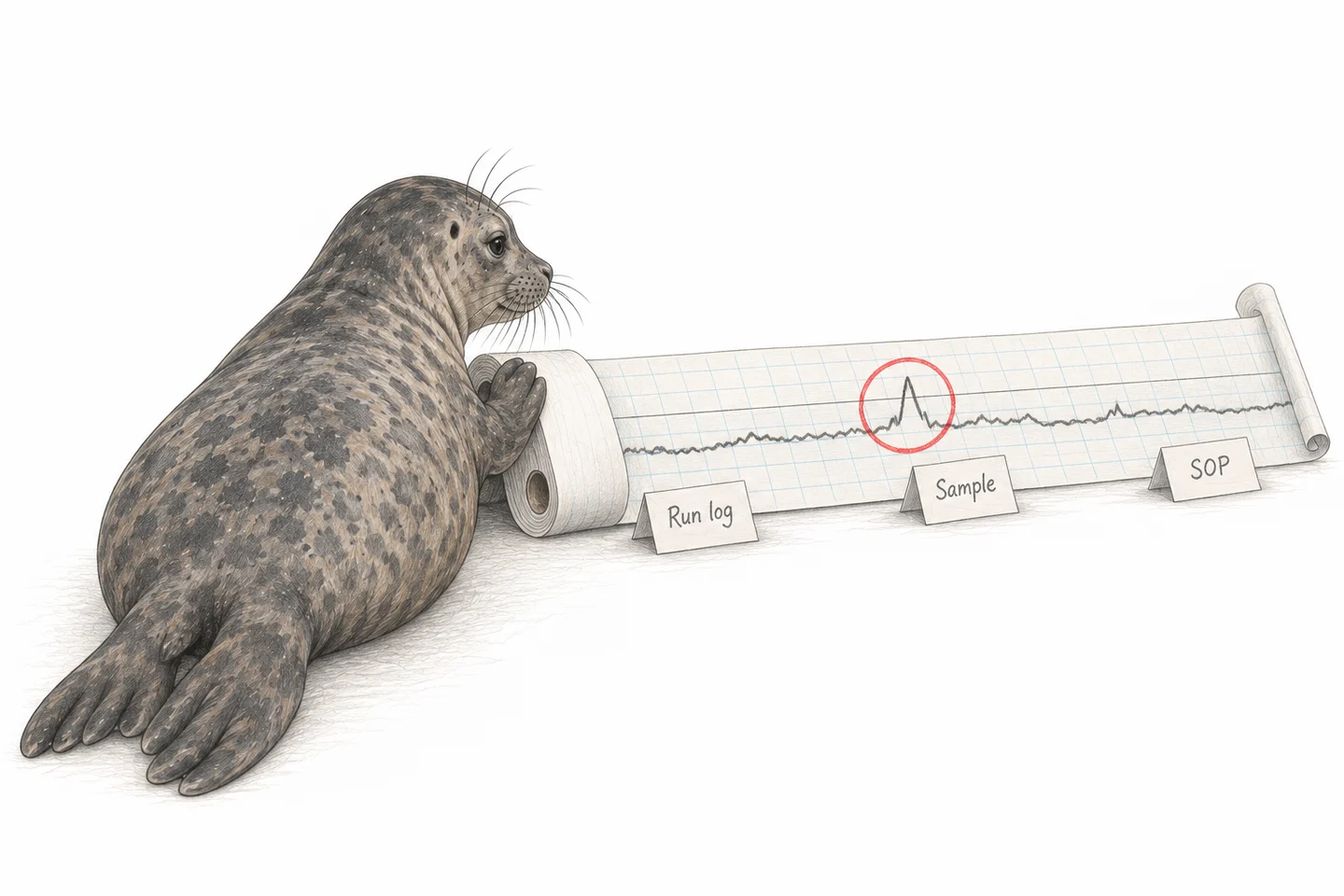
Illustration of a seal examining a circled change in a trace alongside run, sample and procedure records.

You: Environmental-monitoring positives doubled. Has the situation worsened?

neil

The counts rose from 2 positives in 100 samples to 4 in 200. Both are 2%. That removes the apparent doubling in the aggregate rate, but does not establish that locations, organisms or operating conditions stayed comparable.

Positive proportions; counts differ
Positive proportions; counts differ. 2/100, 4/200, 2% positive, 2% positive. Example records.2/1004/2002% positive2% positive

You: So there is no trend to investigate?

neil

I would not conclude that. Two later isolate identities are pending, and aggregate rates can hide a location-specific change. I would compare matched locations and sample types, then inspect organism identity and operational context before interpreting control.

You: Write this up for review, with the sources and the follow-up work we need.

neil

Here is the draft. I have kept the supported finding separate from the open questions, and prepared the evidence requests for the responsible roles.

EM-109 population-adjusted trend assessmentReview draft · source evidence and assessment

EM-109 population-adjusted trend assessment

Both pooled periods have a 2% positive proportion, despite different positive counts. That calculation does not establish equivalence between locations, sample types or organisms. Split the comparison into matched sampling groups and retain the two pending identifications. Those results may change the interpretation of the pattern even though the aggregate proportions are the same.

Source evidence and search scope

EM-A109 (Earlier period); EM-B109 (Later period); ID-109 (Organism identification)

EM-A109 / Earlier period

Recorded evidence
2 positive samples from 100 collected

EM-B109 / Later period

Recorded evidence
4 positive samples from 200 collected

ID-109 / Organism identification

Recorded evidence
Two later isolates still awaiting identification
Inputs needed for your own records
  • Results by location, method, date and organism where available
  • Sampling schedules, missed samples and exposure denominators
  • Cleaning, interventions and related investigation records

Microbiology and quality reviewers assess significance and any required action. A pooled rate does not replace location-specific or organism-specific assessment.

Fictional source snapshots. No live query, assignment or approval.

Follow-up work and evidence requests2 proposed tasks · not assigned

Evidence to request

Resolve the pending isolate identities
Microbiology lead
Link identification outcomes to their original samples, locations and dates; preserve pending status until evidence is available.
Compare like-for-like populations
Environmental monitoring reviewer
Stratify samples and positives by relevant location, sample type and operating condition. Retain denominators and exclusions beside every rate.
Example conversation · prepared replies

See this job with your team.

Tell us how your team handles this job today. We’ll walk through the analysis, supporting evidence and review steps in a demo.

Book a demo
What to bring for this job
  • Results by location, method, date and organism where available
  • Sampling schedules, missed samples and exposure denominators
  • Cleaning, interventions and related investigation records

Source access, permissions and permitted actions are agreed for your environment.

Source excerpt

EM-A109

Earlier period

Recorded evidence
2 positive samples from 100 collected

Selected fictional record, not a live source-system view.