1Fewer leakage events, but no demonstrated reduction in the observed rate.
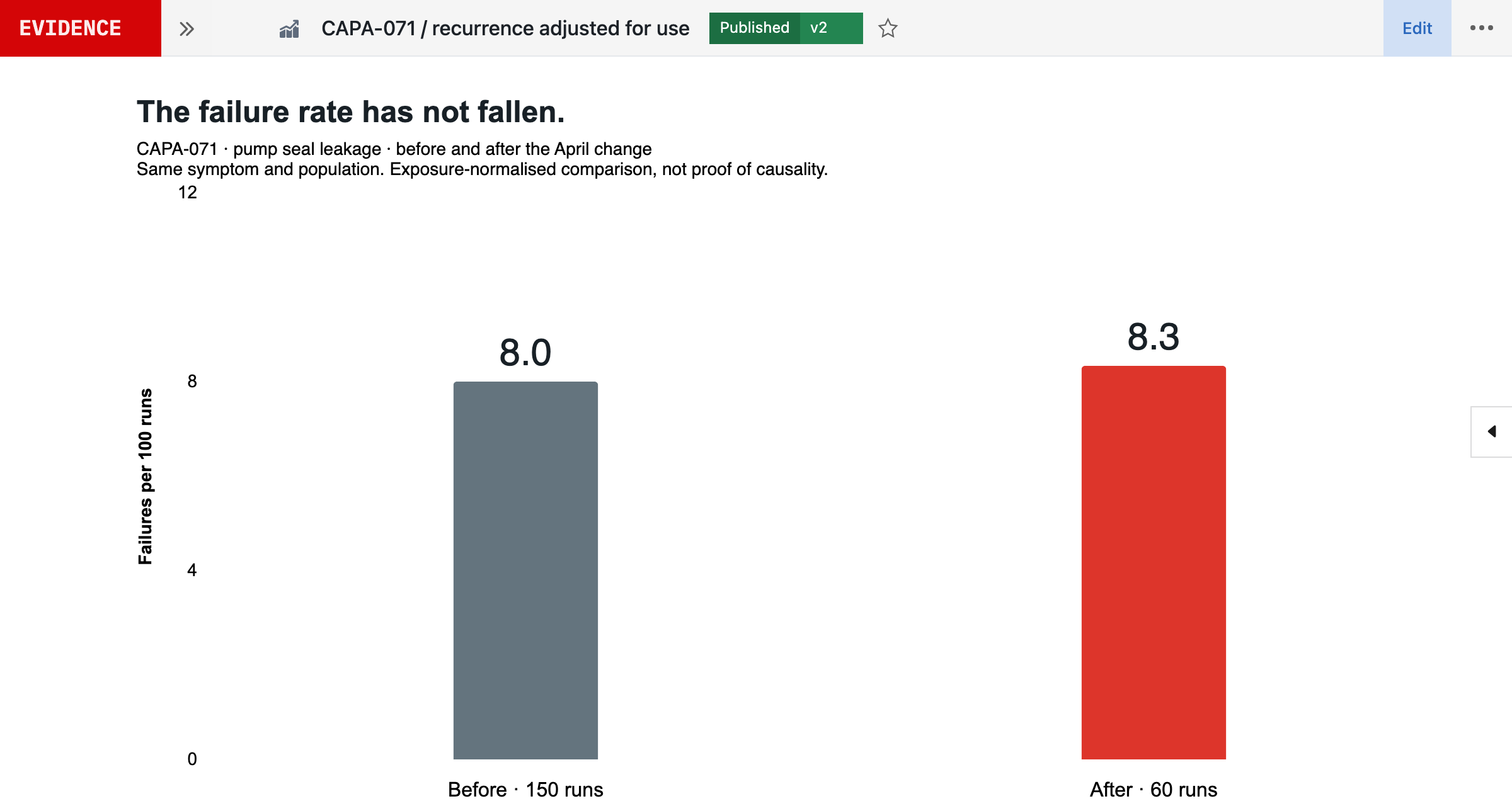
CAPA-071 examines pump seal leakage before and after the April change. The native Seal demonstration compares January–March (12 leakage events in 150 runs) with May–July (5 events in 60 runs). April is the changeover period and is excluded from both populations. Compare events per 100 runs, using the same event definition in both periods.
| Source period | Eligible runs | Leakage events | Events per 100 runs |
|---|---|---|---|
| Before: January | 48 | 4 | 8.33 |
| Before: February | 52 | 5 | 9.62 |
| Before: March | 50 | 3 | 6.00 |
| After: May | 20 | 2 | 10.00 |
| After: June | 22 | 1 | 4.55 |
| After: July | 18 | 2 | 11.11 |
| Before: combined | 150 | 12 | 8.00 |
| After: combined | 60 | 5 | 8.33 |
The event count falls by 7, but the observed rate moves from 8.00 to 8.33 per 100 eligible runs. This does not demonstrate improvement, and these descriptive rates alone do not establish statistical significance or causation. If the illustrative plan requires at least 100 post-change runs, the planned observation is also incomplete.
2Try the CAPA rate calculation
Change the example inputs to inspect the result. This calculator runs on the website and does not change records in Seal.
3Review output and next actions
Effectiveness is not demonstrated by this population. Preserve the unfavourable and incomplete assessment. A later review must identify its new evidence and must not make this earlier review appear to have had it.
Implementation owner
Confirm which runs actually used the changed operation.
Evidence needed: Attributable implementation evidence and an explicit treatment of uncertain exposure.
Effectiveness reviewer
Assess the incomplete observation and whether to continue, investigate implementation or reassess the action.
Evidence needed: A reasoned next step against the original plan; do not extend observation simply until a favourable rate appears.
CAPA decision owner
Keep the action’s implementation and its effectiveness conclusion distinguishable.
Evidence needed: An authorised assessment with the population and limitations retained before any separate closure decision.
The filled review worksheet: CAPA-071 effectiveness assessment with the available observation
This is a fictional worked assessment to adapt to your procedure and actual evidence.
Source pack
- Implementation evidence identifying the change boundary, the event definition and comparable eligible runs.
- The approved observation plan and criteria; retain the source periods supporting each total.
- Population assessed
- January–March before the change; May–July after it. April is the changeover period.
- Before
- 12 events / 150 eligible runs × 100 = 8.00 events per 100 runs.
- After
- 5 events / 60 eligible runs × 100 = 8.33 events per 100 runs.
- Criteria in this illustrative plan
- At least 100 post-change runs and a rate no greater than 4 events per 100. These are example inputs, not a statistical recommendation.
- Current assessment
- The observation is incomplete and the available rate is above the example target. Fewer events do not establish improvement.
4Decisions and exceptions
| Situation | Response | Consequence |
|---|---|---|
| 5 events after versus 12 before | Inspect the exposure before claiming improvement | The combined observed rate is 8.33 after versus 8.00 before |
| 60 post-change runs versus the illustrative required 100 | Report incomplete planned observation and assign a reviewed next action | Do not label the plan completed solely because the calendar review date arrived |
| No eligible post-change runs | Show no assessable exposure and preserve the open question | The calculated rate is unavailable, not 0% |
5Define the operating population before calculating the rate.
Start from the effect the action was intended to produce. In this example the question concerns leakage during a defined pump operation. Select completed runs with comparable equipment and operating context. Record what qualifies as one event and how repeat observations during the same run are counted. If the event definition changes halfway through, the two populations are not automatically comparable.
Use the actual implementation evidence to place the change boundary. The date an action was approved or marked complete may not be the first run that used the revised procedure. If implementation was phased across equipment, retain that distinction. Keep runs with uncertain implementation exposure in an explicit unresolved or excluded population until the reviewer decides how to use them.
6Calculate from totals and keep missing exposure visible.
For the combined post-change population, calculate 100 × (2 + 1 + 2) / (20 + 22 + 18) = 8.33 events per 100 runs. In general, use the combined event and exposure totals instead of averaging period percentages: an unweighted average gives a small period the same influence as a large one. Retain the counts behind the displayed rate so rounding does not become the source of the assessment.
Attach the Python formula below to an Observed rate Number field on the same record as Eligible run count and Event count. These names must match the configured fields exactly. The formula leaves the rate empty when exposure is zero or missing, or the event count is unavailable or negative. Configure evidence and input-validity Checks separately; an empty calculation is not itself a publication Check. Do not substitute zero events per 100 runs when no runs have been observed. Missing event records are also different from confirmed zero events: reconcile the source population before treating an empty result as evidence of absence.
Keep the selected evidence or report population identifiable when the assessment is signed. A live dashboard is useful for finding new work, but its current values must not silently become the historical basis of an earlier decision. If additional runs are assessed later, retain the earlier population and a new assessment revision.
runs = entity["Eligible run count"]
events = entity["Event count"]
field.value = (
    None
    if runs is None or runs <= 0 or events is None or events < 0
    else 100 * events / runs
)7Separate an incomplete observation from an accepted effectiveness conclusion.
The illustrative target is not met by the available data: the observed rate is above 4 per 100 and only 60 of the planned minimum 100 runs are available. The review should report both facts. The authorised team decides whether further observation is justified, whether implementation needs investigation or whether the action should be reassessed. Continuing to add runs until a favourable number appears is not a substitute for the original plan.
Do not automatically rewrite the original cause when an effectiveness check is unfavourable. Incomplete implementation, a changed operating population, a different event definition or an ineffective action can lead to different next work. Link each proposed explanation to evidence that could support or challenge it.
8Audit which events and runs belong in the calculation.
Before aggregating the six periods, join each eligible run to the implementation state of its equipment and to the defined leakage events. Keep a dated extraction and a reviewed list of inclusions, exclusions and duplicate reports. A maintenance note and an incident report may describe one leakage event; two separate leaks during one run may instead be two events. Decide that from the event definition and source evidence, not from how many records the search returns.
The measure here is events per 100 runs. It is not the percentage of runs with a failure: if two distinct events occurred in one run, that run contributes two events but one exposed run. Do not switch between those measures before and after the action. Also compare equipment and operating conditions across periods; a shift to easier work could change the aggregate independently of the CAPA. The observed 8.00 and 8.33 rates alone establish neither statistical significance nor causation.
For the illustrative plan’s minimum of 100 post-change runs, the available 60 leave the planned observation incomplete. Record the current result now, the outstanding exposure and any recurrence requiring action under the plan. Collecting the remaining 40 runs can complete the exposure requirement; it cannot erase the five events already observed or justify changing the original acceptance criterion after seeing them.
| Source situation | Numerator treatment | Denominator treatment |
|---|---|---|
| One leak appears in both maintenance and incident records | Count one event when evidence shows the same occurrence | Count its eligible run once |
| Two distinct qualifying leaks occur in one eligible run | Count two events under the stated event-frequency definition | Count one run |
| A run used equipment before its action was implemented | Assign using the predefined implementation/window rules | Do not silently place it in post-change exposure |
| No exposure record can be recovered for a period | Keep the event evidence | Mark rate unavailable; do not substitute zero exposure or assume no events |
ICH Q10 §3.2.2 describes evaluating CAPA effectiveness in commercial manufacturing and relating investigation effort to risk. The event/exposure review here is one authored way to inspect a proposed effectiveness measure; Q10 does not prescribe this example’s 100-run minimum or numerical target.
9Questions this example raises
What is the difference between implementation and effectiveness?
Implementation evidence establishes that the planned action happened. An effectiveness check asks whether the intended outcome followed, using the population, observation window and criteria in the plan. A revised procedure alone answers only the first question.
How many runs are enough for an effectiveness check?
There is no universal run count in this example. The plan’s illustrative minimum of 100 post-change runs is a configuration input, not a statistical sample-size recommendation. Choose the observation design for the question and risk; these descriptive rates alone do not establish significance or causation.
10Proposed record fields
Start from the Corrective and preventive actions blueprint. The fields below are a proposed design for this case, using Seal’s documented field types and references.
Download the proposed field list
Effectiveness plan
Records the question and criteria before the team selects favourable results. Retain the reviewed plan version with the eventual assessment.
- CAPA and implemented actionReference
- CAPA-071 and the procedure change whose effectiveness is being assessed.
- Implementation evidenceReference
- The record establishing when the change was actually implemented for the selected equipment.
- Eligible populationText and References
- Define which pump, operation and completed runs belong in the review, including exclusions.
- Minimum exposure and targetNumber
- Illustrative only: at least 100 eligible post-change runs and no more than 4 events per 100 runs.
- Event definition and time basisText / Time & date
- Define a leakage event and the boundary between pre-change and post-change work.
Exposure and event population
Keeps the numerator and denominator reviewable. A report period is a grouping of source records, not a substitute for them.
- Eligible run referencesReference, multiple
- The individual completed runs counted in each population.
- Event referencesReference, multiple
- The attributable leakage observations associated with those runs.
- Eligible run countNumber
- 150 before and 60 after, reconciled to the eligible run References.
- Event countNumber
- 12 before and 5 after, reconciled to the leakage observations.
- Excluded work and reasonReferences / Text
- For example, three planned runs never executed are excluded from completed-run exposure.
- Population reconciliationReference
- Evidence that the selected source records and recorded totals agree.
Effectiveness assessment
Retains the calculation, evidence limitations and human conclusion separately from the action’s implementation status.
- Reviewed plan versionReference
- The specific plan used to interpret the selected evidence.
- Observed rateNumber with a documented formula
- 100 × event count / eligible run count; keep the unit “events per 100 runs”.
- Observation completenessSelect
- Incomplete while only 60 of the illustrative required 100 runs are available.
- Assessment and rationaleSelect / Text
- A recorded judgement with source links; avoid a single checkbox that collapses completeness and effectiveness.
- Reviewer and next workUser / References
- The responsible reviewer and any approved investigation, observation or action reassessment.
Seal can connect those records to the action and its implementation evidence. The reviewer can then see which runs support the assessment, how the rate was calculated and whether the planned observation is complete. The worked example below is a proposed review design, using fictional pump-leakage data. Its numerical acceptance criteria illustrate configuration; the responsible team must choose criteria appropriate to its own risk and procedure.
11Configure review around the plan and its evidence.
Use separate Seal Templates for the effectiveness plan and the assessment, connected to the CAPA and implementation records through References. Set the required review groups and signature meanings for those records. Seal review requirements are not sequential approval stages: rearranging them does not force implementation review to finish before effectiveness review. If your process needs those distinct decisions, model the prerequisite explicitly and verify its Check.
A proposed assessment Check can require a reviewed plan reference, a reconciled source population, valid exposure and the required rationale for an incomplete or failed outcome. A separate closure decision can require the authorised assessment. Do not make “rate below target” the only condition for preserving the assessment itself; the system must also be able to retain an unfavourable or inconclusive review. Publication Checks govern the configured record review, not an automatic assertion that the CAPA is effective.
12Configuration references
The record design above is illustrative. These product documentation pages explain the Seal capabilities used in it. They open in the signed-in Seal platform.
13Acceptance tests
These are proposed acceptance tests for the configured workflow. They describe expected behaviour to verify, rather than results of a customer implementation.
Download these acceptance cases
Event counts fall while exposure falls further
Input: Use 12 events in 150 runs before implementation and 5 events in 60 runs after implementation.
Expected: The view shows 8.00 and 8.33 events per 100 runs and retains the raw totals. It does not produce an improvement statement from the lower event count alone.
The post-change denominator is absent
Input: Retain five event records but remove or leave unresolved the eligible run population.
Expected: The rate is unavailable and the configured decision Check identifies the missing exposure evidence. The event observations remain recorded; they are not replaced with zero.
A new run arrives after an assessment
Input: Create a later eligible run after the original assessment population has been reviewed.
Expected: The source population for the original decision remains identifiable. A subsequent assessment can include the new run with its own counts and review history.
14Apply this to your records
Use one action and one preselected effectiveness measure. Keep the original observation plan beside the event and exposure records so the assessment can be reproduced later.
Download the blank working review
Write your working notes here
Notes stay in this tab and are not submitted. Download them before leaving to keep a copy. Use record references to identify your evidence.
Identify the CAPA and implementation evidence. State the event definition, denominator, planned observation window, minimum exposure, acceptance criterion and rule for responding to recurrence. Identify the plan revision agreed before assessment.
List the before/after run populations, extraction time and source query. Record equipment-specific implementation boundaries, excluded runs and reasons. Resolve duplicate reports of the same event; distinguish event count from the number of affected runs.
Record each period’s event count and eligible exposure, then divide the combined events by the combined exposure. Preserve missing denominators as unavailable. If event frequency is the measure, multiple distinct events in one run must not be silently reduced to one.
Identify changes in equipment, product mix, operating load or event detection between windows. Explain whether those changes limit the before/after comparison. State what the descriptive rate establishes and what it cannot establish.
State whether the observation is complete and whether the chosen criterion is met. Record remaining exposure, recurrence actions and the responsible reviewer’s next step. Keep a changed observation plan or later assessment identifiable rather than replacing the earlier result.
Unanswered sections remain marked ‘Not recorded’ in the download.
Evidence needed to finish
Another reviewer can reproduce the numerator, denominator and rate from the retained population and compare the result with the original plan. Observation completeness and effectiveness have separate answers. The illustrative case would still be at 5 events per 100 runs if its next 40 runs had no events, above its stated target of fewer than 4.
15Review the evidence with Neil
Review CAPA-071’s effectiveness plan and implementation evidence. Reconcile the pre-change and post-change run populations, calculate leakage events per 100 eligible runs from the totals, and show exclusions or missing records. Compare the available evidence with the plan’s exposure and outcome criteria. Prepare an assessment brief with separate conclusions on completeness, observed outcome and unresolved explanations; leave the effectiveness and closure decisions to the authorised reviewers.
Review the proposed output against these deliverables:
- A numerator-and-denominator table linked to the eligible runs and observed events.
- An explanation of the 8.00 versus 8.33 observed rates and the incomplete post-change exposure.
- A review brief listing the evidence needed to distinguish implementation, population and action-effectiveness questions.
16Configure this process with Seal
Use a representative source record and an exception your current process struggles with. We can work through the record design, review responsibilities and connection requirements with you.