
Summary
- The problem
- Submission content is drafted from source data that keeps changing, and it is hard to show which evidence supports each approved claim.
- Seal’s approach
- Each section keeps the studies, batches and results it rests on, with missing evidence and exclusions recorded. New source data creates review work instead of silently regenerating approved text.
- Neil
- Seal’s AI agent drafts source-linked sections, flags the claims the evidence does not support and lists the content a changed source touches. Authors and reviewers decide what the submission says. About Neil.
- What changes
- Content approval, package validation, dispatch and authority acknowledgement are retained as separate records with their exact versions.
- Where to start
- One upcoming submission section and its source data set. Book a demo.
A document system files what was written. Seal keeps each claim with its evidence.
A traditional submission system is a system of record for documents. It holds the sections, their versions and the sequences they were sent in, while the studies, batches and results each sentence rests on stay in the laboratory, stability and manufacturing systems, joined by copy and paste.
| A document-based system | Seal | |
|---|---|---|
| Source evidence | Attachments gathered for the draft | Selected records, with versions |
| A reported value | Checked by reading | Linked to the result it reports |
| Missing evidence | Easy to miss | Shown, with a request |
| A conclusion | Reviewed as wording | Reviewed against its source |
| New source data | Found at the next draft | Review work on affected claims |
| After approval | A final folder | Approval, dispatch, receipt apart |
| Authority questions | Reconstructed from folders | Answered from the same sources |
| AI | Text to paste elsewhere | Neil drafts with sources |
| Getting started | A replacement project | One section, beside your tools |
Regulatory content is written from studies that keep producing data. A summary drafted from one data cut may no longer match the records a month later, and a reviewer asked which records support a sentence often has to reconstruct the answer from folders.
The Common Technical Document gives the dossier one structure across regions: Module 1 is regional, and Modules 2 to 5 are common to all of them.¹ Its summaries rest on the data beneath them. The Quality Overall Summary in Module 2 follows the scope and outline of Module 3, and should not include information, data or justification that Module 3 or another part of the dossier does not already contain.² A sentence in a summary is only as good as its link to the body of data.
In Seal each section keeps the studies, batches, methods and results it rests on, so review starts from the evidence and a change to that evidence creates review work. Neil, Seal’s AI agent, drafts source-linked content from those records; authors and reviewers decide what the submission says.
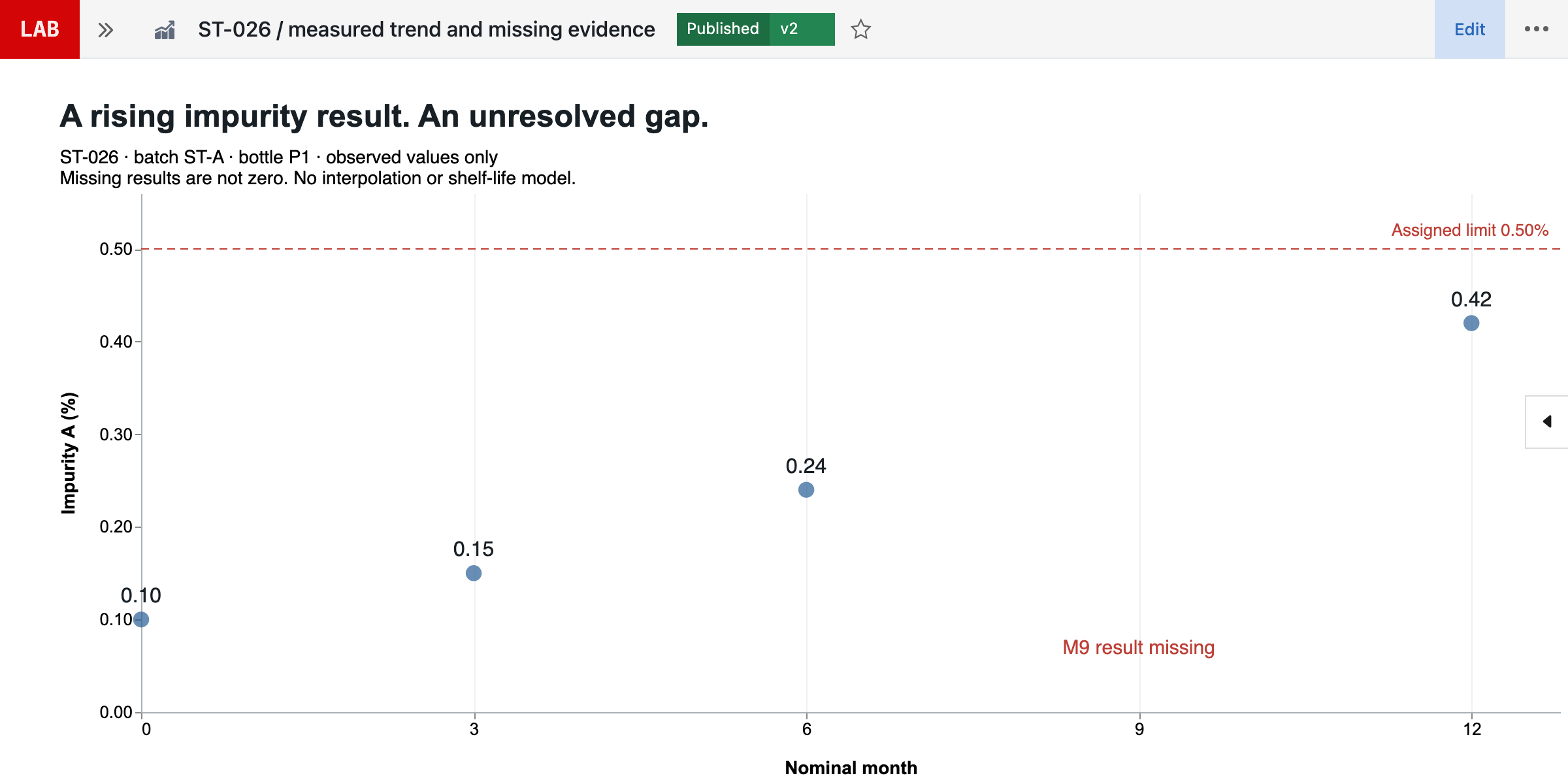
Figure 1 tests three draft statements against the fictional ST-026 stability study, which holds four measured impurity results and a missing nine-month result. The twelve-month result of 0.42% is a recorded observation whose technical review is still open. A claim that the series is complete is not supported, and neither is a twenty-four-month shelf life. The sections below follow ST-026 from the source set to the questions an authority asks about it.
You can start with one section, beside the systems you already run. Seal connects to controlled documents in systems such as Veeva Vault and SharePoint, and to the laboratory and manufacturing records behind them, while dossier assembly, technical validation and transmission stay with your publishing tools. The advantage grows as the studies, batches and methods behind the content run on the same connected records: fewer values copied by hand, and a short path from a submitted sentence back to the result it reports.
Choose the evidence before drafting the claim.
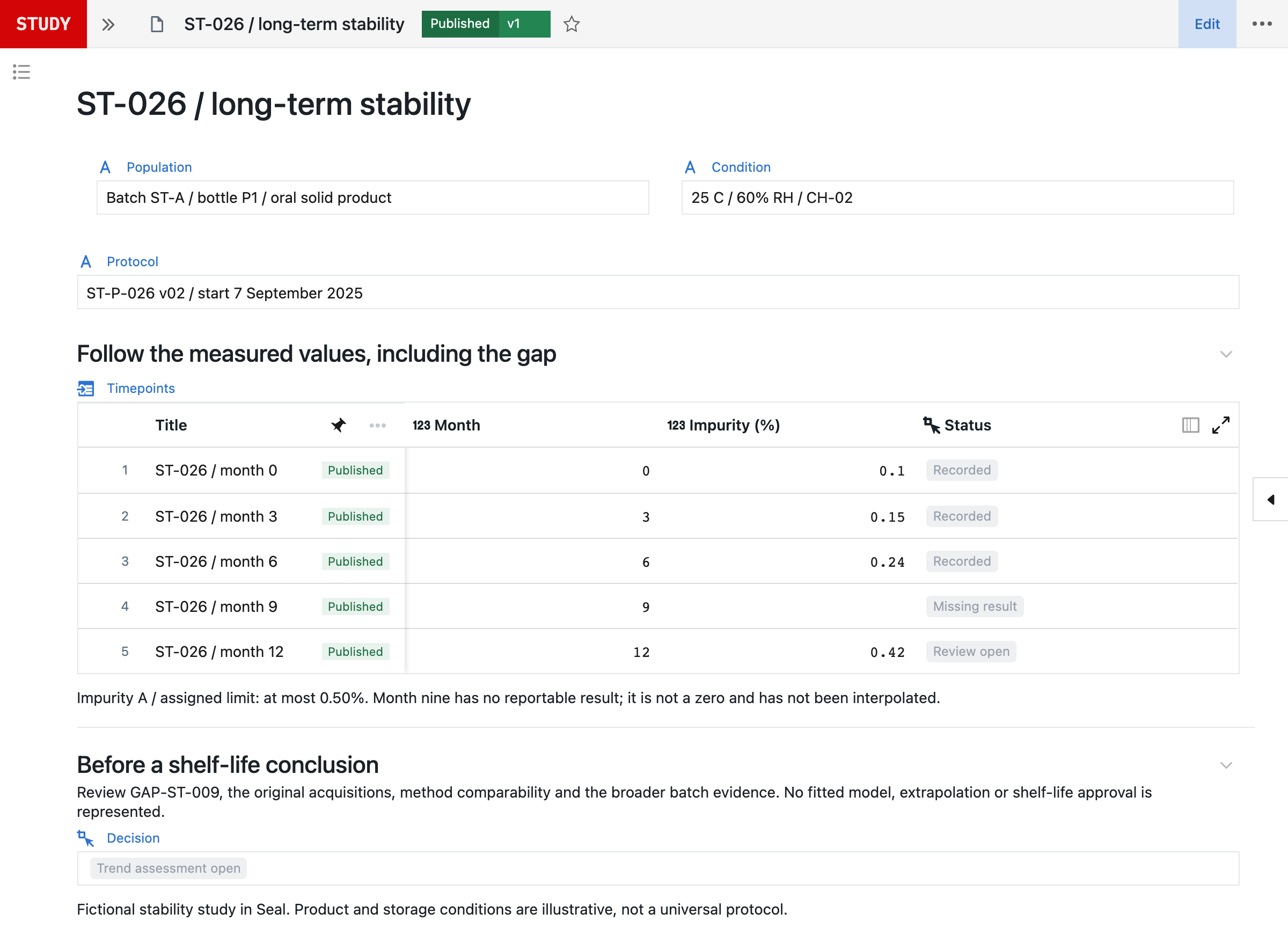
A submission source set needs a defined population and recorded versions. Select the studies, batches, methods and results before drafting, and keep them alongside the content they support, including missing evidence and exclusions.
| A source set keeps | In the example |
|---|---|
| Study | ST-026, long-term stability |
| Protocol | ST-P-026 v02 |
| Population | Batch ST-A, bottle P1 |
| Condition | 25 °C, 60% RH |
| Results | Months 0, 3, 6 and 12 |
| Missing | Month 9, shown as missing |
| Limit | Impurity A at most 0.50% |
ST-026 holds four recorded results for impurity A: 0.10%, 0.15%, 0.24% and 0.42% at months 0, 3, 6 and 12. Month nine has no reportable result. It is not a zero and has not been interpolated, and GAP-ST-009 records the work to recover it. A folder count is not evidence completeness: the source set states what is present, what is missing and what was excluded, and why.
Module 3 presents stability results with information on the analytical procedures used to generate them, and the Module 2 summary tabulates the results from Module 3.² So a value in the source set keeps its method, acquisition and physical pull as well as its number, and a summary table reads from the same records as the body of data.
Freeze the selection as a data cut when content is drafted from it: the population, the record versions, the queries, exclusions and transformations applied, and who approved the cut. A later draft starts from a new cut rather than an edit to the old one, so the content that was reviewed can always be reproduced.
Test each claim against its source.
A value, a statement of completeness and a conclusion need different review decisions, even when they rest on the same records. Each claim keeps its source, its limitations and its review state.
| Draft claim | What the source shows | Review |
|---|---|---|
| Twelve-month result of 0.42% | A recorded observation | Supported; review open |
| All results to month 12 | No month-nine result | Not supported |
| A 24-month shelf life | Data end at month 12 | Beyond the evidence |
“The twelve-month impurity result was 0.42%” is a recorded observation, not an approval. The month-twelve record supplies the value and identifies the method, AM-ST-014, the original acquisition on HPLC-ST-01 and the pull, PULL-ST-026-12. Its technical review is still open, so the value can be drafted with its review state but not presented as reviewed.
“All scheduled results through twelve months are available” is not supported. Month nine has no result in this source set. Keep the gap visible and request the missing evidence; do not turn four available values into a complete series.
“These results establish a twenty-four-month shelf life” goes beyond this evidence. The observations end at twelve months, and the example includes no approved extrapolation or shelf-life assessment. ICH Q1E allows extrapolation beyond the period covered by long-term data to be proposed, and makes it depend on what is known about the pattern of change, the fit of any model and the supporting data.³ None of that is in this source set, so Neil flags the conclusion for expert review instead of drafting it.
A result inside the 0.50% limit does not resolve the missing month or establish a shelf life. Citations show where a statement came from; expert review still decides whether it is right.
New source data creates review work.
Each approved section keeps the source versions behind it. When a result is corrected or new evidence arrives, the change is compared with the selected source set and the affected claims, tables and summaries get review work, while the approved content stays as it was.
- Result
- Recorded
- Evidence
- GAP-ST-009
- Review
- Open
- v01 text (met)Unchanged
- Month 9 (not met)Result to assess
- Completeness (not met)Statement to review
| When a source changes | Seal keeps |
|---|---|
| The approved section | Its source versions, unchanged |
| The changed record | Both versions, side by side |
| Affected claims | Review work, with an owner |
| A sent package | Exactly as sent |
| Other markets | Their own assessment |
If GAP-ST-009 recovers the month-nine result after the stability summary has been approved, the new record is compared with the version the summary used. The 3.2.P.8.3 table and the completeness statement in 2.3.P.8 get review work linked to both versions. Prepare a revised draft or a new data cut when needed; the approved v01 is not regenerated silently.
Do not overwrite what was sent, or assume that all markets can reuse the same wording. Each market keeps its own submitted version and its own assessment of the change.
The same applies when a method or specification behind the content changes. The CMC blueprint follows a method revision to the Module 3 content it touches. Here the question is narrower: which sentences, in which sections, now need a decision.
Neil drafts from the source. Your team decides what it says.
Neil is Seal’s AI agent. Give it the selected source set and the section to write; it works across the documents and records the requester is permitted to see, and prepares the draft, its sources, the missing evidence and the review tasks together, not only a finished paragraph.
| Neil prepares | Your team decides | |
|---|---|---|
| Draft | Source-linked text | What the section says |
| Values | Each with its source record | Whether the source is suitable |
| Gaps | Missing evidence, as requests | How each gap is resolved |
| Claims | Those beyond the evidence | What the submission claims |
| Changed source | Affected claims and tables | Whether to revise |
| Workflow | Templates, states and tests | Whether it matches the work |
Draft the stability summary from ST-026. Cite each value and flag what the evidence does not support.
Neil
- Impurity A: 0.10, 0.15, 0.24 and 0.42% to month 12.
- Each value cited to its ST-026 record.
- Month 9: no result; GAP-ST-009 open.
- Month 12: technical review still open.
- Shelf life: flagged, no conclusion drawn.
- Draft (met)Ready to inspect
- Review (not met)For your reviewers
- Approval (not met)For the approvers
To draft from a bounded source set, ask Neil to prepare the stability summary from the selected records, cite each value and flag any claim the evidence does not support. It prepares a draft summary, a source index and an unresolved-evidence list. Missing results and unreviewed analyses stay visible for the regulatory and scientific reviewers.
To assess a changed source, ask it to compare the new study record with the version used in the dossier and identify the claims, tables and summaries that need review. It prepares a proposed impact assessment and revision tasks linked to both source versions. Previously approved content remains unchanged until the required review.
To configure the content-review workflow, ask it to turn your submission procedure into linked content, evidence-request and review templates, with tests for a missing source and a changed data cut. It drafts the templates, required fields, workflow states and verification cases. Your team verifies the configuration and connects the approved publishing route.
Each drafted value carries its source, and each claim the evidence does not support is flagged rather than smoothed over. The regulatory and scientific reviewers decide what the section says. Neil does not approve content, choose a filing category or route, or send anything to an authority.
In line with the EU’s draft GMP Annex 22 on AI, Neil is not used in GMP execution. It helps set up configuration, which your team verifies and releases under change control. Customer data is not used to train AI models, and the requester’s permissions govern what Neil can read. See how Neil fits Annex 22 and more about Neil.
Start each filing from the change that needs it.
After approval the dossier changes with the product. A change to the process, a specification or a method can need a filing, and the content for that filing starts from the change record and the evidence behind it, not from a separate list.
| Change (21 CFR 314.70) | Potential adverse effect | Reported to FDA in |
|---|---|---|
| Major, (b) | Substantial | A prior approval supplement |
| Moderate, (c) | Moderate | A CBE-30 supplement |
| Moderate, designated in (c)(6) | Moderate | A CBE supplement |
| Minor, (d) | Minimal | The next annual report |
In the US, the holder of an approved application notifies FDA of each change to a condition established in it, by supplement or in the annual report depending on the change. Product made with a major change is distributed only after FDA approves the supplement. With a moderate change, distribution can begin 30 days after FDA receives the supplement, or on receipt for the categories FDA designates, and a minor change is documented in the next annual report. The holder assesses the effects of a manufacturing change before distributing product made with it, and a prior approval supplement describes the methods and studies used and the data they produced.⁴
ICH Q12 frames the same lifecycle across regions. Established conditions are legally binding information considered necessary to assure product quality, so any change to them needs a submission. Changes are communicated by prior approval or by notification according to their risk, and changes that need no report are managed and documented within the pharmaceutical quality system. The product lifecycle management document keeps the established conditions and the reporting category for changing each one.⁵ Each region sets its own categories.
In Seal, a change in change control links to the regulatory assessment for each product and market it touches, and that assessment links to the content and filing work that follows. The required action depends on the confirmed product, market and change scope, not on an automatic global classification: regulatory owners decide the category and the strategy. A linked record is not approval to implement, and an internal approval does not establish market permission. The post-approval CMC change blueprint follows one change market by market.
Keep approval, dispatch and acknowledgement apart.
Approved content is not yet a validated package, a sent package is not yet received, and a receipt is not an approval. Each step keeps its exact versions and evidence as its own record.
- Content plan (met)Sections and sources assigned
- Content (not met)Review open
- Package (not met)Not validated
- Dispatch (not met)Not sent
- Receipt (not met)None recorded
| Record | What it establishes | What it does not |
|---|---|---|
| Content approval | Reviewers accepted this version | That it was sent |
| Technical validation | The package passed its checks | That it was received |
| Dispatch | What was sent, when and how | Receipt by the authority |
| Acknowledgement | Receipt, as the route reports it | Regulatory approval |
| Authority decision | The outcome, with its scope | Use in other markets |
Define the publishing and dispatch route for the intended submission. Regional technical profiles, package validation and gateway handling require a configured, verified integration or a specialist publishing workflow; the examples on this page do not demonstrate those services.
Retain the exact content and package versions, the validation output, the dispatch evidence and the returned acknowledgements separately, linked to the sequence. Transport, receipt, technical acceptance and regulatory approval are different events, and none is inferred from another.
An eCTD sequence carries its regional envelope, modules, leaves, metadata and lifecycle operations, its technical validations, and its published output and checksum. SEQ-0003 in the example is planned: its sections and sources are assigned, while content review, publishing, technical validation and dispatch are still to be established, and no acknowledgement is represented.
Keep the publishing tools you rely on. Seal holds the evidence, the controlled content and its review, and hands the approved content to your publishing workflow; assembly, technical validation and transmission stay there, with their outputs retained against the sequence through the configured route.
Answer questions from the records behind the claim.
An authority question is answered from the records behind the original content, not from a reconstruction. Each question links to the sequence, topic, claim and source material it concerns.
Record the interpretation of the question, the response strategy, the owner and the deadline, and the new evidence the response needs. The response cites the data cut, source versions and review behind the original content, and new evidence enters as a new data cut rather than an edit to the old one. A question about ST-026’s missing month, for example, is answered with what was selected, what was missing and how the gap was resolved.
Commitments made to an authority keep their due date, owner, required evidence and fulfilment status, linked to the submission that created them. Sending a response does not by itself establish that an obligation has been accepted or closed; the authority’s outcome is recorded separately.
Registrations and each market’s approved state belong in regulatory information management. Use the submission workflow for content planning, selected evidence, review and the controlled publishing handoff, and agree which system owns each record where the two cross.
Start with one section.
Bring one upcoming submission section and the source data set behind it: the studies, batches and results it will rest on, and the previous version if there is one.
Neil prepares the source set, a draft with each value cited, the missing evidence and the claims the evidence does not support, and your team inspects them against the records. Start with sample material or arrange an NDA before sharing confidential records.
Test the complete cycle before you rely on it: a missing result, a claim that goes beyond the data, a corrected source after approval and a question that cites the original content. Confirm that approved content stays unchanged until review, and that the package, its validation and its acknowledgement remain separate records.
Seal can run beside the document system and publishing tools you already use. Agree which system owns the dossier, which records Seal reads and how approved content reaches publishing. To scope the first section with us, book a demo.
References
- 1ICH M4(R4), Organisation of the Common Technical Document for the Registration of Pharmaceuticals for Human Use (2016): the CTD is organised into five modules; Module 1 is region specific and Modules 2, 3, 4 and 5 are intended to be common for all regions. The guideline sets a format for the data acquired, not which studies are required. ICH
- 2ICH M4Q(R1), The Common Technical Document for the Registration of Pharmaceuticals for Human Use: Quality (2002). Section 2.3: the Quality Overall Summary follows the scope and outline of the Body of Data in Module 3 and should not include information, data or justification not already included in Module 3 or other parts of the CTD; 2.3.P.8 includes a tabulated summary of the stability results from 3.2.P.8.3, which presents them with information on the analytical procedures used to generate them. ICH
- 3ICH Q1E, Evaluation for Stability Data (2003), section 2.3 (extrapolation): extrapolation to extend the shelf life beyond the period covered by long-term data can be proposed; whether it is appropriate depends on knowledge of the change pattern, the goodness of fit of any mathematical model and the existence of relevant supporting data. ICH
- 421 CFR 314.70, Supplements and other changes to an approved NDA: (a)(1) each change in each condition established in an approved NDA is notified to FDA by supplement or in the annual report; (a)(2) the effects of a manufacturing change are assessed before distribution; (b) major changes need a supplement approved before distribution, describing the methods, studies and data used to assess the change; (c) moderate changes, a “Supplement—Changes Being Effected in 30 Days”, or on receipt for the categories FDA designates under (c)(6); (d) minor changes are documented in the next annual report. eCFR
- 5ICH Q12, Technical and Regulatory Considerations for Pharmaceutical Product Lifecycle Management (2019): chapter 2, risk-based categories of prior approval and notification, with changes not reported managed and documented within the PQS; section 3.2.1, established conditions are legally binding and any change to them necessitates a submission to the regulatory authority; section 5.1, the PLCM document as the central repository for established conditions and their reporting categories. ICH
AConnected records
BQuestions and answers
How is Seal different from the system that holds our dossier?
A document-based system holds the sections, their versions and the sequences they were sent in. In Seal each section also keeps the studies, batches and results it rests on, missing evidence stays visible, and a change to a source creates review work on the claims it affects. You can start with one section beside the document system and publishing tools you already use.
Does this page demonstrate an eCTD publisher or gateway integration?
No. It demonstrates source evidence and an illustrative claim review. The intended technical profile, publisher, validation tooling, dispatch route and acknowledgement handling must be established and verified for the deployment.
What can Neil prepare?
Neil can work with supplied documents and permitted records to draft source-linked sections, assemble evidence requests, compare revisions and author content-review templates and verification cases. Drafts and configuration are staged for human review, not represented as approved or dispatched work.
How are unsupported claims handled?
Keep each claim attached to the selected source set, its limitations and review state. Ask Neil to flag missing evidence or conclusions beyond the source. Expert review remains necessary; source citations alone do not guarantee that a claim is correct.
What happens when a source changes?
Retain the version used in the content and assess the new evidence against it. Identify the affected claims and prepare a revision or new data cut when appropriate. Previously approved sections and sent packages should not silently change.
How do submissions connect to change control?
Link proposed operational changes to accountable regulatory assessments and the resulting content or filing work. Required actions depend on the confirmed product, market and change scope—not on an automatic global classification.
How are authority questions and commitments retained?
Link correspondence to the relevant submission, topic and source material. Record the interpretation, owner, deadline and response evidence. Sending a response does not by itself establish that an obligation has been accepted or closed.
Does this replace RIMS?
Use RIMS for registrations and approved market state. Use the submission workflow for content planning, selected evidence, review and the controlled publishing handoff. Define ownership and reconciliation where the records cross systems.
How is the sent package preserved?
Retain the exact approved content and technical package versions, validation output, dispatch evidence and returned acknowledgements through the configured publishing route. Distinguish transmission, receipt, technical acceptance and regulatory approval.