
Summary
- The problem
- A change can be approved and implemented while some markets still need regulatory action before product made under the new state can be distributed there.
- Seal’s approach
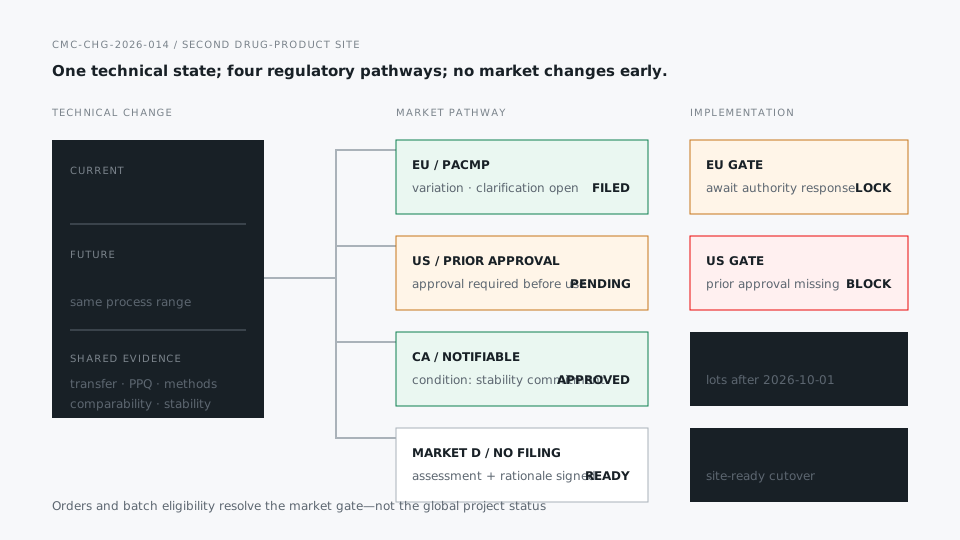
- Seal joins change control and regulatory affairs: it proposes the affected products and markets, records each market assessment and blocks implementation where approval is a prerequisite.
- What changes
- Implementation is authorised market by market, commitments become controlled obligations, and the change closes only when quality and regulatory records agree.
- Where to start
- One recent multi-market change, traced through assessment and implementation by market. Book a demo.
1An approved change is not complete until each market can use it.
A manufacturing-site change passed technical review, validation, quality approval and local implementation, and the change record was closed. Months later, supply planning learned that several markets required regulatory action before product made at the new site could be distributed there.
Nothing was wrong with the engineering package. The failure sat between systems: change control knew what changed and regulatory affairs knew the registrations, but neither record governed when each market could use the changed state.
This blueprint governs that seam. It is not a second RIMS or an eCTD publisher. RIMS remains the authoritative portfolio of products, registrations, dossiers, submissions, correspondence and approved market states; submission management plans and dispatches filing packages; change control governs the proposed operational change. This blueprint identifies which registered products and markets may be affected, records the accountable regulatory assessment, creates the required actions, blocks implementation where approval is a prerequisite and returns evidence to the quality record. One global change becomes many market decisions, each with explicit release conditions.
1.1Why teams choose Seal for regulatory change impact
Change control and regulatory affairs usually run in separate systems, a QMS and a registration tracker, and each can be accurate while the question of when a market may use the new state goes unanswered. Seal links the market assessment, the regulatory action and the implementation gate to the source change, and Neil can propose the affected products and markets for the regulatory team to confirm. Operations read the applicable market decision rather than infer it from a closed change record.
| Change control beside a registration tracker | Seal | |
|---|---|---|
| Affected markets | Identified from memory or a separate query | Derived from recorded relationships, then confirmed by regulatory owners |
| Market classification | A value in a spreadsheet | A signed assessment with its basis, options considered and requirement version |
| Implementation | One global effective date | A gate per market: proposed, allowed, blocked, approved, implemented or verified |
| Closure | When local implementation is done | When quality and regulatory records agree, with deferred markets still visible |
2Derive the affected products and markets from a precise scope.
A regulatory assessment cannot recover from a vague source record. The change carries the current and proposed state of what it touches, whether a material, specification, process, method, site, supplier, packaging, labelling or control strategy. The reason, urgency, affected facilities, planned effective date, validation strategy, inventory exposure and temporary or permanent status are structured fields, and supporting documents stay linked to the claims they support.
Seal follows recorded relationships from the changed object to products, presentations, registrations, manufacturing and testing sites, dossiers, labels and commitments. The result is a candidate impact set, with the relationship that brought each market into it. Regulatory owners confirm, add or exclude candidates with a rationale. The system proposes scope; an accountable person owns it, and a market is not removed silently because a reference was incomplete.
3Assess each market against the requirement in effect.
For each affected registration, regulatory affairs records the classification, its legal or procedural basis, required data, submission type, whether approval is needed before implementation, reporting window, grouping opportunities, local documents and remaining uncertainty.¹
Requirements are versioned by jurisdiction, product class, procedure and effective date. A rule update creates a review task for open assessments; it does not rewrite the basis of a signed decision.
Not every classification is deterministic. Precedent, authority advice, product knowledge, regional interpretation and risk can produce alternatives. Each assessment keeps the options considered, the evidence, assumptions, dissent, chosen strategy, approver and date, so a later reviewer can see why a market was classified and not only the final value.
4Plan the work and make implementation conditional by market.
Required actions become owned work, from data generation and authoring through translation, publishing, dispatch, authority responses and label implementation. Dependencies are explicit: a filing cannot be ready before its evidence, an implementation gate cannot open before the required approval and a launch cannot precede the approved state. Forecast dates can move without changing statutory dates.
One submission may address several changes, and one change may require many submissions. That many-to-many relationship stays explicit down to the affected dossier content and approved outcome. If one element is withdrawn or questioned, teams can determine which changes and markets are affected without reconstructing the package from file names.
There is rarely one global effective date. Some markets permit implementation before notification, some after a waiting period and some only after approval.² Existing inventory, product made under the previous state, packaging and release status add further constraints. Seal keeps a market implementation matrix with proposed, allowed, blocked, approved, implemented and verified states. Execution, ERP, labelling, release and distribution controls can use the applicable decision.
During a transition, both old and new states may be legitimate, and a batch can be eligible for one market and not another. The record connects genealogy, manufacture date, packaging version, destination market, registration state and implementation authorisation. Exceptions need a documented, approved decision, and teams can see where dual-state operation exists and what must happen before it ends.
5Correspondence and commitments are controlled evidence.
Meeting minutes, questions, deficiency letters, advice, approvals and acknowledgements link to the market assessment and topic they affect. A question about comparability can change the evidence plan; an approval condition can become a new commitment.
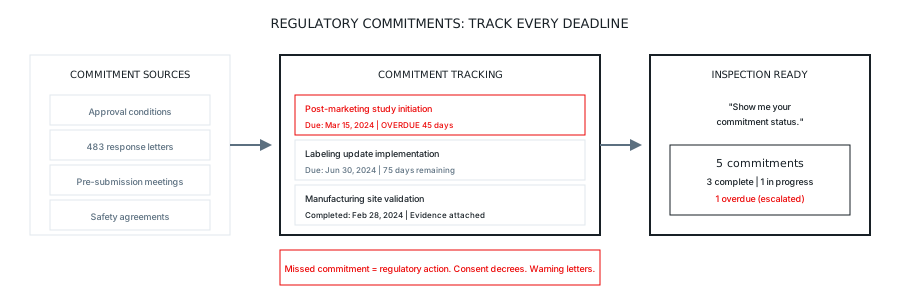
Commitments can originate in approval letters, inspection responses, meeting minutes, submissions or formal correspondence. Each records the exact source text, interpretation, jurisdiction, product, deliverable, milestone, owner, evidence requirement and acceptance state. Completion means the promised outcome and evidence exist. Dispatch may satisfy a filing milestone, but it does not show that the authority has accepted or closed the obligation.
6Dates keep their distinct meanings.
Awareness date, statutory due date, internal target, forecast, filing date, authority receipt, clock start and stop, response due date, approval date, implementation date and commitment closure are separate fields. The plan can forecast risk without moving a legal deadline, and date calculations retain the rule and calendar used.
Escalation follows consequence, so an approaching internal target is not treated like an approaching legal deadline. Escalations consider remaining work, critical-path dependencies, approval prerequisites, supply impact and the current forecast. Leadership sees obligations at risk with their causes and recovery actions.
7Neil proposes; designated roles decide.
Neil can extract candidate obligations, dates, products and deliverables from controlled correspondence, compare proposed wording with approved positions and identify registrations connected to a changed site. Each suggestion keeps its source passage, the reviewer’s decision and any correction.
Neil does not approve a classification, create a requirement, close a commitment or authorise implementation. Those remain signed decisions by designated roles.
8Close the change when quality and regulatory records agree.
The global change closes only under an approved closure policy: required assessments complete, actions dispositioned, prerequisite approvals received, permitted implementation done, evidence linked, residual exceptions accepted, commitments created and downstream master data updated. Deferred markets remain visible with owners and conditions.
Portfolio views show the approved changes waiting on regulatory action, the markets that block use of a new site, the commitments due this quarter and the submissions that contain evidence from a given change, such as CC-0148. Each figure opens to the source change, assessment, action, submission and signed decision. For any change, the record shows how each affected market moved from one controlled state to another under an accountable decision.
Start with one recent multi-market change. Trace it through assessment and implementation by market, and check that deferred markets and open commitments remain visible after the change closes.
References
- 121 CFR 314.70, Supplements and other changes to an approved NDA: the applicant must notify FDA about each change in each condition established in an approved NDA beyond the variations already provided for in it. eCFR
- 2ICH Q12, Technical and Regulatory Considerations for Pharmaceutical Product Lifecycle Management (2019). ICH
AConnected across Seal
BCapabilities
| Capability | What it covers |
|---|---|
| Affected-market derivation | Trace a quality change through products, sites, registrations, dossiers, labels and commitments to produce a reviewable regulatory impact set. |
| Market-specific assessment | Record classification, basis, alternatives, required evidence, filing path, timing, uncertainty and accountable approval for each affected registration. |
| Implementation gates | Keep a market gate closed until the required notification, waiting period or approval is met and verified. Release, labelling and distribution workflows can read the gate for the intended destination. |
| Commitment management | Record authority promises and approval conditions with their exact source text, owner, deliverable, milestones and closure criteria. |
| Submission traceability | Connect many changes to many submissions without losing the dossier content, authority outcome or market state each filing affects. |
| Split-state control | Govern old and new product states by batch, inventory, label, destination market and effective authorisation during a transition. |
| Source-bound extraction | Neil can propose candidate obligations and affected records from controlled correspondence. Each suggestion keeps its source passage and the reviewer’s decision. |
| Closure reconciliation | Close the change under an approved closure policy, once assessments, actions, approvals, implementation, exceptions, commitments and master data agree. |
CConnected records
DQuestions and answers
How is this different from RIMS?
RIMS is the authoritative regulatory portfolio: products, registrations, dossiers, submissions, correspondence and approved states. This blueprint governs the handoff from a QMS change or commitment into market-specific assessment, action, implementation gating and evidence-backed closure. It uses RIMS data rather than duplicating it.
Does the system decide the regulatory classification?
No. Rules and connected data can propose affected markets and candidate paths. A qualified regulatory owner reviews the effective requirement, evidence, precedent, alternatives and uncertainty, then signs the assessment.
Can one submission cover several changes?
Yes. Changes and submissions are many-to-many. Each link retains the affected market, dossier content, assessment, approval outcome and implementation consequence so bundling does not erase traceability.
Can a quality change close while some markets are deferred?
Only if the approved closure policy permits it. Deferred markets remain explicit exceptions with owners, controls, dates and conditions, and they stay visible after the change closes.
How are approval-before-implementation markets controlled?
The market implementation record stays blocked until the linked authority outcome is effective and verified. Release, labelling, inventory and distribution workflows can be configured to read that gate for the intended destination.
What counts as completing a regulatory commitment?
The promised deliverable and its required evidence must be complete, and any required filing or authority acceptance must have the right status. Sending a document is not the same as fulfilling the obligation.
Can AI extract commitments from authority letters?
Neil can propose an obligation, its source wording, dates, products and deliverables, with a citation to the passage. A designated reviewer confirms the interpretation, owner, milestones and closure criteria. Neil cannot close or approve a commitment.
How does the workflow handle different dates?
Statutory due dates, internal targets, forecasts, filings, acknowledgements, clock stops, responses, approvals, implementation and closure are separate fields. A forecast can slip without moving a legal deadline, and escalation reflects which kind of date is at risk.
What happens during old-state and new-state overlap?
Seal records which batches, inventory, labels and markets may use each state. Exceptions are approved and time-bound, and the transition stays visible until every intended market has moved to the new state or been formally dispositioned.
Does this replace regulatory judgement or local affiliates?
No. It gives global and local teams a shared evidence model, routes ownership and makes decisions visible. Regional expertise, authority interaction and accountable approval remain with the regulatory team.