Summary
- The problem
- One report feeds product quality, safety review and complaint handling, and a single record forces them into one status and one conclusion.
- Seal’s approach
- The reporter’s wording stays as submitted. The technical investigation, safety assessment and follow-up are separate records, each with its own status, pointing to the same source version of the complaint.
- Neil
- Seal’s AI agent reads the report and the product’s history, prepares the separate follow-ups and compares similar complaints. Your reviewers decide each question. About Neil.
- What changes
- Unknown identity stays unknown until confirmed, conclusions keep their limitations, and recurring complaints are compared by product population and exposure rather than by counts.
- Where to start
- One complaint type: the procedure, a representative report and the records it touches. Book a demo.
A traditional eQMS tracks one case. Seal resolves each question.
A traditional eQMS is a system of record. Its complaint module copies the report into a case form, moves that case through one workflow to closure, and leaves investigators to fetch the batch record, the device history and earlier complaints from other systems.
| A traditional eQMS | Seal | |
|---|---|---|
| The report | Copied into a case form | Kept as received, versioned |
| Questions | One case, one status | A record each, with an owner |
| Missing facts | Filled in to move on | Unknown until a source confirms |
| Reportability | A field on the case | Criteria, facts and rationale |
| Batch and device history | Fetched from other systems | Linked on the same platform |
| Trends | Counts by code | Rates against units exposed |
| Closure | The workflow ends | Reconciled, limitations kept |
| AI | Text to paste elsewhere | Neil prepares the linked work |
| Getting started | A replacement project | One complaint type, beside your eQMS |
A single report rarely raises a single question. In Figure 1 the reporter says the device stopped during use, the patient needed assistance and the packaging has gone. Product quality needs to examine the device, a qualified safety reviewer needs to assess the patient event and the complaint coordinator needs a lot or serial number. Put all three into one case with one status and it becomes hard to tell which question has been answered.
In Seal the original report, INT-031, stays as it was received, and each question becomes its own record pointing to INT-031 v1, with its own owner and state. The technical investigation, the product identification request and the safety assessment progress separately, and finishing one does not close the others. Once the product is identified, the complaint links to the batch, its records and earlier complaints on the same platform, so the investigation starts from the records rather than from exports.
The sections below follow INT-031, a fictional report, from intake to closure. You can start with one complaint type, alongside the eQMS you already run. The advantage grows as quality, manufacturing and laboratory work run on the same connected records: fewer facts carried by hand between systems, and a clearer path from a complaint to the action it needs.
Neil prepares the work. Your team decides.
Neil is Seal’s AI agent. Bring it the report, your complaint procedure and the product’s history; using supplied documents and permitted records, it prepares the follow-up as linked work in Seal, not a summary to retype.
| Neil prepares | Your team decides | |
|---|---|---|
| Intake | Linked follow-ups, with sources | Who owns each question |
| Identity | What is missing, and from whom | When a source confirms it |
| History | Similar reports, with gaps | Whether a match is meaningful |
| Reportability | The facts known and missing | Whether and where to report |
| Trends | Rates for a defined population | Whether a signal needs action |
| Workflow | Fields, states and test cases | Its release, under change control |
Read this report. What do quality, safety and product identification each need next?
Neil
- INV-031: the device question and its evidence.
- REQ-031: the lot and serial, asked of the reporter.
- SAFE-031: the patient event, for a qualified safety reviewer.
- Each linked to INT-031 v1, with the source wording.
- Lot, patient outcome and cause left unknown.
- Draft (met)Ready to inspect
- Assessments (not met)For your reviewers
- Reportability (not met)For the qualified reviewer
To prepare the missing-evidence work, ask Neil: “Read this report. What do quality, safety and product identification each need next?” It prepares separate linked requests and investigation tasks, with the source statement and the unresolved question attached. It preserves missing facts and ownership for review, and does not invent a lot, a patient outcome or a completed assessment.
To investigate comparable complaints, ask: “Find reports with this symptom. Which similarities are meaningful, and what would distinguish the possible causes?” Neil compares permitted product history, configurations, part lots and examination evidence, and prepares an assessment with supporting and conflicting evidence, suggested matches and gaps. Similar wording is a lead to investigate, not a confirmed common cause.
To configure the workflow, ask it to turn your complaint procedure into linked intake, investigation and review records in Seal. Neil authors source-preserving fields, separate issue records and role-specific review states, prepares verification cases for missing identifiers, new facts and unresolved handoffs, and stages the configuration for testing and approval before operational use.
Ask it for source links, competing explanations and the evidence that would distinguish them, so its output can be checked against the case. People review the proposed work, verify configuration and approve its use. Technical conclusions, safety assessments and any reporting decision remain with the authorised reviewers.
In line with the EU’s draft GMP Annex 22 on AI, Neil is not used in GMP execution. It helps set up configuration, which your team verifies and releases under change control. Customer data is not used to train AI models, and the requester’s permissions govern what Neil can read. See how Neil fits Annex 22 and more about Neil.
Keep the report as it was received.
The reporter’s words, the time of receipt and any attachments are kept as the source, apart from the work they create. What was reported, what has been verified and what is still unknown stay distinguishable.
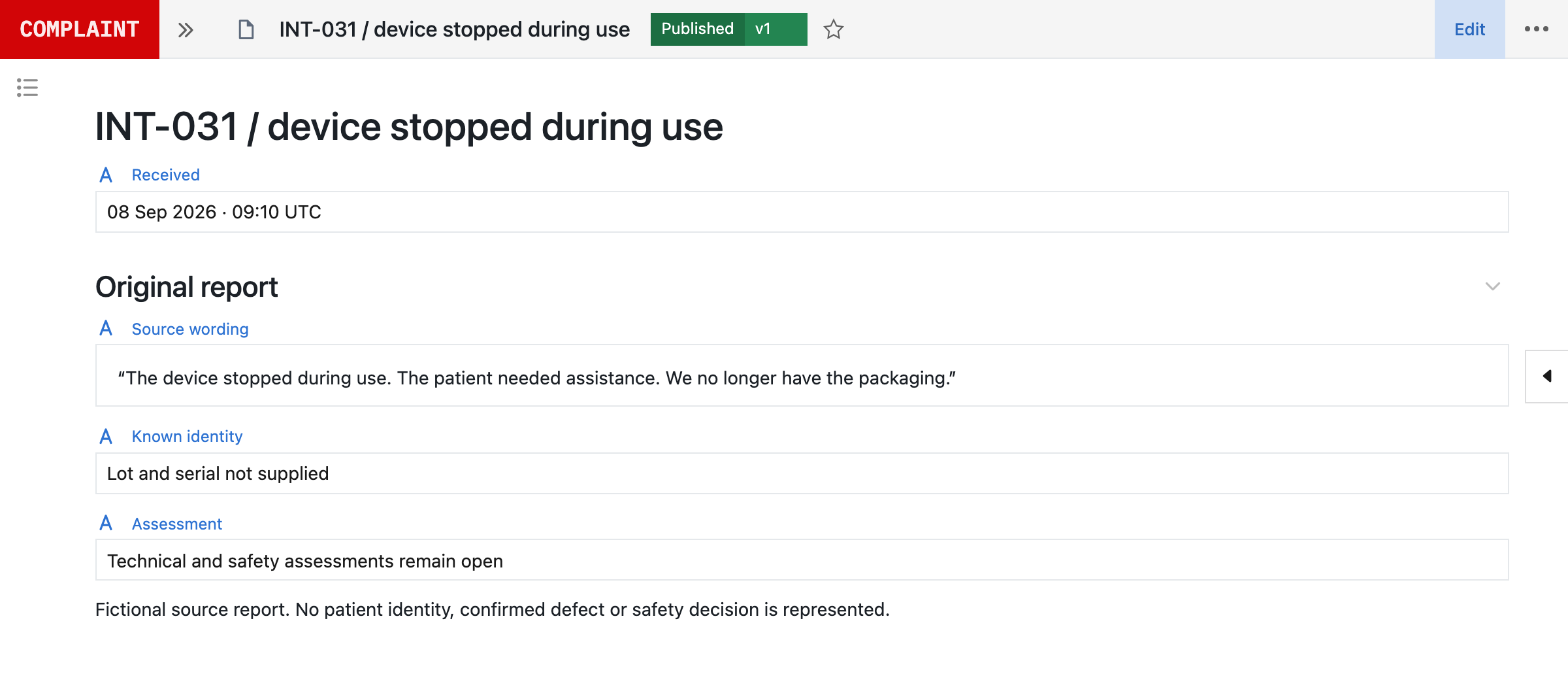
Each intake records its channel, reporter, timestamp, original narrative, attachments, products, event location and contact permissions. Support tickets can start one: Seal’s Zendesk connector brings in tickets whose original description it can verify as public, and does not write back.
The regulations ask for the same core facts. In the US, the written record of each drug product complaint includes, where known, the name and strength of the product, the lot number, the complainant, the nature of the complaint and the reply.¹ For devices, the QMSR adds to ISO 13485’s complaint handling clause a list for complaints that are investigated or reportable, including the date received, any UDI or other device identification, the nature and details, any correction or corrective action, and any reply.² EU GMP asks for the information reported about a possible quality defect to be recorded with all the original details.³
“Where known” matters. INT-031 records that the lot and serial were not supplied rather than leaving the field blank or filling it from a similar complaint. Missing identity stays unknown until a verifiable source supports it; a lot number is never inferred from a similar complaint.
Record when information arrived as well as what it said. A sales representative or a service engineer may hear of an event before the complaint unit logs it, and because a device manufacturer becomes aware when any of its employees does, that earlier moment can be the one that counts.⁴ Keep each receipt and awareness event with its date, source, role and rationale, so the reviewer can establish the date basis that applies.
Give each question its own record.
Each concern in a report becomes its own record, with an owner, a state and a link to the source version. Progress on one does not close another.
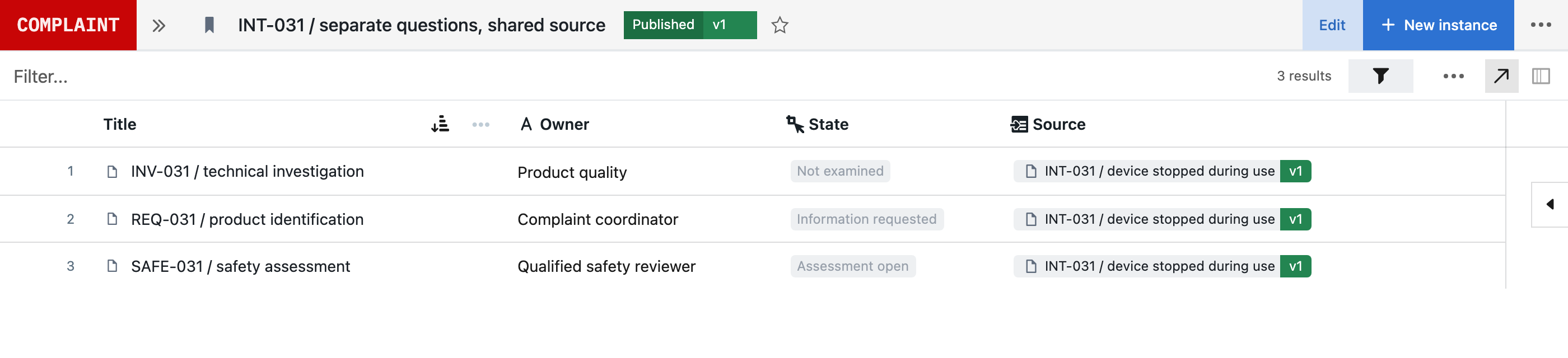
In this fictional example, the device has not been examined, the safety assessment is open and product identification is still requested. A case form that copies the report and tracks a single workflow to closure loses both the exact wording and the separate accountability. Keeping the source apart from the work it creates lets each reviewer see what they are assessing, and lets an auditor see who decided what, on which evidence.
Not every complaint is a quality defect. EU GMP asks for each complaint to be assessed to establish whether it represents a potential quality defect or another issue, and for those that do not to be passed to the people responsible for them, such as for suspected adverse events. It also expects a way to request an investigation of a batch’s quality in support of a suspected adverse event, and special attention to whether a complaint relates to falsification.³
In Seal the safety reviewer works from the same source, not a retyped summary. Quality and safety keep their own questions, evidence and decisions, and where a pharmacovigilance case is opened, it links to the complaint without merging the two accountabilities.
Configure the issue types your procedure uses: product quality, safety and vigilance, distribution, service and suspected falsification, with templates such as a device malfunction or a medicinal product quality complaint. A triage screen can route qualified work by urgency; it does not substitute for the investigation or the reportability decision.
Assess reportability on the facts known.
A reportability assessment keeps the criteria applied, the facts known at the time, what is still missing and the reviewer’s rationale. When new facts arrive it is revised, and the earlier decision stays in its history.
US device reportability
- Criteria
- 21 CFR 803.50, manufacturer
- Reported
- Stopped in use; patient assisted
- Missing
- Patient outcome, device identity
- Date basis
- Set by the reviewer
No decision recorded
The criteria depend on the product, the market and the company’s role. A US device manufacturer reports within 30 calendar days of receiving or otherwise becoming aware of information that reasonably suggests a device may have caused or contributed to a death or serious injury, or has malfunctioned in a way that would be likely to cause or contribute to one if it recurred; and within 5 work days where an event needs remedial action to prevent an unreasonable risk of substantial harm to public health.⁴
In the EU, a device manufacturer reports a serious incident no later than 15 days after becoming aware of it, sooner for a death or a serious public health threat, and reports within the same timeframe when it is uncertain whether the incident is reportable.⁵ For a drug product, the complaint procedure includes a review of whether the complaint is a serious and unexpected adverse drug experience that must be reported to FDA.¹
The date basis is part of the assessment. A manufacturer is considered to have become aware when any of its employees does,⁴ so Seal keeps each receipt and awareness event with its source, and the qualified reviewer can see when the organisation could have known, not only when the complaint unit logged the report. The intake timestamp alone is not a reporting decision, and this example does not calculate a deadline.
Information reasonably known includes what can be obtained from the initial reporter and from analysis or testing of the device, and the manufacturer is responsible for investigating each event.⁴ MDR-031 therefore records what is missing alongside what is known: the patient outcome and the device’s identity. It links to REQ-031, which asks for them. How to proceed on incomplete information is the reviewer’s decision, recorded with its rationale.
Configure an assessment for each jurisdiction and role in scope, with its criteria, required reviewers and the rule version it applies, and verify it with qualified people before use. A regulatory report then carries its deadline basis, validation, dispatch, acknowledgement, identifier, follow-up and amendments, linked to the assessment that required it.
Link the complaint to the batch and its records.
Once the product is identified, the complaint links to its lot or serial, the batch record, the deviations on that batch, its release and where it was distributed. Until then nothing is inferred.
- Product (met)Named in the report
- Lot and serial (not met)Requested in REQ-031
- Batch record (not met)Links once the lot is confirmed
- Deviations (not met)On that batch
- Distribution (not met)Where that lot was shipped
- Earlier complaints (met)Same product and code
Nothing inferred from similar reports
EU GMP lists what a quality defect investigation should consider, including, in some cases, a review of the batch production record, the batch certification record and the distribution records, and the checking of reference or retention samples. It asks for other batches to be considered, and in particular for those that may contain portions of the defective batch or defective components to be investigated.³
In the US, the complaint procedure provides for the quality control unit to review any complaint involving a possible failure to meet a specification, and for a determination of the need to investigate under 211.192;¹ and that investigation extends to other batches of the same drug product and other products that may be associated with the failure.⁶
A standalone complaint system leaves that work to exports. In Seal the trace follows links: from the complaint to the batch, from the batch back to its materials, components, suppliers and release, and forward to the other batches and shipments that used them. For a device, it runs from the UDI and serial to the device history record and the configuration it was built to.
| Where the record lives | What the investigation uses | Connections include |
|---|---|---|
| ERP | Lots, materials and suppliers | Oracle Fusion, Dynamics 365 |
| MES and process data | Batch steps, values and history | Tulip, AVEVA PI |
| LIMS | Samples, tests and results | LabWare, LabVantage |
| Support desk | Tickets as customers wrote them | Zendesk |
| An existing eQMS | Complaints, deviations and CAPAs | Greenlight Guru, Veeva Vault QMS |
Records that originate elsewhere are read where they live, linked to the complaint and kept with the decision. Each connection is scoped before it goes live: what Seal may read, whether anything is written back and which system stays the source of truth. Where manufacturing and laboratory testing also run in Seal, the complaint and the batch share the record rather than a link to it.
Earlier complaints can be compared now, by product and failure code, because those are known. The lot cannot: INT-031 does not say which lot, and a similar complaint from a known lot is a lead to investigate, not evidence of this one’s identity.
Investigate the reported failure with evidence.
Each investigation starts with a question and the evidence that could answer it. It keeps the observations, tests and limitations behind its conclusion.
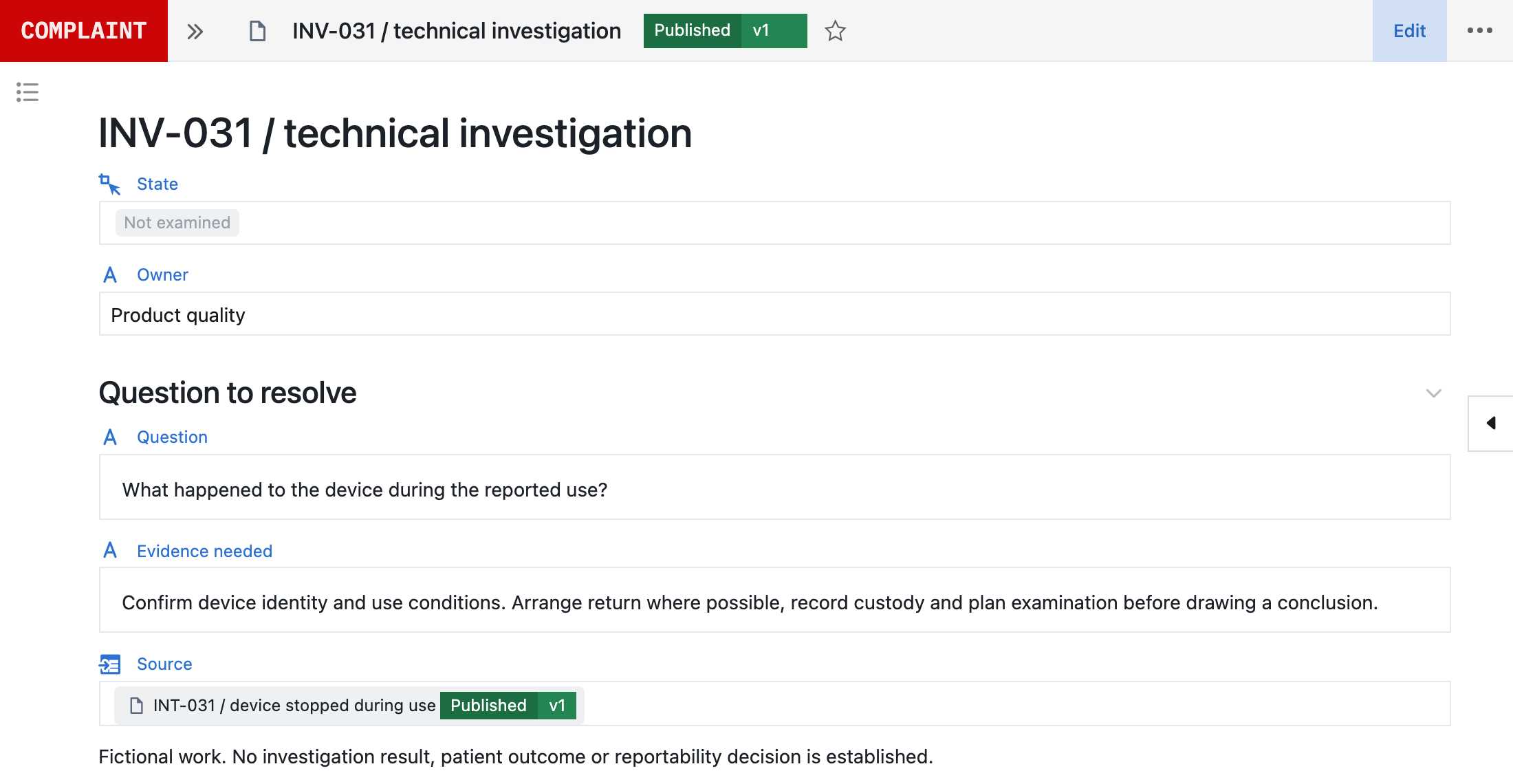
Confirm the product identity and conditions of use, keep custody of any returned product, and retain the observations, tests and limitations behind the technical conclusion. Keep a reporter’s statement, an observed fact and an investigator’s inference distinguishable.
EU GMP asks the investigation to consider requesting a sample or the return of the product, and to evaluate it where one is provided.³ In Seal a returned product carries its return authorisation, custody, condition on receipt, decontamination, storage, examination scope, retention and disposition with the investigation. Destructive work, such as a teardown, carries its own approval. If the product cannot be returned, record why, the follow-up attempts and what remains untested, and plan other relevant evidence without presenting it as an examination of the reported device.
Look back as well as down. Quality defect investigations review previous reports for any sign of a specific or recurring problem, and apply an appropriate level of root cause analysis. Where the true cause cannot be determined, the most likely cause is identified and addressed, and where human error is suspected, the conclusion is formally justified so that process, procedural or system problems are not overlooked.³
Where no investigation is needed, record why. For a drug product the record then includes the reason an investigation was found unnecessary and the name of the person who decided;¹ for a device, where an earlier investigation of a similar complaint is relied on, the justification for not investigating again.²
Trend complaints against the population exposed.
A trend compares complaints with the population that could have produced them, over a defined period, so a rising rate is seen even when the count is flat.
Stopped during use
- Reports
- 12
- Units shipped
- 6,000
- Per 1,000 units
- 2.0
Stopped during use
- Reports
- 12
- Units shipped
- 4,000
- Per 1,000 units
- 3.0
Rate up by half
A chart of counts would show nothing in TRD-012. The rate shows a change worth reviewing, though not a defect: the reviewer still checks the population, the coding and the narratives behind the pattern, and whether units shipped in the quarter is the right denominator for a device that stays in service.
Define each trend before reading it: the population and denominator, the code set, the time window, the baseline and the alert method, with any missing denominator explained. The definition is versioned, so a later change to the codes or the population is visible rather than silently changing the result.
EU GMP asks for quality defect records to be reviewed and trend analyses performed regularly for any indication of specific or recurring problems.³ Complaints are part of the annual review of each drug product in the US⁷ and of the product quality review in the EU,⁸ and ICH Q10 names complaints among the feedback that process performance and product quality monitoring should include.⁹
For devices in the EU, a statistically significant increase in the frequency or severity of incidents that are not serious incidents is itself reportable, measured against a methodology and observation period set in the post-market surveillance plan.⁵
For a trend review, Neil compares accessible events across a defined period and population, and the team checks missing or inconsistent records and inspects the events behind the pattern. A reviewed signal links to the investigation or quality action it requires, and the same complaints feed the annual product quality review for the period.
Close with an investigation or a CAPA.
A complaint closes when its investigation, assessments, reply and any quality action have been reconciled. What was concluded, its limitations and who authorised the closure stay with the record.
- Investigation (not met)INV-031 not examined
- Identification (not met)REQ-031 requested
- Safety (not met)SAFE-031 open
- Reportability (not met)MDR-031 not decided
- Reply (not met)Not sent
- Quality action (not met)Depends on INV-031
Creating or publishing INT-031’s follow-ups does not close it: in these captures Published identifies a saved version, not an approved assessment. Each follow-up closes on its own evidence, and the complaint closes when all of them, and anything they lead to, are reconciled.
When the investigation finds a cause, the complaint links to the action it needs: a deviation or nonconformance, a CAPA, a supplier action, a design or labelling change, or a field action or recall. ICH Q10 expects corrective and preventive actions to result from the investigation of complaints,⁹ and EU GMP asks for appropriate CAPAs for a quality defect, with their effectiveness monitored and assessed.³ The CAPA keeps its link to the complaint, so its effectiveness review reads against the complaints that follow.
Decisions cannot always wait for the root cause. EU GMP expects risk-reducing actions to be taken at an appropriate point during an investigation, with every decision and measure documented, and a recall may need to start before the cause and full extent of a defect are known.³
The reply to the complainant is part of the record.¹ A final response is approved, checked for privacy and aligned with the investigation’s conclusions and what can be disclosed.
When new facts arrive after closure, record a revised conclusion alongside the earlier one instead of overwriting it, and reassess reportability where they require it. Closing individual cases does not establish that a systemic issue is controlled; the trend and the CAPA’s effectiveness review answer that.
Start with one complaint type.
Bring one complaint type: the procedure, a representative report and the records it touches.
Neil prepares the intake, the separate follow-ups and their review states from that material, and your team inspects them against how the work should run. Start with sample material or arrange an NDA before sharing confidential records.
Test the cases that matter before you rely on it: a report with several concerns, a missing lot or serial, a product that cannot be returned, new facts after a decision, and a closure attempted while an assessment is open.
Seal can run beside the eQMS and the safety database you already use. Agree which system owns the complaint record, which records Seal reads and how status crosses the boundary. To scope the first complaint type with us, book a demo.
References
- 121 CFR 211.198, Complaint files: written procedures for all written and oral complaints, including quality control unit review of a possible failure to meet a specification and a determination of the need for an investigation under 211.192, and a review for a serious and unexpected adverse drug experience reportable to FDA; a written record of each complaint with, where known, the product name and strength, lot number, complainant, nature of the complaint and reply, the investigation’s findings and follow-up, or the reason no investigation was needed and who decided. eCFR
- 221 CFR 820.35(a), Records of complaints: in addition to ISO 13485:2016 clause 8.2.2, records of the review, evaluation and investigation of complaints involving a possible failure to meet specifications, a justification where a similar complaint’s investigation is relied on, and for reportable or investigated complaints the device name, date received, UDI or other identification, complainant, nature and details, any correction or corrective action and any reply. eCFR
- 3EudraLex Volume 4, Part I, Chapter 8, Complaints, Quality Defects and Product Recalls (2014): complaints documented and assessed (8.5), falsification (8.6), complaints that are not quality defects passed to those responsible (8.7), batch investigations for suspected adverse events (8.8), what an investigation addresses (8.9), original details recorded (8.10), other batches (8.11), previous reports (8.12), timely risk-reducing actions (8.14), root cause and CAPA (8.16–8.18), trend analysis (8.19) and recall before the root cause is known (8.22). European Commission
- 421 CFR 803.50, Manufacturer reporting: reports no later than 30 calendar days after receiving or otherwise becoming aware of information that reasonably suggests a device may have caused or contributed to a death or serious injury, or malfunctioned and would be likely to if the malfunction recurred; information reasonably known and the duty to investigate each event (803.50(b)); 5-day reports where remedial action is needed (803.53); and becoming aware when any employee does (803.3). eCFR
- 5Regulation (EU) 2017/745 on medical devices, Article 87 (serious incidents reported no later than 15 days after awareness, 10 days for a death or unanticipated serious deterioration, 2 days for a serious public health threat, and within those timeframes when reportability is uncertain) and Article 88 (trend reporting of a statistically significant increase in incidents that are not serious incidents). EUR-Lex
- 621 CFR 211.192, Production record review: an unexplained discrepancy or a failure to meet specifications is thoroughly investigated, whether or not the batch has been distributed, extending to other batches of the same drug product and other drug products that may have been associated with it. eCFR
- 721 CFR 211.180(e), General requirements: records maintained so that each drug product’s quality standards can be evaluated at least annually, including a review of complaints, recalls, returned or salvaged drug products and investigations. eCFR
- 8EudraLex Volume 4, Part I, Chapter 1, Pharmaceutical Quality System (2013), section 1.10 (viii): the product quality review includes all quality-related returns, complaints and recalls and the investigations performed at the time. European Commission
- 9ICH Q10, Pharmaceutical Quality System (2008), section 3.2.1 (process performance and product quality monitoring includes feedback from complaints) and section 3.2.2 (a CAPA system for corrective and preventive actions resulting from the investigation of complaints). ICH
AConnected records
BQuestions and answers
How is Seal different from the complaint module in our eQMS?
A traditional eQMS keeps one case and one status per complaint. Seal keeps the report as received, gives each question its own record and owner, and links the complaint to the batch, the device history and earlier complaints on the same platform. You can start with one complaint type beside the eQMS you run.
What if one report raises several concerns?
Keep one original intake and link separate follow-up work for the concerns it raises. Each reviewer retains the source wording, their unresolved question and their own decision.
Can the intake date determine a reporting deadline?
Record receipt and awareness events explicitly. Qualified reviewers establish the applicable criteria and date basis; configure and verify that workflow for the products and jurisdictions in scope. This example does not calculate a deadline.
What if the lot or serial number is missing?
Keep the identifier unknown and request a verifiable source. Do not infer a product lot from a similar complaint or fill a required field with a guess.
What if the device cannot be returned?
Record the reason, follow-up attempts and investigation limitation. Plan other relevant evidence where available, without representing it as an examination of the reported device.
What can Neil prepare?
Neil can read supplied documents and permitted records, investigate related history, prepare linked follow-up work and author templates, fields and review states. People review the work, verify configuration and approve its use.
Can Neil decide the safety assessment?
The qualified reviewer retains responsibility for safety and any required reporting decisions. Proposed classifications or related cases are inputs to review, not approved conclusions.
Does Published mean the complaint is closed?
No. In these captures it identifies a saved version. The technical investigation, safety assessment and product-
How should recurring complaints be compared?
Retain the relevant product population, exposure, period and coding context. Explain missing denominators and uncertainty. A reviewed pattern can lead to investigation or quality action without being treated as proof of a common cause.