Cell & Gene Therapy
Collect. Process. Infuse.
Unbreakable chain of identity from collection to infusion.
Chain of identity is everything.
In Cell & Gene Therapy, losing traceability doesn't just mean lost product—it means a patient who can't be treated, or worse, receives the wrong cells. Whether you're processing a patient's own cells (autologous) or manufacturing from donor material (allogeneic), the chain of identity is the foundation everything else rests on.
In labs across the world, scientists are teaching cells to cure disease. They're engineering T-cells to hunt cancer. They're correcting genetic defects that condemned children to lives of suffering. The science is here. The bottleneck isn't discovery—it's the brutal operational complexity of getting these therapies to patients.
Every delay, every error, every batch failure isn't just lost product—it's a patient whose treatment window is closing. The urgency isn't abstract. These are people running out of time.
Legacy systems were built for small molecules: massive, identical batches of commodity product. They break under the demands of CGT—whether that's thousands of unique patient-specific batches running in parallel (autologous), or complex donor genealogies spanning multiple products and recipients (allogeneic). The problem isn't your people. It's your data architecture.
Chain of Identity as the core object
Most CoI systems are label printers that don't talk to the floor. They generate barcodes and hope someone scans them. Seal is different. Chain of Identity isn't a module or an add-on—it's the data model itself.
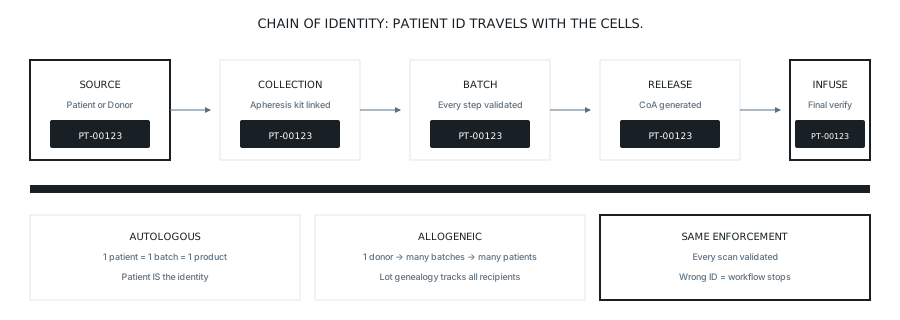
Every object in the system carries its patient identity. The apheresis bag knows which patient it came from. The cryovial knows which patient it belongs to. The batch record knows which patient's cells it's processing. When a technician scans a vial, the system doesn't just record the scan—it validates the identity against the batch.
This validation happens at every step, every transfer, every touchpoint. The chain isn't just documented; it's enforced.
Mix-ups are impossible, not just unlikely
Warning dialogs don't prevent catastrophes. People click through warnings. They get desensitized. They're rushing and don't read the message. A warning that gets overridden 2% of the time will eventually kill someone when you're processing thousands of batches.
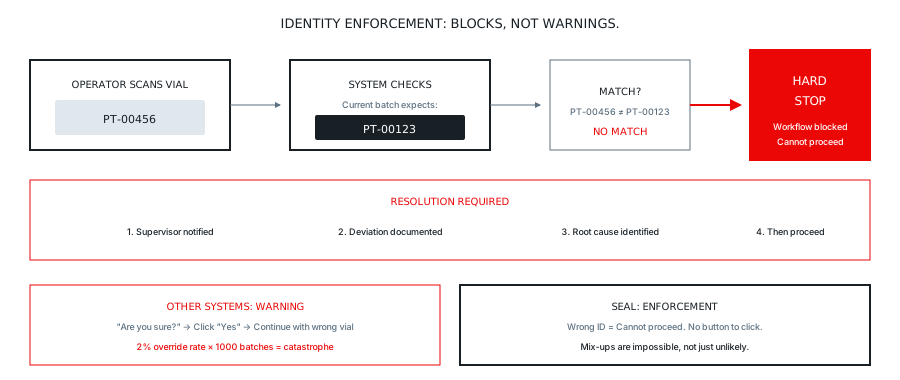
Seal doesn't warn. It blocks. When an operator scans a vial that doesn't match the current batch's patient ID, the workflow stops. Not a warning that can be dismissed—a hard stop that requires supervisor intervention and deviation documentation to proceed. The mismatch is logged, investigated, and resolved before any processing can continue.
This enforcement extends to every handoff. Materials can't be released to the wrong batch. Products can't be shipped to the wrong patient. Every potential mix-up point has a validation gate that physically prevents progression with mismatched identities.
Dynamic batch records
Patient cells are not commodity reagents. They vary in quality, quantity, and behavior. A process optimized for ideal cells will fail when it encounters the inevitable variation of real patient material.
Traditional batch records are static documents designed for consistent starting material. You fill them out, hope nothing changes, and pray the auditor doesn't ask about that handwritten correction on page 47.
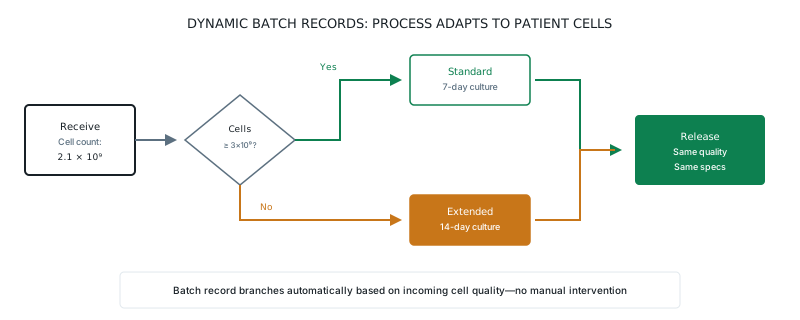
Seal batch records are living data structures. They branch based on real-time measurements. If cell counts are low, the system automatically triggers expanded culture protocols. If viability drops below threshold, it alerts QA and routes to an investigation workflow. If a step takes longer than expected, the time limit tracking shows exactly how much margin remains.
This dynamic execution captures the reality of CGT manufacturing: plans change because patient cells don't read the protocol.
Real-time release
You can't wait 30 days to release a product with a 48-hour shelf life. The traditional model of manufacturing first, then reviewing, then releasing simply doesn't work when your product is living cells with a ticking clock.
Seal enables what we call "concurrent release." QA reviews data during the batch, not after. Test results are reviewed as they come in. Deviations are investigated in real time. The Certificate of Analysis builds incrementally as each test passes.
When the final release test comes back acceptable, the CoA is essentially complete. Review the summary, verify the chain of identity one final time, apply the electronic signature, and the product is released. What used to take days now takes hours.
Vein-to-vein visibility
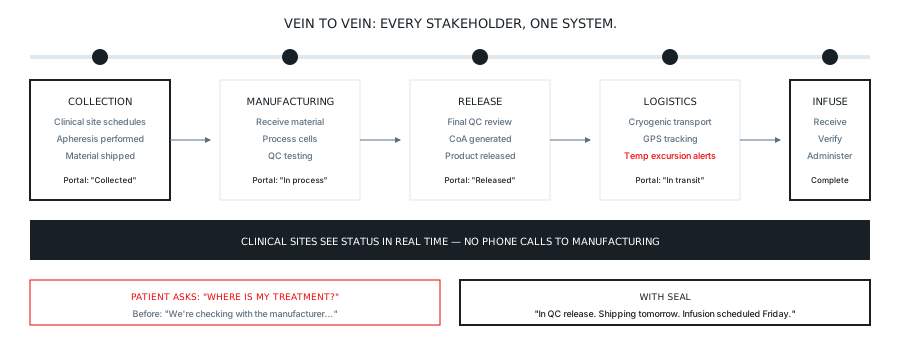
CGT manufacturing involves multiple organizations: the clinical site performing collection, the logistics company managing cryogenic transport, the manufacturing facility processing cells, and often a different clinical site performing infusion. Traditional systems create data gaps at every handoff.
Seal provides a single view from patient collection to patient infusion. Clinical sites schedule collections through a portal, entering patient information and preferred dates. They receive shipping instructions and tracking information. They can see when their patient's product enters manufacturing, progresses through processing, passes QC testing, and ships back.
Logistics partners have visibility into pickup and delivery requirements. Manufacturing has complete context about incoming material before it arrives. Everyone sees the same data because everyone is working in the same system.
This visibility builds trust with clinical partners. When a patient asks "where is my treatment?", the clinical team can give them a real answer instead of "we're checking with the manufacturer."
Autologous and allogeneic workflows
Autologous therapy (patient's own cells) and allogeneic therapy (donor cells for multiple patients) have fundamentally different data models. Autologous is one patient, one batch, one product. Allogeneic is one donor, many batches, many patients.
Seal supports both on the same platform. Autologous workflows are patient-centric: the patient ID is the organizing principle from collection to infusion. Allogeneic workflows are donor-centric: lots are tracked from donation through manufacturing, with genealogy connecting donor material to every patient who receives product derived from it.
The underlying capabilities—chain of identity, dynamic batch records, real-time release—work for both models. The difference is in how identity is tracked and how genealogy is structured.
The compliance advantage
CGT facilities face intense regulatory scrutiny. The FDA, EMA, and other agencies understand the stakes and examine CGT manufacturing with corresponding rigor. Chain of identity, data integrity, and traceability aren't just good practices—they're regulatory requirements.
Seal provides the documentation and traceability that regulators expect. Every scan, every validation, every decision is captured with full context. When an inspector asks "how do you ensure chain of identity?", you don't show them a procedure document—you show them the system that enforces it at every step.
Audit trails are complete and immutable. Electronic signatures are Part 11 compliant. Data integrity is built into the architecture. The compliance burden doesn't disappear, but it becomes manageable because the system generates compliance as a byproduct of doing the work.
Capabilities